





Let's look into the painful and agonizing "hay fever.
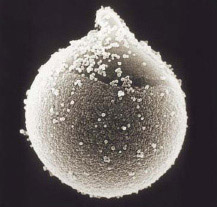
Hay fever" suddenly becomes more common as spring approaches each year. It is characterized by unpleasant symptoms such as a runny nose and itchy eyes. It is said that nearly 20% of people in Japan suffer from hay fever, which is why it is also called a national disease.
Mechanism of hay fever
When a foreign substance enters the body, the human body's cells (Note 1) produce antibodies (Note 2) to expel it from the body. When these antibodies work harder than necessary, it is called allergy.
When the weather becomes warm and pollen from plants fly into the wind and enter the eyes and nose, the antibodies try to blow the pollen away with a sneeze or wash it away with a runny nose or tears. When these antibodies work more than necessary, hay fever symptoms appear. In early spring, you see many people wearing masks and large goggle-like glasses. These people are preventing pollen from entering their bodies.
Hay fever is such a serious phenomenon in Japan that it makes the news, but strangely enough, we rarely hear of hay fever sufferers in other countries.
(Note 1) Cell: The basic unit that makes up the body of all living organisms. It is about 0.005 mm in diameter and visible only with a microscope. In the case of humans, it is made up of approximately 60 trillion cells.
(Note 2) Antibody: A substance produced to fight bacteria and toxins that enter the body.
Plants that cause hay fever
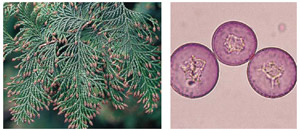
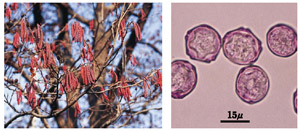
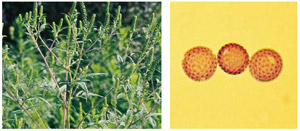
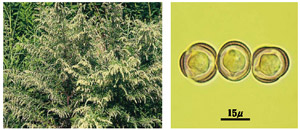
(Courtesy of Norio Sato, Professor, Faculty of Pharmaceutical Sciences, Toho University)
About 70% of hay fever is thought to be caused by cedar pollen. This is because cedar forests cover 18% of Japan's forests and 12% of the country's land area. Other trees besides cedar include cypress and alder, while grasses and flowers include chamogoya, ragweed, and mugwort. In all, there are about 60 species of plant pollens that are thought to cause hay fever.
Plants have two types of pollinators: insect-catalyzed pollinators, which are carried by insects attached to their bodies, and wind-catalyzed pollinators, which are carried by the wind. Pollen is carried by the wind, so it is said that on sunny and windy days, the amount of pollen flying is higher.
The amount of pollen varies depending on the season and location, since different plants shed pollen at different times of the year, and different plants grow in different areas.
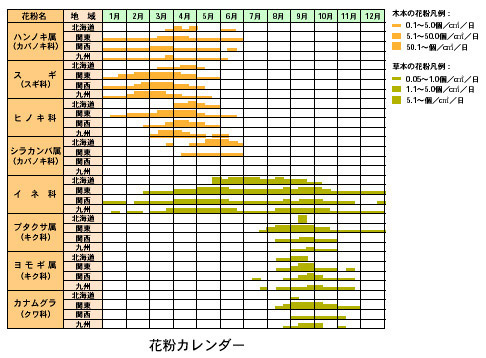
Provided = "Hay Fever Health Guidance Manual" by the Committee for the Preparation of Nasal Allergy Treatment Guidelines [published by the Ministry of the Environment].
How to prevent hay fever
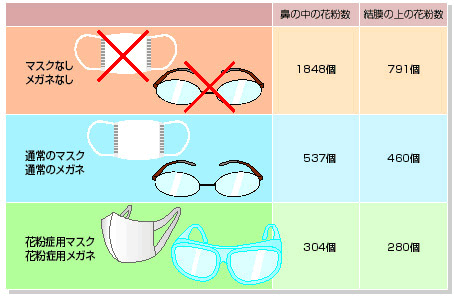
Source = "For Accurate Treatment of Hay Fever" by Kimihiro Okubo, Department of Otolaryngology, Nippon Medical School [published by the Ministry of Health, Labor and Welfare].
Hay fever is an allergy caused by pollen entering the body. Therefore, the best way to prevent hay fever is to prevent pollen from entering the body.
First, watch the pollen information and news published by the Ministry of the Environment, and on days when pollen counts are high, close windows and doors to prevent pollen from entering the room, and refrain from going outside.
When going outside, use masks and glasses to prevent pollen from getting into your eyes and nose. In addition, try to avoid using coats with shiny woolen surfaces, which easily catch pollen.
When you come home from outside, thoroughly wipe off your clothes and face powder before entering the house, wash your face, gargle, and blow your nose to reduce the amount of pollen in the room.
However, if the symptoms are too severe, see a doctor at a hospital.
The Mysterious Relationship between Hay Fever and Parasites
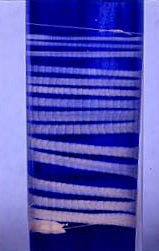
Source: Koichiro Fujita, Professor, Faculty of Medicine, Tokyo Medical and Dental University, Environment goo WEB Lecture "No. 5 Cleanliness-orientation leads to environmental degradation.
It is not only humans who suffer from hay fever. Have you ever seen a Japanese monkey suffering from hay fever in a TV commercial or advertisement? Besides Japanese monkeys, there are also dogs. In the case of canines, it seems that the most common symptom is an itchy body rather than a stuffy nose or sneezing. Indoor dogs should be brushed to remove pollen after coming back from a walk.
Parasites have an unexpected relationship with hay fever. Parasites are organisms that live inside the bodies of other animals. Immediately after World War II, about 70% of the Japanese population was infected with parasites, but as living standards improved and people became cleaner, the infection rate declined to 0.2% in the 1980s. However, as the number of parasite-infected people decreased, the number of allergy sufferers such as atopic dermatitis and hay fever began to increase. It seems that the antibodies produced by cells were originally intended for parasites, but since the parasites were no longer present in the body, hay fever developed in response to pollen, which is supposed to be harmless. In fact, hay fever patients are rarely found in countries with high parasite infection rates.
But I would think twice if someone told me that I wouldn't get hay fever if I kept parasites in my body.