


Let's look into sleep.
Children are sleeping much less these days than in the past. This is because they have so much to do: TV, video games, homework, and so on. But what happens when they don't get enough sleep? Why do we sleep? And why do we dream? The mystery is deeply related to the brain. I have researched about sleep.
Kids these days don't sleep well!
What time do you usually go to bed?
Compared to 40 years ago (1960 and 2000), children between the ages of 10 and 15 are going to bed one and a half hours earlier.
According to a recent survey, even elementary school students are going to bed after 10:00 a.m., and the average time for junior high and high school students is around midnight. It is obvious that people are sleeping less than before.
Have you ever thought about how many hours of sleep you need? Usually, elementary school students need about 10 hours of sleep in the upper grades, and junior high school students need about 9 hours.
But what happens if they don't sleep? This has been a big question for a long time, and there have been several "no-sleep" experiments: In 1964, an American boy did not sleep for 11 days, an official record (with a researcher present), which is a world record. In Japan, there is a record of 101 hours, 8 minutes and 30 seconds set by a 23-year-old boy in 1966, who said that on the third day he could not keep himself awake, and that he had visions of haze and other illusions.
Why do people sleep? What's happening while we sleep?
Why do people sleep?
First, let's remember for a moment what happens when we don't get enough sleep. We become foggy, irritable, and listless. This is a state in which the important part of the brain (the cerebrum) that handles emotions and thoughts is tired.
Recently, it has become clear that sleep is more for resting the brain than the body. Did you know that the brain is actually the most energy-intensive part of the body? Even when we are quiet, the brain consumes 18% of the energy used by the entire body. So, if we don't rest our brain, it will overheat and break down.
While you sleep, your brain (located in the hypothalamus) also secretes a hormone called growth hormone, which encourages the body to build itself. Without enough growth hormone, the growth of bones and muscles slows down. It is a scientifically proven fact that "children who sleep grow up.
There are two types of sleep: deep sleep and shallow sleep.
Now, there are two types of human sleep: shallow sleep, in which only the body rests and the brain is awake, and deep sleep, in which both body and brain rest.
I found this out by studying the brain's function during sleep (by examining the tiny little electric current waves (EEG) that are generated in the brain).
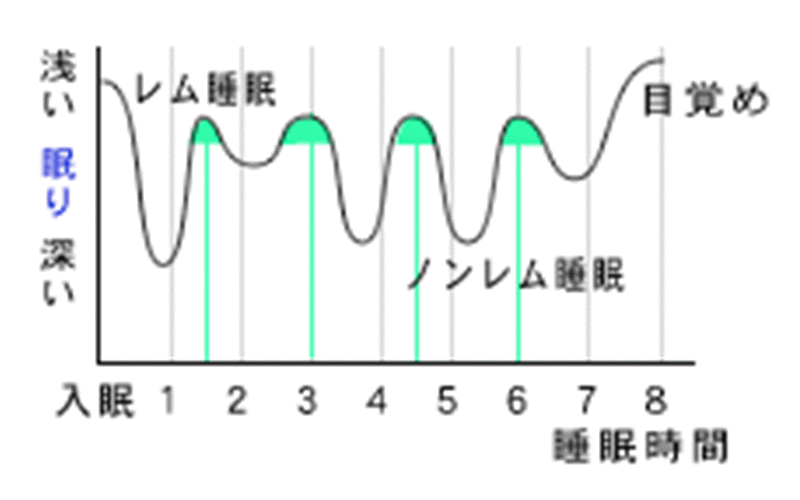
During shallow sleep, the eyeballs were moving even though the eyes were closed, hence the name "REM sleep" (an acronym for "Rapid Eye Movement"). When we dream, we are mostly in REM sleep.
Conversely, deep sleep, in which we sleep soundly, is called "non-REM sleep. Among living organisms, this type of sleep is found in birds and mammals with well-developed brains, so it is also called "evolved sleep.
Humans repeat these two types of sleep several times a night. The rhythm is approximately 90~100 minutes for adults. Immediately after going to bed, we fall into non-REM sleep, then into REM sleep a short time later, and then back into non-REM sleep (......).
In the morning, when we wake up from REM sleep, we wake up refreshed.
What exactly is a dream?
By the way, what are these "dreams" that we have during REM sleep?
It is a mess, isn't it? You can easily get what you want, you can't go where you need to go, you can fly in the sky, you can become a hero, and so on.
Freud was the first psychologist to scientifically elucidate the nature of dreams (1900, "The Dream Judgement"). He proposed the theory that dreams are an expression of instinctive desires.
He also said that external stimuli such as sounds and the state of the body also affect dreams. Have you ever experienced a dream in which your alarm clock rings and in your dream it is the bell for a train to depart?
Various other theories have emerged, but the most popular theory is that dreaming helps us to organize our various memories. While we are sleeping, we sort out the information and memories we have recently seen and heard into those that are necessary and those that are not, and we see them as dreams. Don't you think it is somewhat understandable?
If you sleep well, you will study better!
The fact that sleep is "brain rest" means that it has a lot to do with studying.
For example, when they were asked to memorize meaningless words in the middle of the night and put to bed immediately, they found that half of the words were still remembered after 8 hours. When the same experiment was done during the daytime, 90% of the words were forgotten after 8 hours. In other words, if the brain rests immediately after learning, the memory is more likely to be retained during that time. Besides, if your brain is tired, you won't be able to study well.
So, let's take a look at how to get a good night's sleep to rest the brain. First, do not do anything exciting before going to bed. It is best to avoid playing video games until just before going to bed. Also, keep the lights in your room dark. Even if you close your eyes, you can feel light, which stimulates your brain. However, pitch-darkness can have the opposite effect by making you feel "anxious. In such cases, it is okay to leave a weak light on.
And when you wake up in the morning, you should be exposed to sunlight. If you establish a good body rhythm in this way, you will be able to sleep properly at night.
Sleep well, and your brain and body will be healthy.