





What kind of ties do China and Japan have?
Answer: In ancient times, Japan was a major adopter of Chinese culture, and today, ties are mainly based on food, trade, and other factors.
China (People's Republic of China) has had a flourishing culture since B.C. that has greatly influenced the countries around it. Various things were introduced to Japan as well, including rice production, Chinese characters, Buddhism, Confucianism, and money. Japan sent envoys to Sui Dynasty and Tang Dynasty China in order to introduce Chinese culture.
In September 1972, the two countries signed the "Japan-China Joint Statement" and restored diplomatic relations. One month later, China sent two pandas, Kang Kang and Lan Lan, to Japan as a token of friendship1).
Ties in Culture
Most of the Chinese characters we use either came from China or are simplified versions of them. The phonetic readings of Chinese characters are based on the old Chinese pronunciation. It is said that the reason there are two or more phonetic readings is because the sounds of the Chinese language changed over time, and they were transmitted one after another. Landscape painting, calligraphy, and court music also came from China, and after the normalization of diplomatic relations in 1972, many cultures were introduced from Japan to China.
Ties in food
Chinese cabbage, radish, carrot, burdock root, lotus root, turnip, eggplant, cucumber, spinach, mandarin orange, peach, and tea were introduced to Japan directly from China or through China. Vegetables introduced in recent years are called "Chinese vegetables," such as bok choy and Chinese cabbage, which are also grown in Japan. Chinese restaurants can be found all over Japan, and dishes such as fried rice, dumplings, shaomai (Chinese dumplings), tanmen (Chinese noodles), and ma-bo doufu (bean curd) are very familiar to us all.
Ties in trade
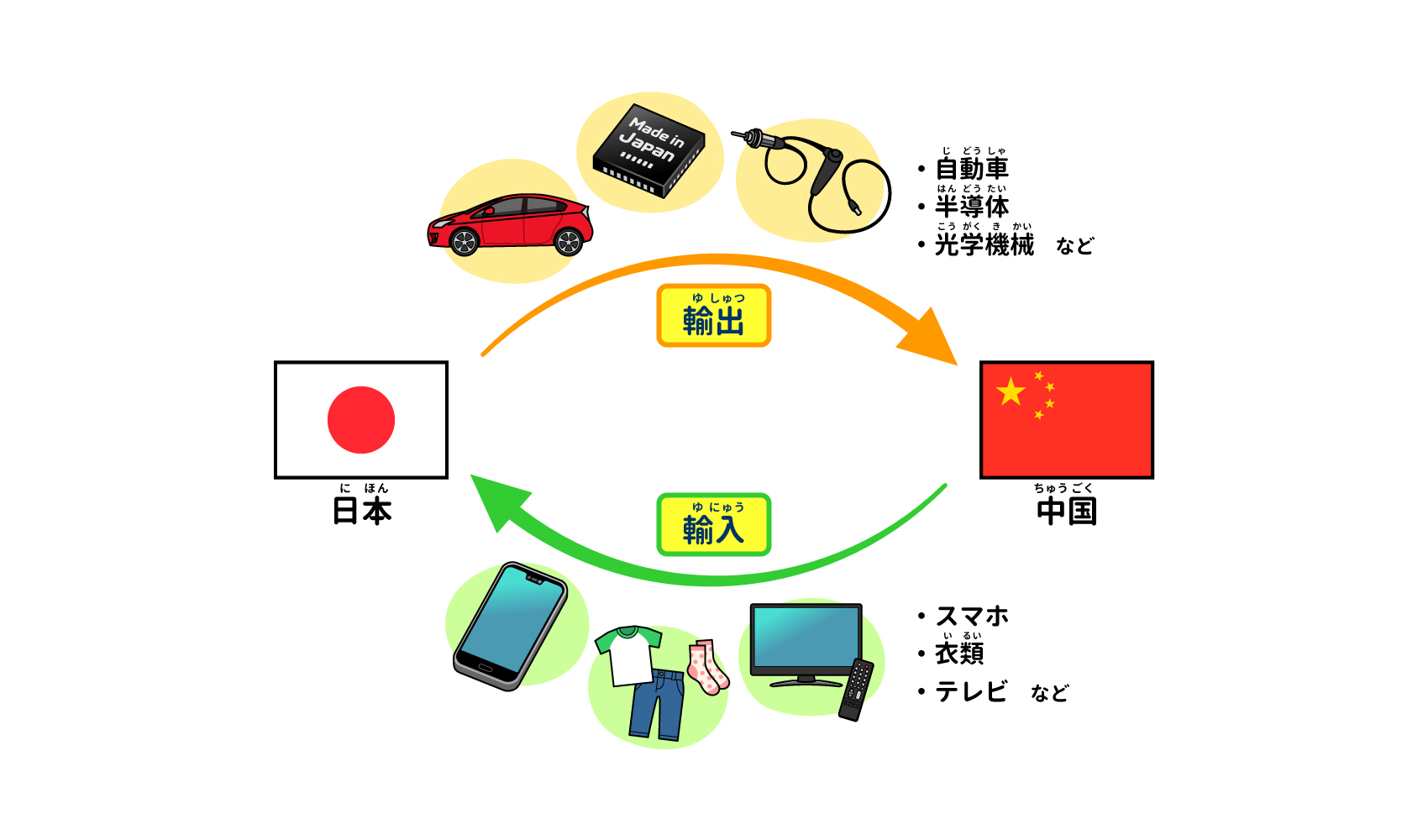
For Japan, China is its second largest trading partner in exports and first in imports (2019) 2). On the other hand, Japan is China's third largest trading partner in terms of exports and second largest in terms of imports (2018) 3). Japan exports to China items such as semiconductors and other electronic components, semiconductor manufacturing equipment, plastics, automobiles, and scientific optical equipment, while China imports to Japan items such as smartphones and other communication devices, clothing, computers and other computer equipment, televisions and other audio visual equipment, and metal products.
Article published: October 2021
reference data
(1) Ministry of Foreign Affairs, "On the Occasion of the 45th Anniversary of the Normalization of Diplomatic Relations between Japan and China and the 40th Anniversary of the Conclusion of the Treaty of Peace and Friendship between Japan and China," June 26, 2018:
https://www.mofa.go.jp/mofaj/press/pr/wakaru/topics/vol168/index.html
(2) Trade Statistics, Ministry of Finance:
https://www.customs.go.jp/toukei/suii/html/time_latest.htm
(3) Japan Foreign Trade Council, "Japan's Major Trading Partners," JFTC Kizu Website:
https://www.jftc.or.jp/kids/kids_news/japan/country/China.html
Supervisor: Mitsuharu Oyama

Born in Tokyo in 1957. Completed a master's degree at Tokyo Institute of Technology. After working as a physics teacher at a high school, a chief instructor at Chiba Prefectural Board of Education, and principal of Chiba Prefectural Chousei High School, he is currently a professor at Shumei University School Teachers' College, where he teaches lectures and exercises on teaching methods for "Science and Mathematics Exploration" and "Integrated Learning Time". He has appeared in many science experiment classes and TV experiment programs. He is also a project advisor for the Chiba City Science Museum, an executive director of the Japanese Society of Physics Education, a member of the Japanese Society for Science Education and the Japanese Society for Science Education, and a member of the editorial board of the monthly magazine "Science Education.