





What is the human body made of?
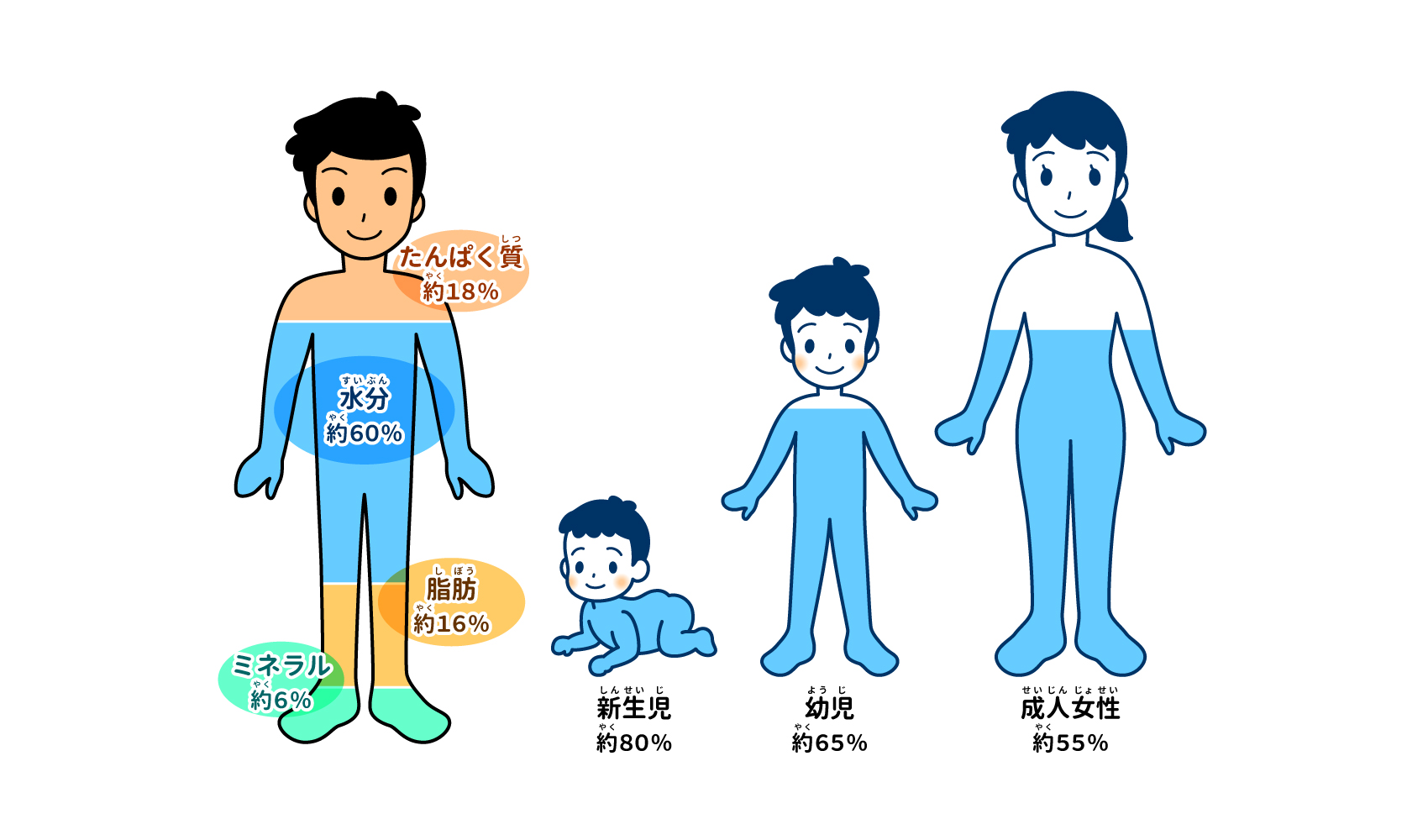
Answer: It is made up of water, protein, fat, and minerals.
Of all the components of our bodies, water is the most abundant. Depending on age and gender, a newborn baby is about 80% water, an infant about 65%, an adult male about 60%, and an adult female about 55%1). 1) A male weighing 70 kg has approximately 42 liters (liters) of water in his body.
After water, protein is the second most abundant component, accounting for about 16% of the protein in an adult male2). 2) The next most abundant component is fat (lipid), which accounts for about 15%. In addition to these, the human body contains about 6% minerals, which are also found in rocks and soil.
What are the functions of these ingredients in the body? Let's look at them in order.
First, water that enters the body through the mouth is absorbed by the intestines and then circulates through the body as "body fluid" such as blood. Body fluid carries oxygen and nutrients to all parts of the body, expels unneeded substances from the body, and regulates body temperature.
Protein is the main material for muscles, bones, internal organs, skin, nails, and hair. Protein entering the body is broken down into "amino acids" in the small intestine and absorbed. After that, they become materials for muscles, "hormones" that regulate body functions, "enzymes" that assist chemical reactions in the body, and "antibodies" that protect the body from pathogens.
Although fat is often dismissed as a problem when it increases too much in adulthood, it has important functions just like any other component. First, each gram of fat releases approximately 9 kcal (kilocalories) 3). 3) In addition to protecting the body from cold, fat also serves as a material for hormones and cell membranes, protects the internal organs by becoming subcutaneous fat, and facilitates the absorption of fat-soluble vitamins, which are easily soluble in oil.
There are 114 types of minerals, 16 of which are considered "essential minerals" for the human body, but it is important to note that potassium, calcium, iron, and zinc are easily deficient4). For example, a lack of calcium prevents the growth of strong bones and teeth. Iron deficiency is one of the causes of anemia.
All of these nutrients are taken into the body through food. In other words, it is important to eat a well-balanced variety of foods in order to build a healthy body.
Article published: January 2022
reference data
1) Otsuka Pharmaceutical, "Hydration: Body and Moisture."
https://www.otsuka.co.jp/nutraceutical/about/rehydration/water/body-fluid/
(2) Morinaga Seika "Kantan, Wakaru! Protein Textbook" "The human body is made of protein. Explaining the relationship between proteins, amino acids and peptides": https://www.morinaga.co.jp/protein/columns/detail/?id=20&category=health
(3) Foundation for the Advancement of Longevity Science, "Functions and Daily Intake of Lipids of the Three Major Nutrients": https://www.tyojyu.or.jp/net/kenkou-tyoju/eiyouso/shishitsu-shibousan.html
(4) Lotte, "Medi Palette," "What are Minerals? Why the body needs them and the types of foods rich in them": https://www.lotte.co.jp/medipalette/1080/
Supervisor: Mitsuharu Oyama
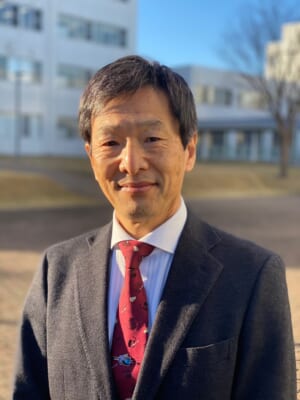
Born in Tokyo in 1957. Completed a master's degree at Tokyo Institute of Technology. After working as a physics teacher at a high school, a chief instructor at Chiba Prefectural Board of Education, and principal of Chiba Prefectural Chousei High School, he is currently a professor at Shumei University School Teachers' College, where he teaches lectures and exercises on teaching methods for "Science and Mathematics Exploration" and "Integrated Learning Time". He has appeared in many science experiment classes and TV experiment programs. He is also a project advisor for the Chiba City Science Museum, an executive director of the Japanese Society of Physics Education, a member of the Japanese Society for Science Education and the Japanese Society for Science Education, and a member of the editorial board of the monthly magazine "Science Education.