





Why do I have hiccups?
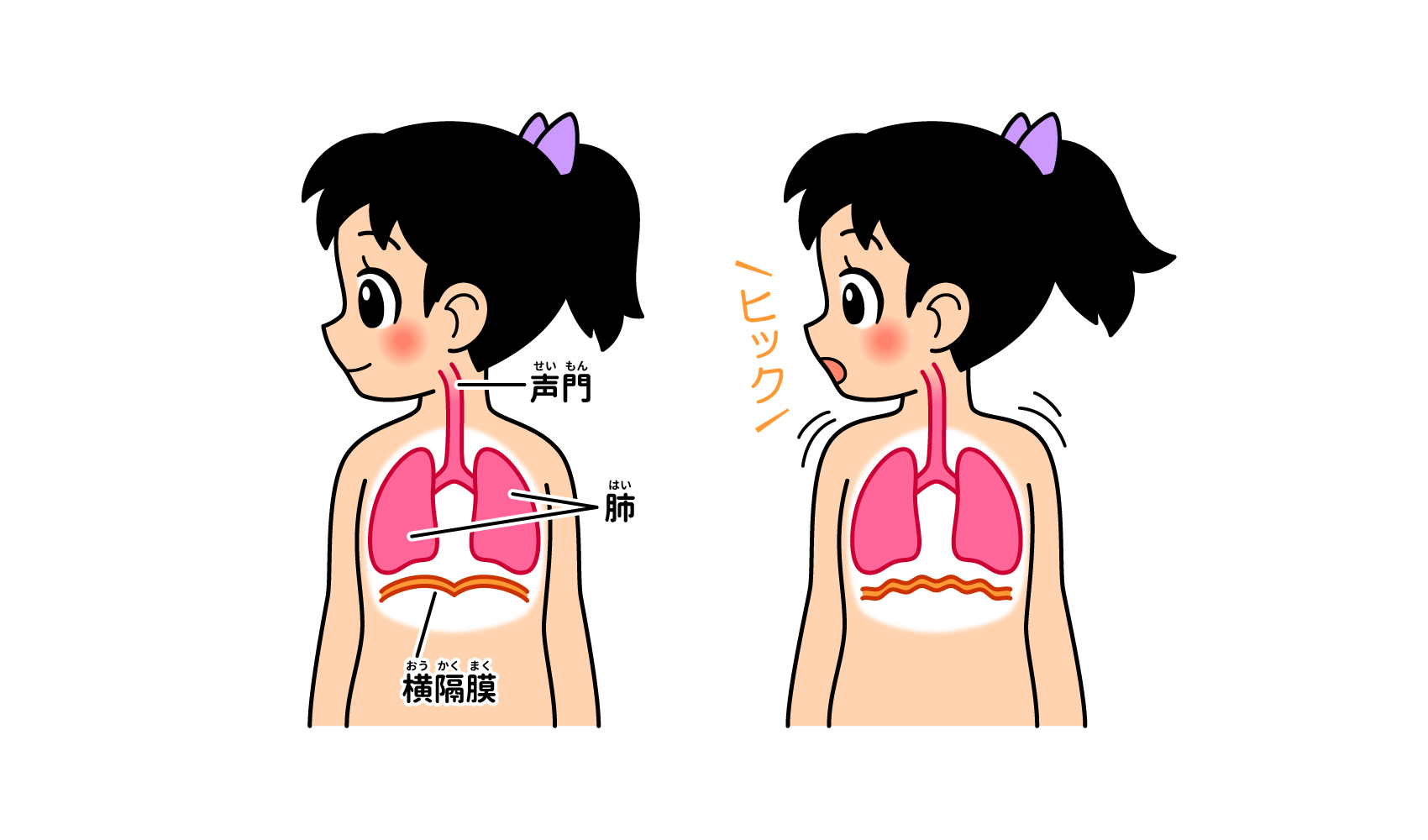
Solution: It is caused by a sudden contraction of the diaphragm.
Hiccups start without warning with a "hiccup...hiccup..." sound, which is annoying because you want to stop them but cannot control them yourself. Where does that "hiccup...hiccup..." sound come from?
The sound of hiccups is the glottis of the throat*1 It comes from a place called the diaphragm," which lies beneath the lungs.*2 The muscle called spasm When the vocal cords on both sides of the throat suddenly close, air can no longer enter the body, causing a jerking vibration and a "click" sound at the same time! 1) The following is a list of the most common problems with the
Although the exact cause of hiccups is not known, it is thought to be related to irritation of the nerves that control the muscles associated with breathing, such as the diaphragm, or parts of the brain. Hiccups are most likely to occur when eating a lot of food in a hurry, drinking drinks all at once, drinking carbonated beverages, or eating hot or spicy food. In adults, drinking a lot of alcohol or smoking cigarettes may also trigger hiccups. What they all have in common is that the carbon dioxide level in the blood tends to decrease due to fast, deep breathing, etc.
Most hiccups subside spontaneously within a few minutes and can be left alone, but even a brief hiccup can be painful for the hiccup sufferer. That's why people have been trying to find a quick fix for hiccups with familiar things for a long time. There are many folk remedies that have been handed down from generation to generation, such as "Surprise me and I will stop hiccups. For example, "surprise the patient," "drink cold water in one gulp," "drink water from the other side of the glass with your head tilted back," and so on. Others include "holding your breath for a moment," "plugging your ears with your fingers," and "gently pulling on your tongue. You have probably tried at least one of these. Temporary hiccups can occur even in healthy people, but if hiccups persist for more than two days, there is a possibility of illness and it is better to consult a doctor2).
Even if the hiccups are short-lived, just when you think they have stopped, they start again with a "hiccup..." and you may wonder how long they will last. There are people in the world who have had hiccups for years without stopping. The "Guinness World Records" has certified Charles Osborne of the United States as the world's longest hiccup survivor, with 68 years of hiccups. He had hiccups at a rate of 20 to 40 times per minute for 68 years, which is estimated to be about 430 million hiccups.
Hiccups occur in both adults and children. A slightly different phenomenon, however, is that the baby inside the abdomen also hiccups. The baby's hiccups, which are movements of the chest and abdomen, can last up to 30 minutes. Although it varies from person to person, in the mid to late stages of pregnancy, the mother can also feel the "twitch, twitch, twitch" convulsions in a steady rhythm.
Studies show that babies hiccup as early as the first nine weeks of pregnancy3). 3) You may be concerned that hiccups at such a young age may be painful, but rest assured, they are not. It is believed that these hiccups are a part of the baby's training to breathe better after birth. If you see a soon-to-be-born baby hiccupping, you may want to say, "Hang in there.
1 Glottis: The left and right vocal cords and the space surrounded by them are called the glottis. The left and right vocal cords make contact in the middle of the glottis, and when air slips through there, the mucous membrane of the vocal cords vibrates to produce voice4).
2 Diaphragm: A dome-shaped membrane made of thin muscles that separates the chest and abdomen, and plays an important role in breathing. When the diaphragm contracts and moves downward, the thoracic cavity (space in the chest surrounded by the ribs) expands and the lungs expand, allowing air to flow in through the nose and mouth. When the diaphragm relaxes and moves back up, air is forced out of the lungs.
Article published: October 2021
reference data
(1) Alex Frith et al/text, Federico Mariani et al/illustrations, Kaoru Takeuchi/translation and supervision. 100 Things You Should Know About the Human Body". 2017. Shogakukan
(2) "Is it true that hiccups are a sign of illness? Should I go to the hospital if they don't stop?" Medicalook":
https://epark.jp/medicalook/hiccup-sick/
3) "Baby hiccups contribute to development of ability to breathe, British study," CNN, November 14, 2019:
https://www.cnn.co.jp/fringe/35145326.html
(4) The Japanese Otorhinolaryngological Society "To Survive in the '100-Year-Life Era': Is a blurred voice fatal if left untreated? The Japanese Society of Otorhinolaryngology, "The Challenge of Healthy Life Expectancy: Otorhinolaryngology for Functional Protection":
http://www.jibika.or.jp/owned/healthy-aging/vocalization.php
Supervisor: Mitsuharu Oyama

Born in Tokyo in 1957. Completed a master's degree at Tokyo Institute of Technology. After working as a physics teacher at a high school, a chief instructor at Chiba Prefectural Board of Education, and principal of Chiba Prefectural Chousei High School, he is currently a professor at Shumei University School Teachers' College, where he teaches lectures and exercises on teaching methods for "Science and Mathematics Exploration" and "Integrated Learning Time". He has appeared in many science experiment classes and TV experiment programs. He is also a project advisor for the Chiba City Science Museum, an executive director of the Japanese Society of Physics Education, a member of the Japanese Society for Science Education and the Japanese Society for Science Education, and a member of the editorial board of the monthly magazine "Science Education.