





Why do my fingers wrinkle when I take a bath?
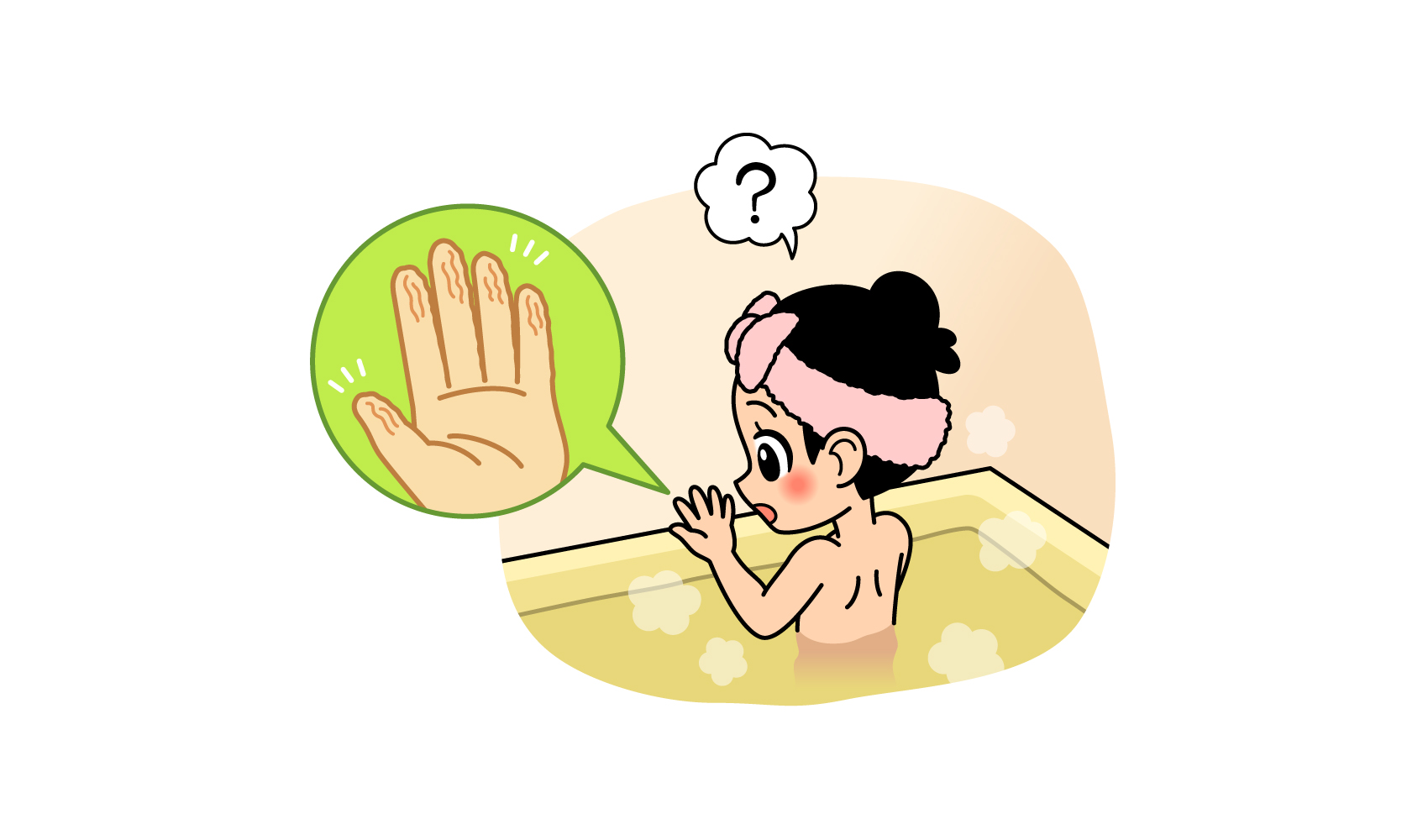
Answer: "To grasp wet things firmly" is the latest theory.
When we spend a lot of time in the water, whether playing in the pool or taking a relaxing bath, the fingertips of our hands and feet become wrinkled and white. Why do the fingertips become wrinkled while the arms, legs, and stomach remain unchanged?
This phenomenon is said to occur because keratin, a protein contained in the stratum corneum (stratum corneum) on the surface of the skin, easily absorbs moisture. The stratum corneum becomes furrowed in areas where it is firmly attached to the underlying layer, while other areas absorb moisture and swell, resulting in wrinkling. There are several theories as to why only the fingertips wrinkle.
The second theory is that the outer skin of the fingertips is devoid of blood vessels and nerves, and thus absorbs water more easily, leading to blistering and stretching. Strangely enough, however, people who have lost the nerves in their fingers due to injury do not have wrinkled fingertips.
Recent research suggests that the wrinkling may be the result of nerve action. A third theory, which has been proposed by some researchers, is that the autonomic nervous system causes the blood vessels in the fingertips to contract when immersed in hot water, resulting in wrinkling due to the difference between the surface and volume of the blood vessels1).
In the midst of all this, a new theory was presented in 2013 and attracted a lot of attention. The theory is that the reason why only the fingertips wrinkle is to make it easier to grasp an object under the water2). 2) A research team at the University of Newcastle in the U.K. has derived this theory from experiments.
After having their fingers wrinkled by dipping them in warm water, the participants were asked to transfer the glass balls and fishing weights from one container to another using only their thumbs and index fingers. A group of people whose fingertips were not wrinkled were asked to do the same. The results showed that the group with wrinkled fingertips worked much faster than the group without wrinkled fingertips.
This mechanism is similar to that of automobile tires. A car can run on a wet surface without slipping because the grooves wick away water from the road surface and firmly grip the road surface3). Fingertips can also grip objects firmly by allowing water to escape through the creases.
The team says that wrinkled fingertips are an evolutionary advantage that humans have acquired. It may have helped us to get food from damp plants and rivers, and it may have prevented us from slipping when running in damp places in the absence of footwear. In modern times, we also feel safer when washing dishes if they are non-slippery.
However, in an experiment in which wrinkled fingers grasped a soft object, there was no difference whether the fingertips were wrinkled or soft, which led to the question, "Why are human fingertips not always wrinkled?" The researchers then asked, "Why aren't human fingertips wrinkled all the time? The researcher says that wrinkled fingertips have a negative effect on sensitivity.
reference data
1) "Why Do Your Fingers Wrinkle in the Bath?" The Asahi Shimbun, March 23, 2013: https: //www.asahi.com/shimbun/nie/tamate/kiji/20130325.html
(2) "Phenomenon of wrinkled fingers in water is 'evolutionary advantage,' British study," AFPBB News, January 9, 2013:
https://www.afpbb.com/articles/-/2919831?cx_part=search
(3) Bridgestone . Tire Grooves and Wet Grip."
Supervisor: Mitsuharu Oyama

Born in Tokyo in 1957. Completed a master's degree at Tokyo Institute of Technology. After working as a physics teacher at a high school, a chief instructor at Chiba Prefectural Board of Education, and principal of Chiba Prefectural Chousei High School, he is currently a professor at Shumei University School Teachers' College, where he teaches lectures and exercises on teaching methods for "Science and Mathematics Exploration" and "Integrated Learning Time". He has appeared in many science experiment classes and TV experiment programs. He is also a project advisor for the Chiba City Science Museum, an executive director of the Japanese Society of Physics Education, a member of the Japanese Society for Science Education and the Japanese Society for Science Education, and a member of the editorial board of the monthly magazine "Science Education.