





Why does my breath turn white on cold days?
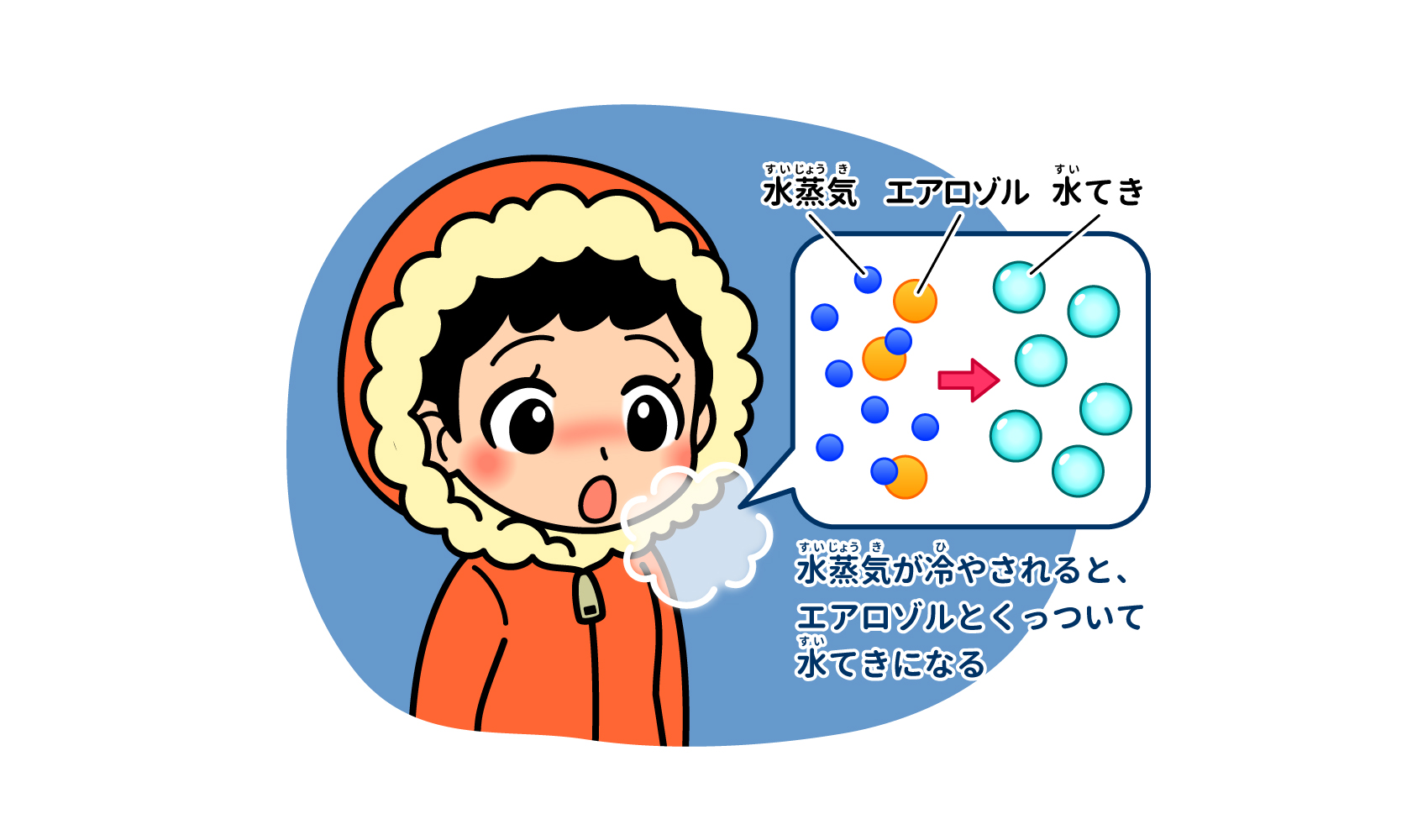
Answer: Because the water vapor in the breath is cooled and converted into hydrothermal fluid.
On winter mornings, when you see your breath turn white, you know it is another cold day. Why does your breath appear white on a cold day when you normally cannot see it when you are talking?
The process is similar to the formation of clouds (see related article, "What Are Clouds Made From and How Are They Formed?) The water vapor (gas) in the breath is cooled by the surrounding air and becomes water (liquid). The water vapor (gas) in our breath is cooled by the surrounding air and becomes a liquid, which appears white.
Let's take a closer look. First, our bodies are constantly replacing water, not only through urine and feces, but also through the skin and exhalation. In the case of exhalation, approximately 400 mL of water is discharged as water vapor per day1).
The temperature of exhaled air is 35-37°C, close to body temperature. In contrast, it is not uncommon for winter temperatures to fall below 10°C (50°F). Therefore, the temperature of the exhaled air is rapidly lowered by the surrounding air.
The amount of water vapor that air can contain depends on the temperature of the air, and the lower the temperature, the less water vapor it can contain*. When the temperature drops and the exhaled air can no longer contain enough water vapor, it turns into water vapor (condensation).
However, for water vapor to condense, it must be attached to something. This is small dust particles called "aerosols. When many small particles of water vapor collide with aerosols floating in the air, water droplets are formed. When these droplets collect, they appear white.
1 The amount of water vapor that 1 m3 of air can contain is called "saturated water vapor content.
There is a place on earth where it is very cold but the exhaled air is not white. That place is Antarctica. The reason is that the air is clean.
I mentioned above that aerosols are necessary for water vapor to condense and become water vapor. Aerosols are dust from wind, volcanic gases from volcanic activity, salt crystals from the ocean, pollen from plants, and exhaust gases from factories and automobiles2). In Antarctica, which is covered with ice and where human activity is low, aerosols derived from dust, pollen, and exhaust gases should also be low.
In the atmosphere of Japanese cities, 1 cm 3 The amount of aerosols in the vicinity of Showa Station in Antarctica is 1/1000 to 1/100th of that amount. On the other hand, the amount of aerosols observed around Showa Station in Antarctica is 1/1000 to 1/100th of that amount. 3). They say that the exhaled air is less likely to be white because there is less aerosol required for water vapor to condense.
Article published: April 2022
reference data
(1) Suntory, "Water Science: Outgoing and Incoming Water," Water Dictionary: https://www.suntory.co.jp/eco/teigen/jiten/science/10/
(2) H. Iwatsuki, "The Latest Book for Understanding the Essentials of Meteorology [3rd Edition]". 2017. Shuwa System
(3) National Institute for Local Studies, "Record of the 47th Expedition, Atmospheric Aerosol Observations," Showa Station NOW! . May 7, 2006: https: //www.nipr.ac.jp/jare-backnumber/now/back47/20060507.html
Supervisor: Mitsuharu Oyama

Born in Tokyo in 1957. Completed a master's degree at Tokyo Institute of Technology. After working as a physics teacher at a high school, a chief instructor at Chiba Prefectural Board of Education, and principal of Chiba Prefectural Chousei High School, he is currently a professor at Shumei University School Teachers' College, where he teaches lectures and exercises on teaching methods for "Science and Mathematics Exploration" and "Integrated Learning Time". He has appeared in many science experiment classes and TV experiment programs. He is also a project advisor for the Chiba City Science Museum, an executive director of the Japanese Society of Physics Education, a member of the Japanese Society for Science Education and the Japanese Society for Science Education, and a member of the editorial board of the monthly magazine "Science Education.