





What is snot made of?
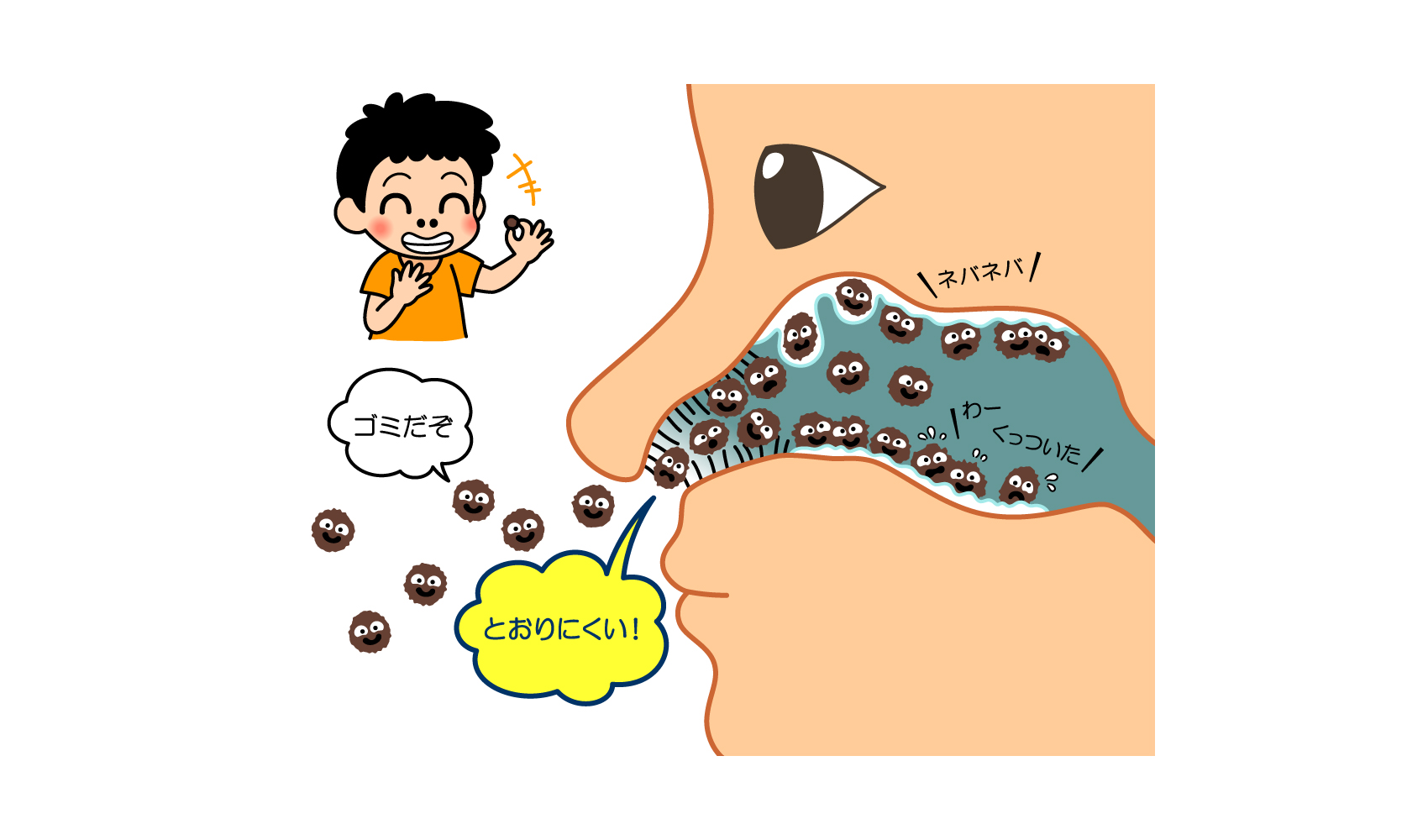
Solution: Airborne debris hardened with mucus.
The air around us contains a lot of dust, mold, pollen, bacteria, viruses, and other debris. If we inhale these things along with the air in our bodies, we may become ill. Therefore, the human body has a mechanism to prevent airborne debris from entering the body. These are nose hairs, runny nose, and snot.
When humans inhale air through the nose, the nose hairs near the entrance work first1). 1) The nose hairs trap debris between the nose hairs, preventing it from moving on to the next part of the nose. However, not all debris is caught by the nose hairs, and the smallest debris slips through.
The sticky liquid (mucus) secreted by the mucous membranes of the nose stands in the way of garbage. The mucus is always produced little by little inside the nose to moisten the inhaled air and protect the mucous membrane2). When the mucous membrane detects debris, it secretes more mucus than usual to prevent it from entering the body and sticking to the debris. The mixture of debris and mucus is thus runny nose. As the nasal discharge flows outward, it also expels the debris caught by the nose hairs. In other words, nasal discharge acts as a humidifier to moisten the air entering the body and as a cleaning fluid to keep the inside of the nose clean.
Runny nose may flow out in this way, or it may be sneezed out, or it may be carried by the movement of protuberances called "hairs" on the surface of the mucous membrane and expelled as "tongue" from the throat, or swallowed into the stomach. Some of the nasal discharge that cannot be expelled remains inside the nose. When this dries out and hardens, it becomes snot.
Since nasal mucus is formed through this process, long exposure to polluted air increases mucus and makes nasal mucus buildup more likely. In dry places, the moisture in the nasal mucus tends to evaporate, which also makes it easier for snot to accumulate.
A nose full of snot makes it difficult to breathe, so you want to get rid of it as soon as possible. However, "picking" your nose with your fingers is not recommended*. The claws may damage the mucous membranes of the nose, and there is a risk of transmitting bacteria or viruses on the fingertips to the mucous membranes of the nose. It is better to blow your nose gently after taking a bath, when the mucous membrane of the nose is moist.
When we are bothered by a runny or snotty nose, we can cover it with a tissue and blow our nose, or we can use our fingers or a cotton swab to blow our nose.
For example, dexterous monkeys use their hands to blow their noses3). In the wild, chimpanzees have been observed putting wooden sticks in their noses to induce sneezing and relieve congestion. Other examples include bearded macaques picking their noses with grass leaves and wooden sticks, and even a bonobo mother has been observed sucking snot out of her child's nose with her mouth.
Unlike monkeys, however, hoofed animals such as cattle and horses cannot blow their noses with their hands. Instead, their nostrils point forward and upward, so that they can pass their noses with a simple "hum" (sniff). If something is stuck in the nose, the giraffe removes it with its long tongue.
Although it is "common knowledge" that "sniffing is bad," research has shown that sniffing is linked to brain activation4). 4) In addition to maximizing the amount of oxygen inhaled through the nose, researchers say it stimulates the nerves in the nose, which in turn activates brain cells.
Article published: November 2021
reference data
(1) Sylvia Bransey/text, Jack Keeley/pictures, Koichiro Fujita/translation. 1998. Kodansha Ltd. Kodansha
(2) Kracie Holdings. Why do you have a runny nose?" The Runny Nose and Rhinitis Laboratory:
https://www.kracie.co.jp/ph/k-kampo/hanamizu/why.html
3) "What Do Animals Do When Their Noses Get Pinched?", National Geographic Japan, August 26, 2015:
https://natgeo.nikkeibp.co.jp/atcl/news/15/b/082500027/
(4) Koichiro Fujita, "'Batchiimono' Kenko Gaku (Health Science of 'Batchiimono')". 2007. Kosaido Publishing Co.
Supervisor: Mitsuharu Oyama
Born in Tokyo in 1957. Completed a master's degree at Tokyo Institute of Technology. After working as a physics teacher at a high school, a chief instructor at Chiba Prefectural Board of Education, and principal of Chiba Prefectural Chousei High School, he is currently a professor at Shumei University School Teachers' College, where he teaches lectures and exercises on teaching methods for "Science and Mathematics Exploration" and "Integrated Learning Time". He has appeared in many science experiment classes and TV experiment programs. He is also a project advisor for the Chiba City Science Museum, an executive director of the Japanese Society of Physics Education, a member of the Japanese Society for Science Education and the Japanese Society for Science Education, and a member of the editorial board of the monthly magazine "Science Education.