





What does it mean to "go blind"?
Answer: Vision loss is caused, among other things, by the inability to properly adjust to the refraction of light.
Have you ever reluctantly turned off a game or rushed to move your face away from the screen after being warned by an adult that "playing games all the time will damage your eyes" or "you will damage your eyes if you put your face too close to the tablet"? However, there must be some people who do not understand what is meant by "your eyes will get worse. What kind of changes are actually occurring when your eyes get worse?
When adults tell children that their eyesight will deteriorate, they usually mean that their eyesight will deteriorate, as in "nearsightedness," "farsightedness," or "astigmatism. Visual acuity is a measure of how well the eye can distinguish objects. In other words, "vision loss" means that it becomes harder to distinguish objects.
The eye is made up of the "eyeball," the "conjunctiva," which connects the eyeball to the eyelid, and the "optic nerve," which sends information captured by the eyeball to the brain1). When light reflects off an object and enters the eye, the "cornea" and "lens" refract the light and project an image onto the retina. When this information is transmitted to the brain via the optic nerve, objects are "seen" (see related article, "Why Can We See?) (Related article: "How do we see?")
The parts of this mechanism directly related to vision are the cornea and the lens, which are responsible for refracting light. The cornea is a transparent membrane with a diameter of about 11 mm and a central thickness of about 0.5 mm. Of the light refraction in the eye, 70% is caused by the cornea2). The lens, on the other hand, is approximately 9 mm in diameter and 4 mm thick in the shape of a convex lens, which bulges due to contraction of a muscle called the ciliary muscle and thins due to stretching of the ciliary muscle3). The lens thickens to increase refraction when looking close up and thins to decrease refraction when looking far away, thereby adjusting the lens so that it is focused on the retina.
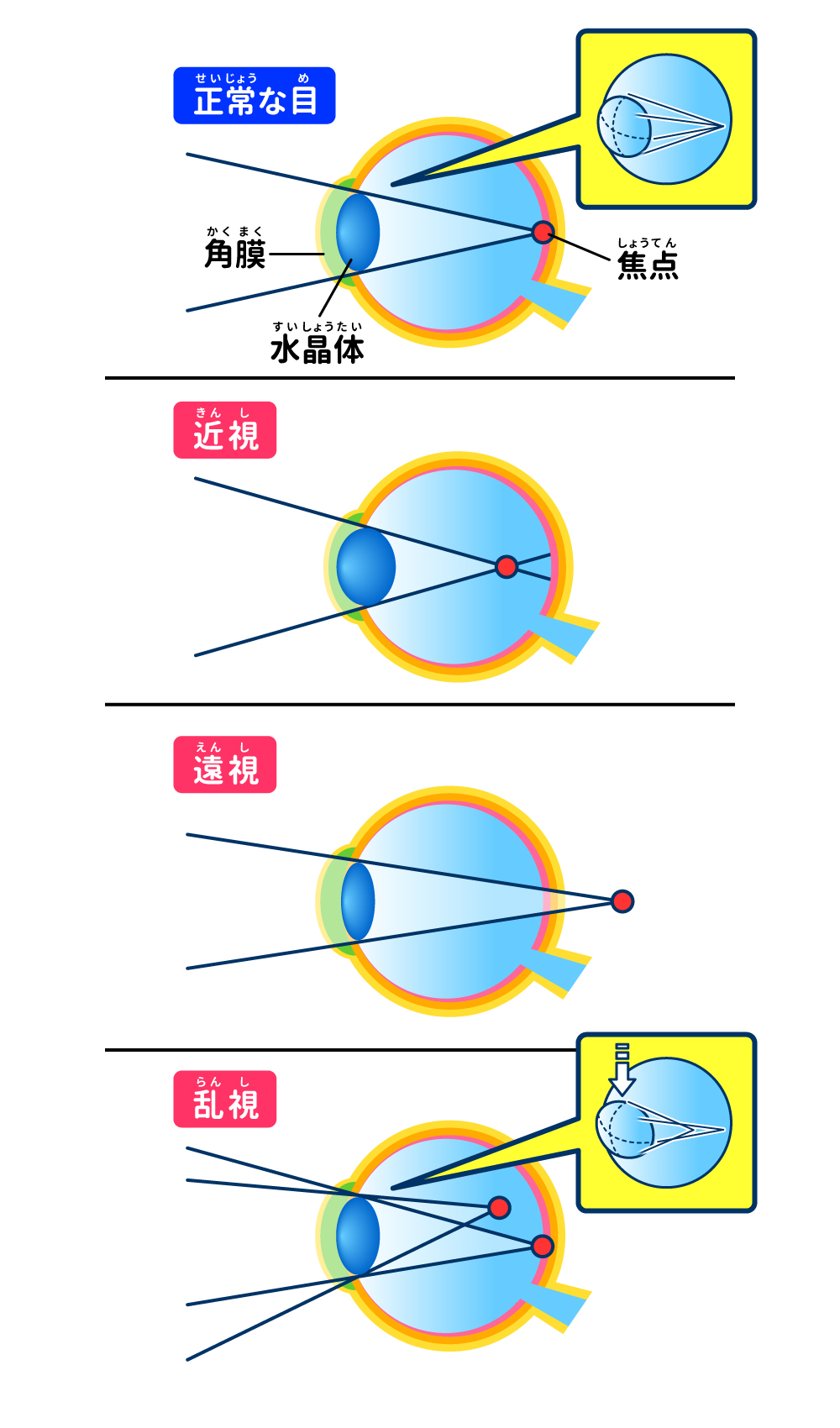
However, when the cornea and lens fail to refract light properly, vision deteriorates. Myopia, which makes it difficult to distinguish distant objects, is a condition in which refracted light comes into focus before it reaches the retina, resulting in a blurred image on the retina. It is believed to be caused by an elongation of the depth of the eyeball (the front-back length, or "eye axis"), which prevents the lens from focusing on the retina even if the lens is sufficiently thin, or by too much light being refracted by the lens.
On the other hand, in the case of farsightedness, which makes it difficult to distinguish objects up close, the focus is behind the retina and the image is blurred on the retina. This is caused by the shortening of the eye axis and the small refraction of light by the lens.
Astigmatism often occurs in combination with myopia and hyperopia. The cornea and lens are distorted into a rugby ball shape, with the angle of the curves varying from direction to direction4). 4) This makes it difficult to focus on a single point on the retina, resulting in blurred or double vision depending on the location. There are three types of distortion: vertical, horizontal, and oblique.
There are various reasons for this inability to refract light properly, some of which are innate (genetic factors) and some of which are influenced by the environment in which we live (environmental factors) *. Therefore, there is no way to completely prevent myopia, hyperopia, and astigmatism, but we can take care to reduce environmental factors.
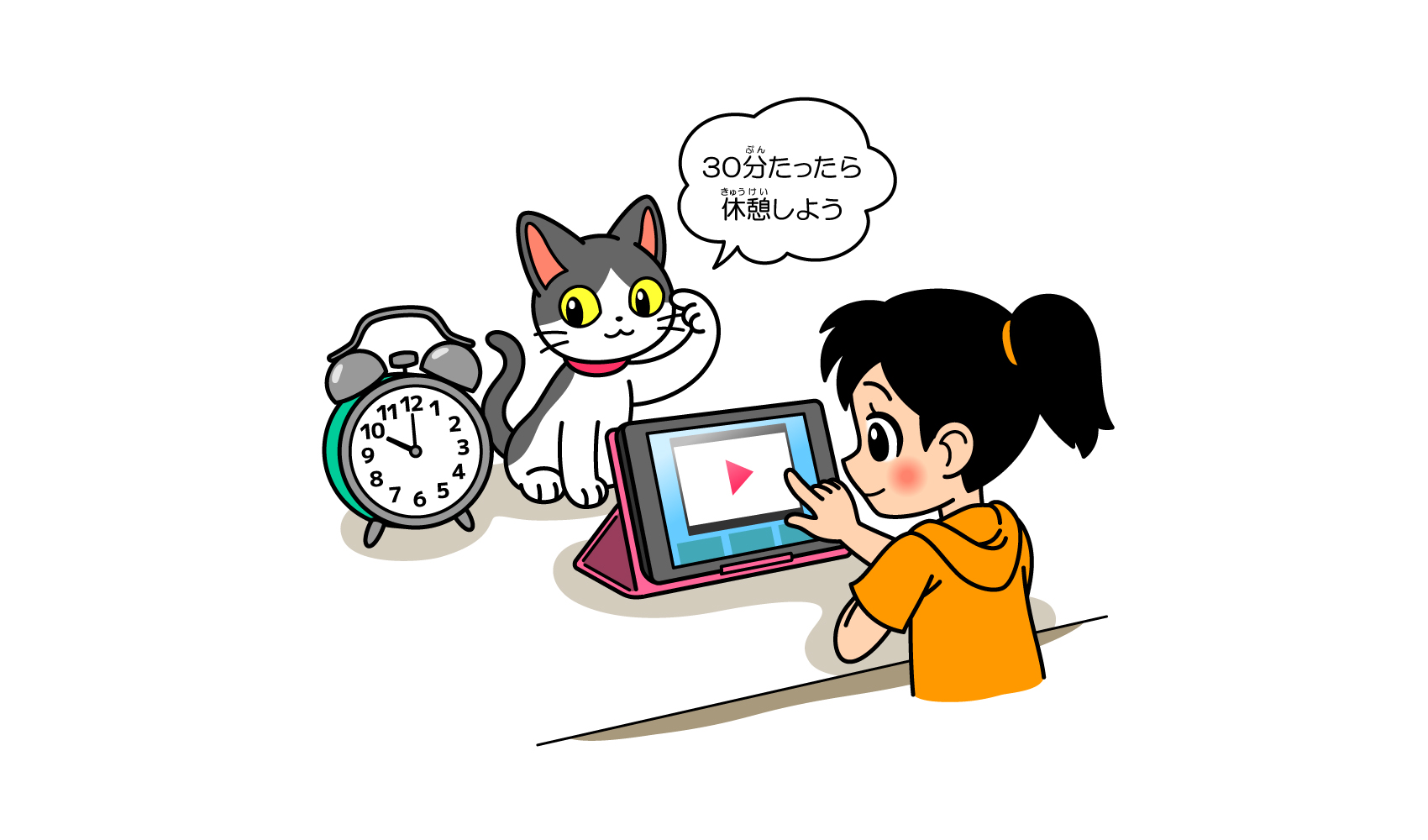
For example, look far away every 30 minutes if you are engrossed in reading or playing a game. Looking at close objects for long periods of time while reading or playing games increases the risk of myopia because the ciliary muscle becomes tense and the lens is always thick. If you get into the habit of resting your eyes by looking into the distance, you will release the tension in the ciliary muscle and reduce the risk of myopia.
We receive a lot of information from our eyes in our daily lives. In order to maintain our quality of life, we need to take care of our eyes.
Article published: June 2022
Related Articles
The following article from Gakken Kids Net provides more information on vision loss in elementary school students.
Special Feature] STOP Elementary School Children's Vision Loss
(1) Lies and Truths about Myopia According to Ophthalmologists: https://kids.gakken.co.jp/parents/parenting/0225/
(2) How to get along with tablets and smartphones: https://kids.gakken.co.jp/parents/parenting/220316/
(3) What is the difference between nearsightedness and farsightedness and when to see an ophthalmologist?:https://kids.gakken.co.jp/parents/parenting/220414/
reference data
(1) Akihiro Sazama, "Why kara hajimaru taike no kagaku [The Science of the Body, Starting from Why: Seeing]". 2020. Childcare Co.
(2) Santen Pharmaceutical, "Eye Care Information: How the Cornea Works": https://www.santen.co.jp/ja/healthcare/eye/products/otc/sante_medical/eyecare/kakumaku.jsp
(3) Santen Pharmaceutical, "Eye Fatigue and Blurred Vision in Modern Humans: The Mechanism of Eye Focus Adjustment": https: //www.santen.co.jp/ja/healthcare/eye/products/otc/sante_medical/cause/cause_01.jsp
(4) Vision Care Company, "What does it mean to be "blind"? How Do Myopia, Hyperopia, and Astigmatism Occur?" : https: //acuvuevision.jp/article/135
Supervisor: Mitsuharu Oyama

Born in Tokyo in 1957. Completed a master's degree at Tokyo Institute of Technology. After working as a physics teacher at a high school, a chief instructor at Chiba Prefectural Board of Education, and principal of Chiba Prefectural Chousei High School, he is currently a professor at Shumei University School Teachers' College, where he teaches lectures and exercises on teaching methods for "Science and Mathematics Exploration" and "Integrated Learning Time". He has appeared in many science experiment classes and TV experiment programs. He is also a project advisor for the Chiba City Science Museum, an executive director of the Japanese Society of Physics Education, a member of the Japanese Society for Science Education and the Japanese Society for Science Education, and a member of the editorial board of the monthly magazine "Science Education.