





How do volcanoes erupt?
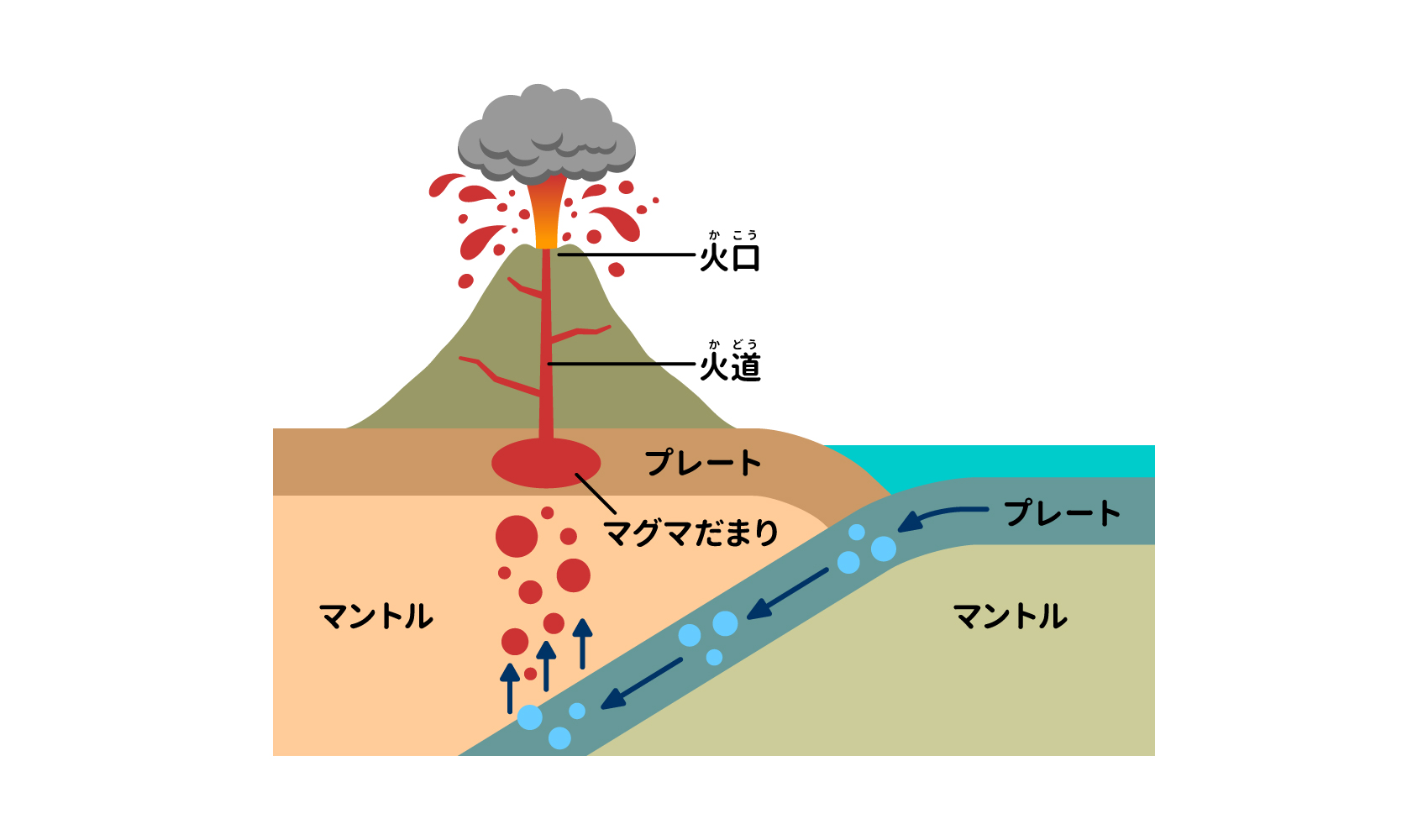
Answer: Magma rises up due to the pressure inside the earth, and then it spews out onto the surface of the earth.
volcano is the accumulation of the Earth's interior. magma The mountain was formed by the blowing out of the Of which, , Within the past 10,000 years eruption volcanoes that have been active or are still active.."active volcano The number of active volcanoes in Japan is 111, or about 7% of the world's active volcanoes. The number of active volcanoes in Japan is about 7% of the world's active volcanoes (111). 1) The number of volcanoes that have been created in the Japanese archipelago from about 2 million years ago to the present is estimated at about 350. It is said that the number of volcanoes created in the Japanese archipelago from about 2 million years ago to the present is about 350! 2) The following is a list of the most common problems with the
If you check the location of these volcanoes on a map, you will see that they are parallel to "ocean trenches" (the Kuril Trench, Japan Trench, Izu-Ogasawara Trench, Sagami Trough, and Nankai Trough), where plates (a solid bedrock about 100 km thick) burrow under each other's tectonic plates. Apparently, the eruption is related to plate subduction. What in the world is going on?
Near Japan, the oceanic plate is subducting under the land plate, and at this time the oceanic plate is subducting with a large amount of seawater. This causes the water and other elements of the earth's interior to mantle part of the magma melts and becomes magma. 3) Magma is a rocky material that is dense and dense. Since the density of magma is smaller than that of the surrounding rocks, it rises toward the earth's surface, but stays at a depth of 5 to 20 km below the surface to form a "magma pool. When new magma enters the magma pool from below, the pressure pushes the magma out of the magma pool, causing it to ascend along a path called a "fire path. note 1 When magma comes close to the surface of the earth, the surrounding bedrock cannot handle the pressure. When magma comes close to the surface, the surrounding bedrock breaks down under the pressure, and magma and volcanic ash come to the surface. note 2 (supplementary information) The following is a list of the most common problems with the
Some eruptions are explosive, with a bang, while others are relatively gentle. There are several factors that determine the force of an eruption, one of which is thought to be the "air bubble "4). In other words, as the magma leaves the magma reservoir and moves out into the fire channel, the pressure on the magma decreases, and the amount of water vapor, carbon dioxide, sulfur dioxide, and other gases that can dissolve in the magma decreases, causing them to form gases and bubble. As the magma rises, the pressure decreases further and the volume of the bubbles increases. When the magma filled with bubbles reaches near the surface, the magma suddenly erupts, causing a violent eruption. This means that explosive eruptions are more likely to occur when magma contains a large amount of easily vaporizable constituents.
1 Recent studies have shown that when a certain amount of magma accumulates, its buoyancy alone can break through the ceiling of the magma reservoir and cause it to rise5).
2 In addition to magmatic eruptions, in which magma directly erupts to the surface, there are phreatomagmatic eruptions, in which groundwater is heated by magma and erupts explosively, and magmatic phreatomagmatic eruptions, in which groundwater touches magma and erupts together6).
The Japan Meteorological Agency monitors active volcanoes that are particularly active or those that are likely to cause major disasters due to eruptions around the clock as "volcanoes under constant observation7). The 50 volcanoes that are subject to this system are those selected by the Liaison Committee for Prediction of Volcanic Eruptions as "volcanoes that require enhanced monitoring and observation systems to prevent volcanic disasters.
For example, several types of instruments are installed on volcanoes to measure volcanic earthquakes and small tremors that occur in and around the volcano, as well as "shock waves" that cause vibrations in the surrounding air due to eruptions. Surveillance cameras are installed a short distance away from the volcano to monitor the height and color of the volcanic plume (steam mixed with volcanic ash that erupts during an eruption), and fire reflections (lava inside the crater that illuminates clouds and plumes in the sky in red). In addition, they monitor the volcano in various ways, such as using a helicopter to observe the crater from the sky and driving a car to observe volcanic gases. When the JMA determines that an eruption may occur that affects the surrounding area or that eruptive activity is spreading, it issues an eruption warning and forecast.
Thus, observation and monitoring of volcanoes is an important task to protect the lives of people in the surrounding areas. In order to continue monitoring in the future, research is underway to apply cosmic ray technology, simulation technology, and robots to volcano observation and monitoring8).
Article published: October 2022
reference data
(1) JMA, "Distribution Map of Active Volcanoes in Japan": https://www.data.jma.go.jp/svd/vois/data/tokyo/STOCK/bulletin/catalog/appendix/v_active.html
(2) Shizuoka University Disaster Prevention Research Center, "A Book to Understand Mt. Fuji, an Active Volcano," "1. Basic Knowledge of Volcanoes": https://www.cnh.shizuoka.ac.jp/research/barchive/mtfuji/001-2/
(3) Sendai District Meteorological Observatory, "How Eruptions Work": https://www.jma-net.go.jp/sendai/knowledge/kyouiku/eqvol/a_vol_ws.pdf
(4) Kyushu University, "Foaming Phenomena in Magma as a Key to Volcanic Intensity," June 29, 2020: https: //www.sci.kyushu-u.ac.jp/koho/qrinews/qrinews_200629.html
(5) Okayama University, "Magma buoyancy key to supergiant eruptions".January 16, 2014: https: //www.okayama-u.ac.jp/tp/release/release_id133.html
(6) Nagoya University, Ontake Volcano Research Facility, "Basic Knowledge of Volcanoes," "What Types of Eruptions Are There?":https://www.seis.nagoya-u.ac.jp/center/kovo/volcano/volcano4.html
(7) Japan Meteorological Agency, "Earthquake, Tsunami and Volcano Monitoring": https://www.jma.go.jp/jma/kishou/intro/gyomu/index92.html
(8) Sankei Shimbun, "Not Enough Volcanologists: Ministry of Education Plans to Double the Number of Volcanologists in Collaboration with Other Fields to Strengthen Disaster Prevention".October 5, 2015: https: //www.sankei.com/article/20151005-CJV6E7PQDNOJFDQ6PE5M447OGU/3/
Supervisor: Mitsuharu Oyama
Born in Tokyo in 1957. Completed a master's degree at Tokyo Institute of Technology. After working as a physics teacher at a high school, a chief instructor at Chiba Prefectural Board of Education, and principal of Chiba Prefectural Chousei High School, he is currently a professor at Shumei University School Teachers' College, where he teaches lectures and exercises on teaching methods for "Science and Mathematics Exploration" and "Integrated Learning Time". He has appeared in many science experiment classes and TV experiment programs. He is also a project advisor for the Chiba City Science Museum, an executive director of the Japanese Society of Physics Education, a member of the Japanese Society for Science Education and the Japanese Society for Science Education, and a member of the editorial board of the monthly magazine "Science Education.