


What is the diameter of the earth?
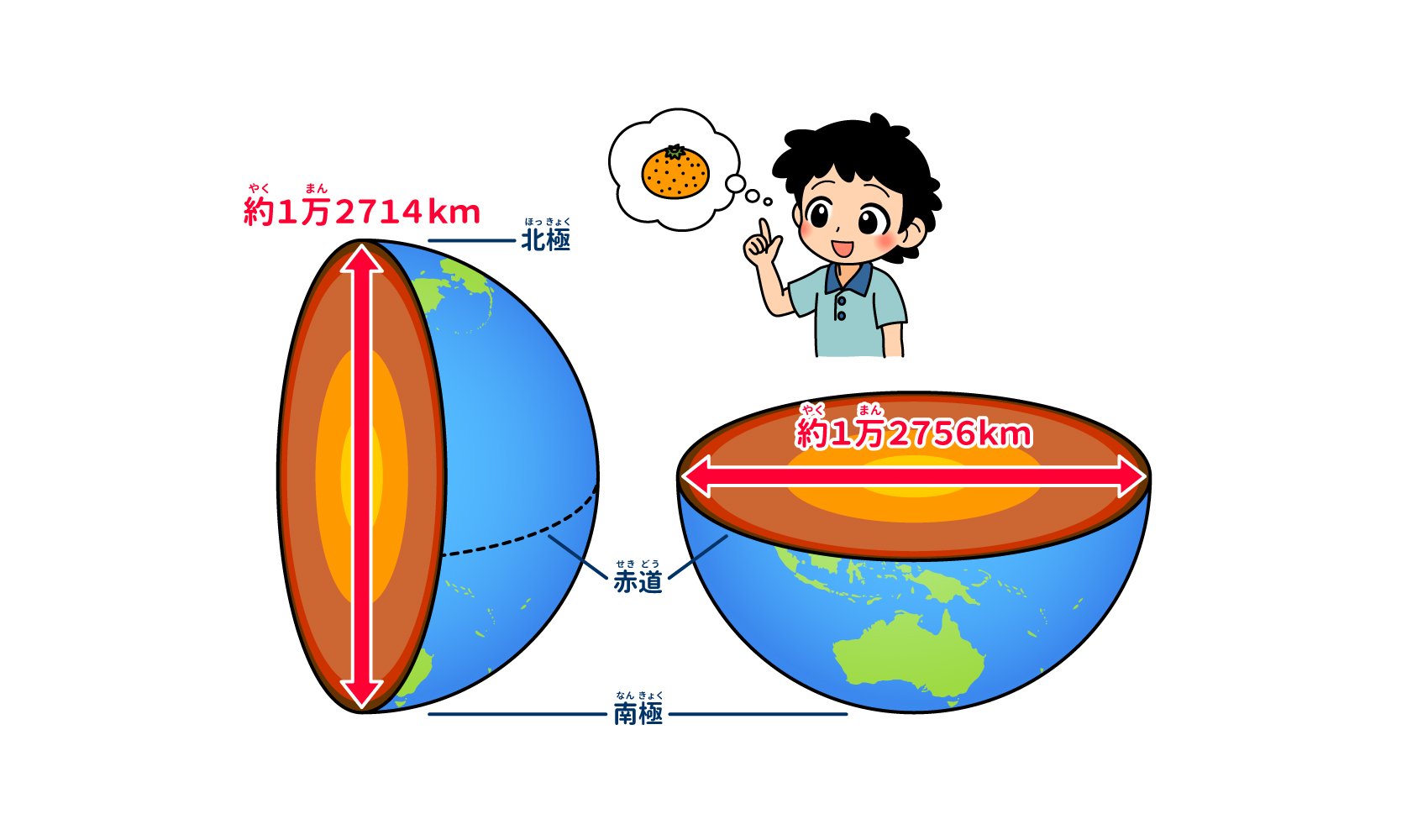
Answer: It is about 12,700 km. However, the length varies slightly depending on the direction of measurement.
When you look at a satellite photo of the earth, you will see that the earth is shaped like a ball. This is because as a celestial body grows larger and heavier, the universal gravitational force (the force of attraction between all matter) also grows, making it impossible for it to maintain its complex shape1). The force of attraction to collapse and the pressure of repulsion between internal materials become almost equal, and the body becomes round and stable. Not only the earth, but all celestial bodies of a certain size are round. The roundness of a ball is also due to the fact that the pulling force of the rubber on the surface is equal to the pressure of the air inside.
However, the earth is not a perfect sphere. Since the earth orbits the sun while rotating on its own axis, centrifugal force (the force that moves the earth away from the center when it rotates in a circle) is always at work. The greater the distance from the axis of rotation, the greater the centrifugal force, so the centrifugal force is greatest at the equator and decreases as one approaches the North and South Poles. As a result, the earth is stretched in the direction of the equator and becomes like a ball lightly crushed from above, or in extreme cases, like a tangerine.
In other words, the length of the equator, which is located at the belly of the earth, is slightly different from the length of the line passing through the north and south poles. The equatorial diameter is about 12,756 km, and the diameters of the north and south poles are about 12,714 km, a difference of about 42 km.
This difference of 42 km is negligible in terms of the size of the entire earth. If this is the case, then why not consider it to be spherical? However, there are some problems with a spherical shape. One of them is the calculation of gravity. Since gravity is determined by the relationship between gravitational and centrifugal forces, it varies slightly with latitude, being about 0.5% smaller at the equator than at the North and South Poles2). For example, weighing instruments such as scales and pressure gauges are affected by gravity, so it is necessary to know the correct gravity in order to adjust the instrument so that it points to the correct value.
Therefore, a standard called the "global ellipsoid" was devised to approximate the shape and size of the earth as closely as possible. There are several types of ellipsoids, and since 2002, Japan has been surveying and mapping the earth based on the Geodetic Reference System 1980 (GRS80).3) According to GRS80, the equatorial radius (radius perpendicular to the axis of rotation) of the earth is The polar radius (radius in the direction of the axis of rotation) is 6356.752 km4).
Article published: October 2021
reference data
(1) National Astronomical Observatory of Japan, Calendar Computation Office, "Forms of Celestial Bodies:
https://eco.mtk.nao.ac.jp/koyomi/wiki/C5B7C2CEA4CEB7C1BEF5.html
(2) GSI, Ministry of Land, Infrastructure, Transport and Tourism, "What is Gravity?" :
https://www.gsi.go.jp/common/000213099.pdf
(3) Geodetic System of Japan, Geographical Survey Institute, Ministry of Land, Infrastructure, Transport and Tourism:
https://www.gsi.go.jp/sokuchikijun/datum-main.html
(4) National Astronomical Observatory of Japan, Calendar Calculation Office, "Radius of Solar System Objects:
https://eco.mtk.nao.ac.jp/koyomi/wiki/CFC7C0B12FC8BEB7C2.html
Supervisor: Mitsuharu Oyama

Born in Tokyo in 1957. Completed a master's degree at Tokyo Institute of Technology. After working as a physics teacher at a high school, a chief instructor at Chiba Prefectural Board of Education, and principal of Chiba Prefectural Chousei High School, he is currently a professor at Shumei University School Teachers' College, where he teaches lectures and exercises on teaching methods for "Science and Mathematics Exploration" and "Integrated Learning Time". He has appeared in many science experiment classes and TV experiment programs. He is also a project advisor for the Chiba City Science Museum, an executive director of the Japanese Society of Physics Education, a member of the Japanese Society for Science Education and the Japanese Society for Science Education, and a member of the editorial board of the monthly magazine "Science Education.