


Why are there mountains and how were they formed?
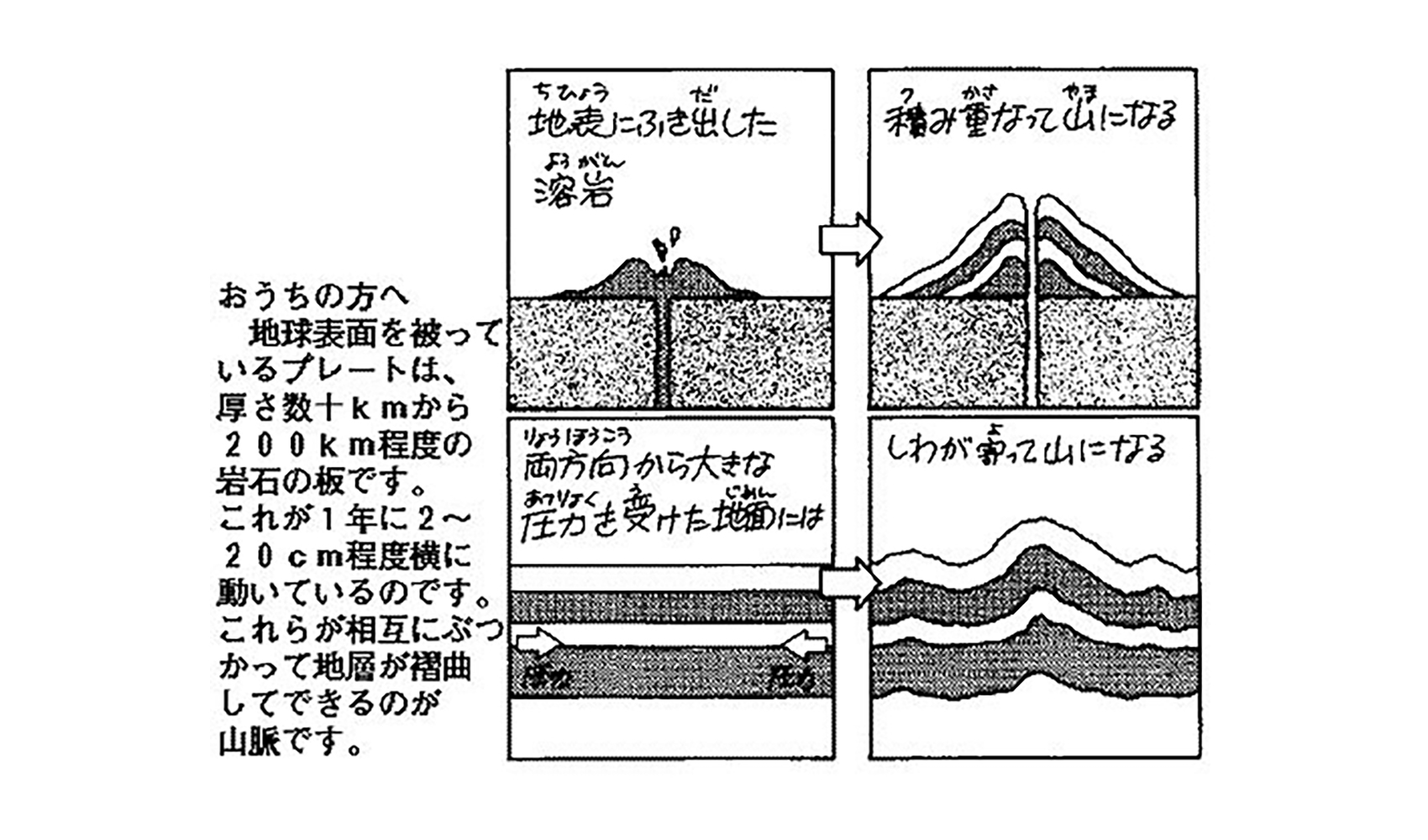
There are two main types of mountains. The first is volcanic mountains. These are formed when lava flows from an eruption, and the lava piles up and rises gradually.
The most famous volcano is first and foremost Mt. Fuji is a mountain that has been elevated by the accumulation of lava spewed by three major explosions.
Fuji, but rather a chain of many mountains. In Japan, the Northern and Southern Alps fall into this category. In the world, the Rocky Mountains of Canada, the Himalayas with Chomolungma (Everest), and the Alps of Europe are famous.
These mountain ranges are not volcanoes. In other words, they are not mountains formed by piles of lava. They are mountains formed by wrinkling of the ground over a long period of time.
The Earth's surface is moving sideways little by little, about 2 to 20 cm per year. The surface of the earth is like a jigsaw puzzle, with each piece moving in different directions. Each piece is moving in different directions, and there is bound to be a collision point somewhere. Usually, when they collide, one of them sinks downwards, but sometimes large objects collide with each other. This force is so strong that it can bend even the strongest rocks.
The Japanese Northern and Southern Alps were formed by the head-on collision of the Japanese archipelago and the Izu Peninsula, and the Himalayas were formed by the head-on collision of the Asian and Indian continents.