


Why does the air get so thin when you climb a mountain?
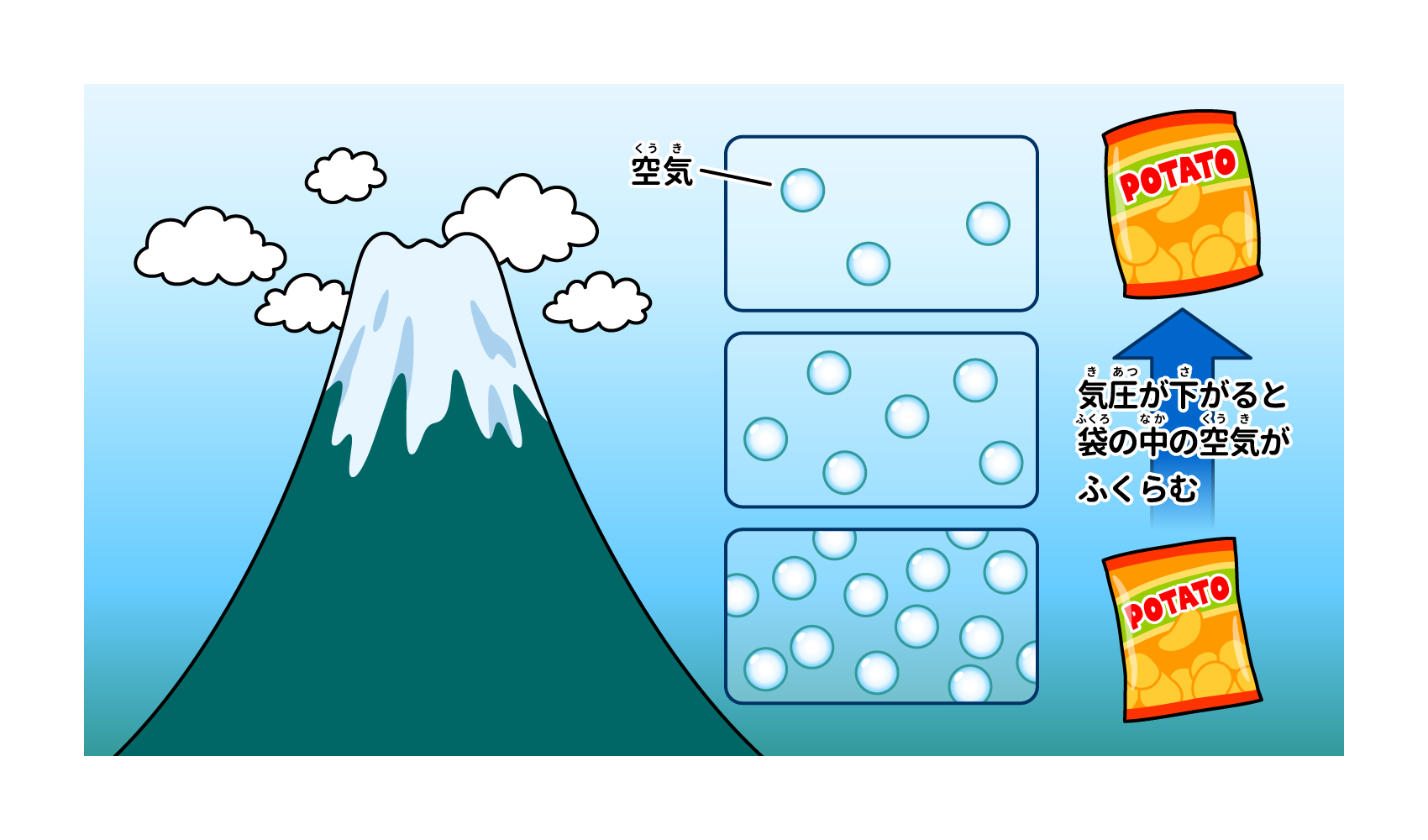
Solution: The higher the location, the less air there is above it.
The term "thin air" refers to the fact that atmospheric pressure has decreased and air density has decreased. In other words, when the amount of air in the same volume is compared between places at higher and lower elevations, the amount of air is lower at higher elevations due to lower atmospheric pressure. Since the percentage of oxygen in the air is constant, the lower the air density, the lower the amount of oxygen, and the person in that location will feel suffocated.
When climbing a mountain, the atmospheric pressure gradually decreases as we slowly climb from the base of the mountain to the top. Therefore, it may be difficult to feel the change in atmospheric pressure. Here is an example that shows at a glance how low the atmospheric pressure is.
You may have experienced, or seen in videos or photos, "I took a bag of snacks up a mountain, and when I took them out at the top, the bag was bulging out. The bulging bag is evidence that the atmospheric pressure is lower at higher elevations than at lower elevations. What makes the bag bulge is air. Since the mouth of the bag is closed, the amount of air in the bag is the same at the summit as it is at the base of the mountain. The reason the bag expands is because the force pushing the bag from the outside, in other words, the atmospheric pressure, has decreased.
Atmospheric pressure changes slightly depending on latitude, but is considered to be approximately 1013 hPa (1 atmospheric pressure) at an altitude of 0 meters. It then decreases by approximately 1 hPa for each 10 m higher. Fuji is 3,776 meters high, and the atmospheric pressure at its summit is approximately 630 hPa.
So why is atmospheric pressure lower at higher elevations? It is because there is less air piled up on top of it. Atmospheric pressure is a force acting under the weight of the air above it, so if there is less air, the pressure will be lower.
It is easy to imagine this in terms of water pressure. Water pressure increases by about 1 atmospheric pressure for every 10 meters of travel, and reaches 1,000 times the water surface at the bottom of the Mariana Trench, where the water depth is more than 10,000 meters. The deeper the water, the higher the water pressure because of the greater volume of water above it.
Article published: December 2021
Supervisor: Mitsuharu Oyama

Born in Tokyo in 1957. Completed a master's degree at Tokyo Institute of Technology. After working as a physics teacher at a high school, a chief instructor at Chiba Prefectural Board of Education, and principal of Chiba Prefectural Chousei High School, he is currently a professor at Shumei University School Teachers' College, where he teaches lectures and exercises on teaching methods for "Science and Mathematics Exploration" and "Integrated Learning Time". He has appeared in many science experiment classes and TV experiment programs. He is also a project advisor for the Chiba City Science Museum, an executive director of the Japanese Society of Physics Education, a member of the Japanese Society for Science Education and the Japanese Society for Science Education, and a member of the editorial board of the monthly magazine "Science Education.