


How does rain fall?
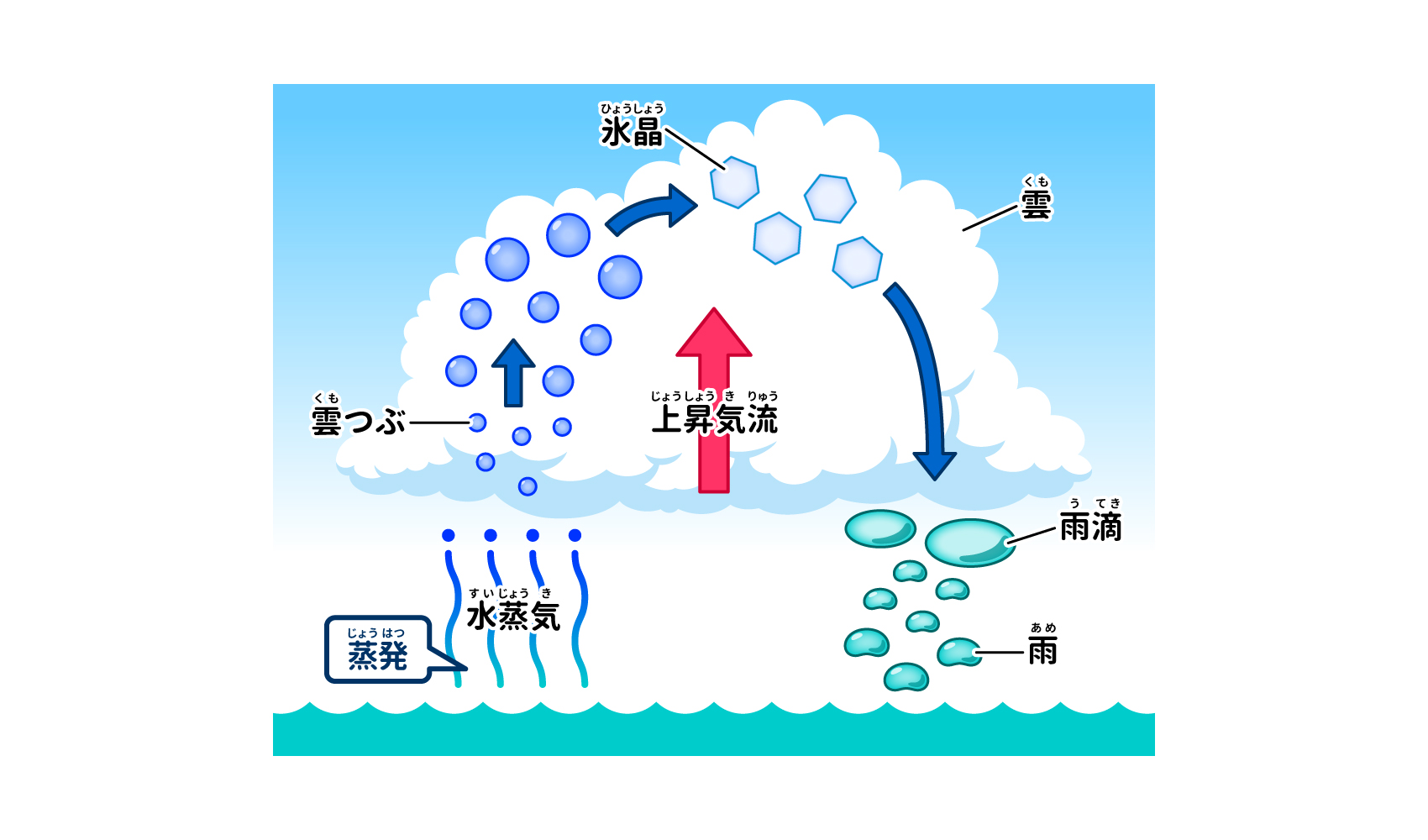
Solution: Water droplets and ice cubes in the clouds grow and fall as rain.
Fluffy clouds in the sky are made up of water particles called "cloud particles" and ice crystals called "ice crystals" (see related article, "What are clouds made of and how are they formed? When these become large and heavy and fall from the sky, they form rain and snow.
First, the moisture evaporated from the ocean and the ground is carried by the upward atmospheric flow, "updraft When the air is cooled by the cold air above it, cloud particles are formed. Clouds are formed when cloud particles are blown up into the sky by the rising air currents.
In clouds, cloud particles are driven upward by updrafts and grow as they take in water vapor from the surrounding air1). At first, the radius of the cloud particles is 0.001 to 0.01 mm (about one-fifth the thickness of a human hair), but as they rise, they become larger and heavier, eventually reaching a radius of about 0.1 mm. The rising air currents can no longer support the cloud particles, and they begin to fall from the cloud toward the ground. When the water droplets fall from the cloud, they stick together with the surrounding water droplets to form "raindrops," but when they reach a radius of 2.5 mm to 3 mm, they break off and become smaller, and fall to the ground as rain.
If the temperature drops below -20°C while the cloudbursts are growing, the cloudbursts scorch and become ice crystals2). Snow crystals are formed when the surrounding water vapor attaches to the ice crystals (related article: "Why Does Snow Fall?) Snow crystals are formed when the surrounding water vapor sticks to the ice crystals. When cloud particles further adhere to snow crystals, they form hail. When the temperature near the ground is above 0°C, the snow and hail melt and fall to the ground as rain.
Thus, rain that falls as cloud particles enlarge is called "warm rain" and rain that falls as ice crystals melt is called "cold rain. Warm rain falls in tropical regions. Most of the rain that falls in temperate zones, including Japan, is cold rain.
Article published: March 2022
reference data
(1) Kentaro Araki, Supervisor, "A Study of Clouds and Rain: Let's Discover the Mechanism and Mystery of the Sky! PHP Research Institute, Inc.
(2) "Gakken's Illustrated Book LIVE eco Abnormal Weather: How Weather Works" supervised by Yasuo Takeda.2018. Gakken Plus
Supervisor: Mitsuharu Oyama

Born in Tokyo in 1957. Completed a master's degree at Tokyo Institute of Technology. After working as a physics teacher at a high school, a chief instructor at Chiba Prefectural Board of Education, and principal of Chiba Prefectural Chousei High School, he is currently a professor at Shumei University School Teachers' College, where he teaches lectures and exercises on teaching methods for "Science and Mathematics Exploration" and "Integrated Learning Time". He has appeared in many science experiment classes and TV experiment programs. He is also a project advisor for the Chiba City Science Museum, an executive director of the Japanese Society of Physics Education, a member of the Japanese Society for Science Education and the Japanese Society for Science Education, and a member of the editorial board of the monthly magazine "Science Education.