
Why does thunder rumble?
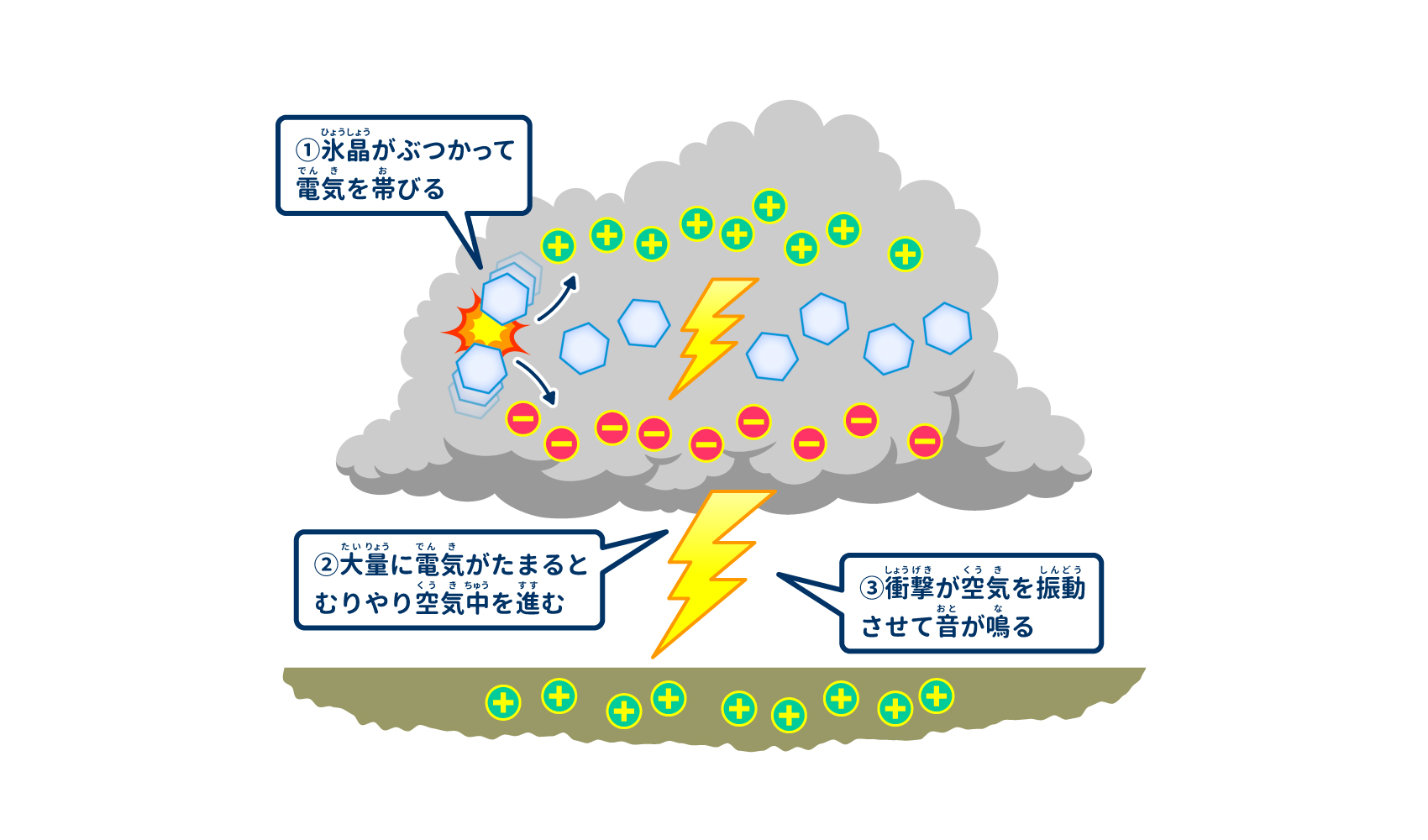
Answer: Electricity causes the air to shake and makes a loud noise.
Clouds are made up of water droplets called "cloudbursts" and ice crystals called "ice crystals" (see related article, "What Are Clouds Made From and How Are They Formed?)). Clouds come in a variety of shapes, but cumulonimbus clouds, also known as thunderclouds, are clouds with many ice crystals.
In thunderclouds, ice crystals are moving violently upward and downward with the air, colliding with each other here and there, generating static electricity, which causes a lot of electricity to accumulate. Normally, the air around us does not conduct electricity, but when large amounts of electricity accumulate like this, an electric current can flow through the air. This is lightning (see related article, "How is lightning formed?").
When electricity is forced to pass through air that normally does not conduct electricity, the air in its path suddenly becomes hot and expands violently, as if exploding. This burst is transmitted to the surrounding air and causes it to vibrate violently, resulting in rumbling, crackling, and booming noises.
By the way, have you ever heard someone say, "It must have struck nearby," when you hear a rumble immediately after a flash of lightning? It is true that the sound made immediately after the flash is loud, but the sound made seconds later is a little quieter and seems to be heard further away.
This is because light travels through air much faster than the speed of sound. The speed of light is 300,000 km per second, and the speed of sound is 340 m per second; by multiplying the number of seconds between the flash and the sound by 340, we can calculate how many meters to the location where the lightning struck.
Article published: March 2022
Supervisor: Mitsuharu Oyama
Born in Tokyo in 1957. Completed a master's degree at Tokyo Institute of Technology. After working as a physics teacher at a high school, a chief instructor at Chiba Prefectural Board of Education, and principal of Chiba Prefectural Chousei High School, he is currently a professor at Shumei University School Teachers' College, where he teaches lectures and exercises on teaching methods for "Science and Mathematics Exploration" and "Integrated Learning Time". He has appeared in many science experiment classes and TV experiment programs. He is also a project advisor for the Chiba City Science Museum, an executive director of the Japanese Society of Physics Education, a member of the Japanese Society for Science Education and the Japanese Society for Science Education, and a member of the editorial board of the monthly magazine "Science Education.