


Why are there white clouds and black clouds?
Answer: It is really colorless and transparent, but it appears to change color depending on the light of the sun.
In the sky, clouds are floating around, changing their shapes in various ways. It is not only the shape that changes, but also the color. When the white clouds in a clear sky increase and turn gray and then black, you start to worry that it might start raining at any moment.
In fact, clouds do not have color. Clouds are made up of small water droplets called "cloud particles" and ice crystals called "ice crystals. Since cloud particles and ice crystals are originally water evaporated from the ground and oceans, clouds are essentially colorless and transparent (see related article "What Are Clouds Made From and How Are They Formed?)). ) Why, then, do clouds appear in a variety of colors?
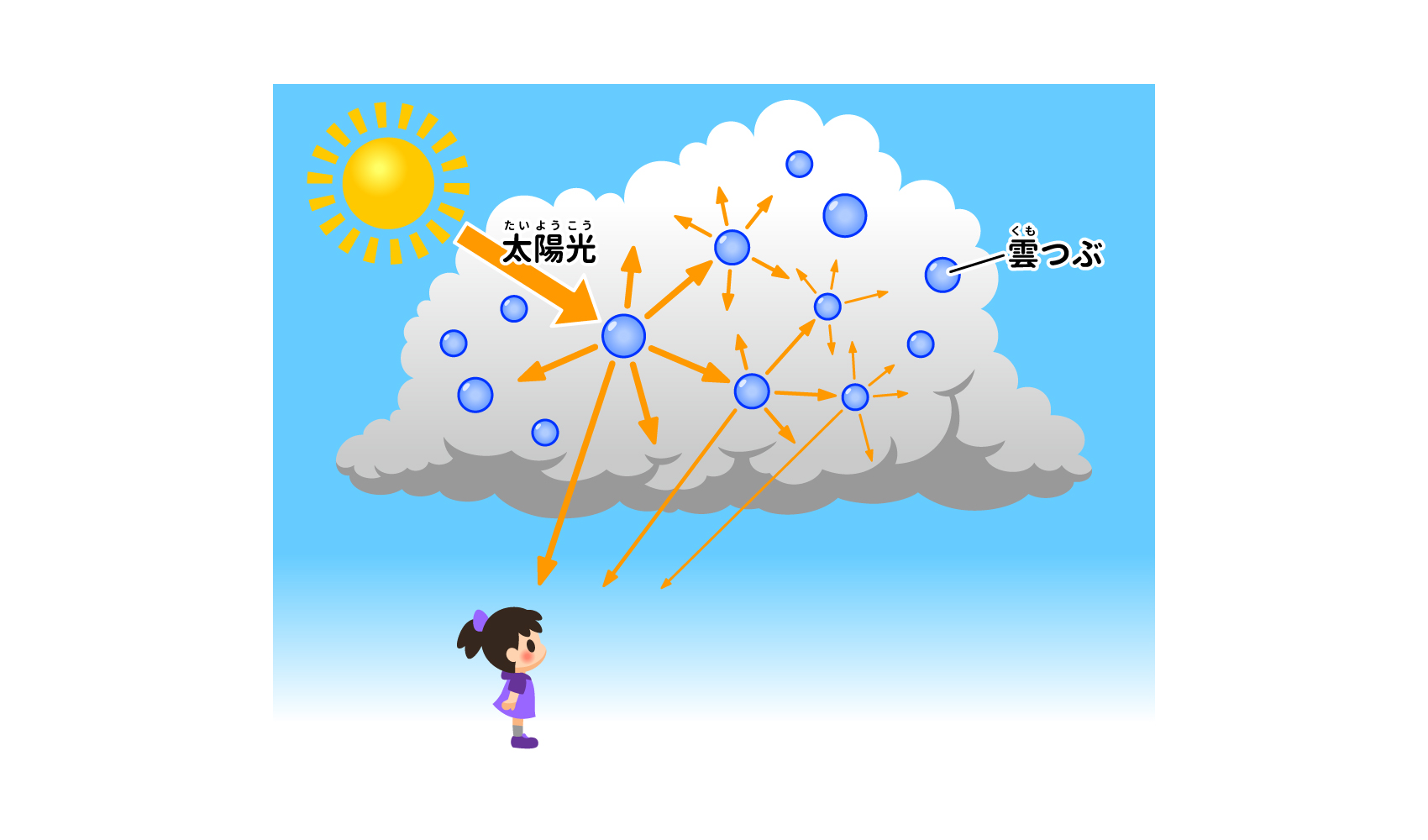
This is because the sun's rays hit the cloud particles and scatter (scatter) light here and there1). How much light coming from the sun is scattered in a cloud and how much light can pass through it (transmission) determines the color of the cloud.
Sunlight is scattered in various directions on the surface of cloud particles, some of which penetrate directly through the cloud particles, and some of which hit other cloud particles and are further scattered. Through these repeated scattering and transmission processes, light reaches our eyes on the ground. If the amount of light reaching our eyes is high, the cloud appears whitish, and if it is low, it appears blackish.
To give an example. cirrostratus cloud Veil-like clouds, such as "thin clouds" (thin clouds), appear white because light passes through them easily. On the other hand, clouds like "cumulus clouds Thickly developed clouds, such as cirrus clouds, appear black because light is scattered and weakened as it passes through the cloud. In addition, clouds that produce rainfall, such as cumulus clouds, appear even darker because of their large cloud particles.
The same cloud can change color depending on where it is viewed from. For example, if you look at a distant cumulonimbus cloud from the side, the cloud appears to be a glowing white color because it has been exposed to a lot of sunlight. However, to a person below the cloud, the cloud looks completely black. The thick clouds block the sun's rays, and the clouds in the shadows appear black.
When we think of cloud colors, we think of white, gray, and black, but sometimes clouds appear to be rainbow-colored. Clouds with these mysterious colors are called "colored clouds.
A tinted cloud is a phenomenon that occurs when the sun's rays are scattered or bent as they pass between cloud particles, causing interference between the rays. This often happens when a "cirrocumulus" (scaly cloud) or "altocumulus" (cirrocumulus) cloud passes near the sun.
In Buddhist sculptures and paintings, clouds in five different colors sometimes appear. These clouds are called "Keiun" or "Zuikumo," meaning "good omens" or "auspicious clouds.
In winter, the probability of colored clouds appearing increases due to the atmospheric pressure pattern. In this season, we tend to shrink in the cold and walk around looking down, but if you look up at the sky on a clear day, you may be able to see colorful clouds.
Sunlight is red, orange, yellow, green, blue, purple, and other colors. visible ray are made up of a mixture of the two, and these appear white when mixed together. The color of each is wavelength However, since the cloud particles are larger than the wavelength, light of any color can be scattered. This is called "Mie scattering.
Article published: March 2022
reference data
(1) Kentaro Araki, "Understanding all the mysteries of the sky! The Amazing Illustrated Book of the Weather".2021.KADOKAWA
(2) Maie Kikuchi, "Tokimekuru Kumo Zukan" [Illustrated Book of Exciting Clouds]. 2020. Yama-Tokeyosha
Supervisor: Mitsuharu Oyama
Born in Tokyo in 1957. Completed a master's degree at Tokyo Institute of Technology. After working as a physics teacher at a high school, a chief instructor at Chiba Prefectural Board of Education, and principal of Chiba Prefectural Chousei High School, he is currently a professor at Shumei University School Teachers' College, where he teaches lectures and exercises on teaching methods for "Science and Mathematics Exploration" and "Integrated Learning Time". He has appeared in many science experiment classes and TV experiment programs. He is also a project advisor for the Chiba City Science Museum, an executive director of the Japanese Society of Physics Education, a member of the Japanese Society for Science Education and the Japanese Society for Science Education, and a member of the editorial board of the monthly magazine "Science Education.