





How do cumulus clouds form?
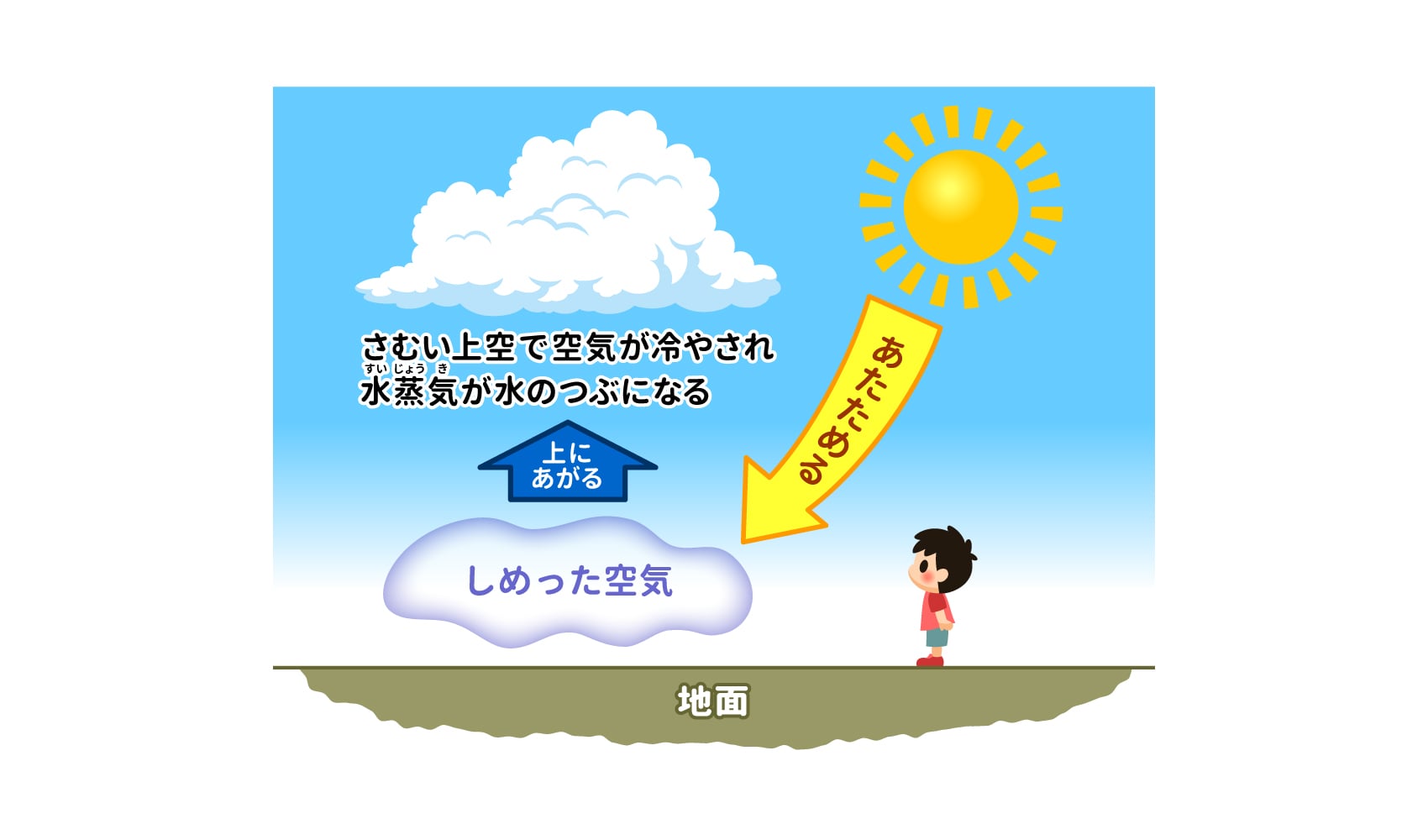
Solution: Warm, moist air is lifted high with great energy.
Iridocumulus clouds, which are often seen in the summer sky, are clouds that dump heavy rain in a short period of time (30 minutes to an hour) over a narrow enclosure1). The name "irido" comes from the fact that the shape of the cloud resembles a large, powerful monk called "irido," and that the cloud resembles an irido with a powerful hump. In meteorological terms, these clouds are called "cumulonimbus clouds.
Cumulonimbus clouds range in size from a few kilometers to more than a dozen kilometers, and are more than 10 kilometers high. How are such large cumuliform clouds formed? First, let's look at how clouds are formed (see related articles "What are clouds made of and how are they formed?) Clouds are created by an updraft, a flow of air that rises into the sky. One of the reasons for updrafts is that the air near the ground is warmed. When a mass of air heats up, its volume increases and it becomes lighter than the surrounding air, causing it to rise.
Because of the low atmospheric pressure above, the rising air mass expands further. Since air has the property of decreasing in temperature as its volume increases, the temperature of the air mass decreases as it rises. The air then reaches the maximum amount of water vapor that it can contain (saturated water vapor content), and a bubble of water or a block of ice is formed. These float in the air above and become clouds.
There are three conditions that facilitate the formation and development of cumulonimbus clouds: [1] unstable atmospheric conditions, [2] warm, moist air, and [3] energy to lift the air high.
[The "unstable atmospheric conditions" described in [1] refers to a state in which there is a layer of cold air above and a layer of warm air on the ground, and the temperature difference between the two is large enough to cause strong updrafts to occur easily. [The warm, moist air in (2) is the "source" of clouds. [The "lifting energy" in [3] refers to the heat called "condensation heat" that is generated when water vapor becomes water when clouds form. This heat causes the cloud to expand, creating a buoyancy force that lifts the cloud higher.
Thus, when there is strong cold air in the sky, when the air near the ground is warmed by strong sunlight, or when there is warm moist air, clouds grow vertically under their own power and form cumulonimbus clouds that reach more than 10 km above the ground.
Cumulonimbus clouds that have produced heavy rain gradually weaken and disappear within 30 minutes to an hour2). However, if there is a large temperature difference between the sky and the ground, and warm moist air flows in one after another near the ground, a cumulonimbus cloud with a structure that does not easily weaken in energy may form and continue to produce heavy rainfall for several hours. This type of cumulonimbus cloud is called a "supercellular cumulonimbus" (supercell). Supercells are believed to be one of the causes of guerrilla downpours, tornadoes, and downbursts.
reference data
(1) Ministry of Land, Infrastructure, Transport and Tourism, Japan Meteorological Agency, "What kind of cloud is a cumulonimbus cloud?":https://www.jma.go.jp/jma/kishou/know/tenki_chuui/tenki_chuui_p2.html
(2) Hokkaido Government, "Gerrilla Torrential Rain," Global Warming Prevention Study Group Newsletter, March 28, 2013, No. 21: http://www.pref.hokkaido.lg.jp/ns/nkk/grp/ondanka_21.pdf
Supervisor: Mitsuharu Oyama
Born in Tokyo in 1957. Completed a master's degree at Tokyo Institute of Technology. After working as a physics teacher at a high school, a chief instructor at Chiba Prefectural Board of Education, and principal of Chiba Prefectural Chousei High School, he is currently a professor at Shumei University School Teachers' College, where he teaches lectures and exercises on teaching methods for "Science and Mathematics Exploration" and "Integrated Learning Time". He has appeared in many science experiment classes and TV experiment programs. He is also a project advisor for the Chiba City Science Museum, an executive director of the Japanese Society of Physics Education, a member of the Japanese Society for Science Education and the Japanese Society for Science Education, and a member of the editorial board of the monthly magazine "Science Education.