





How do airplane clouds form?
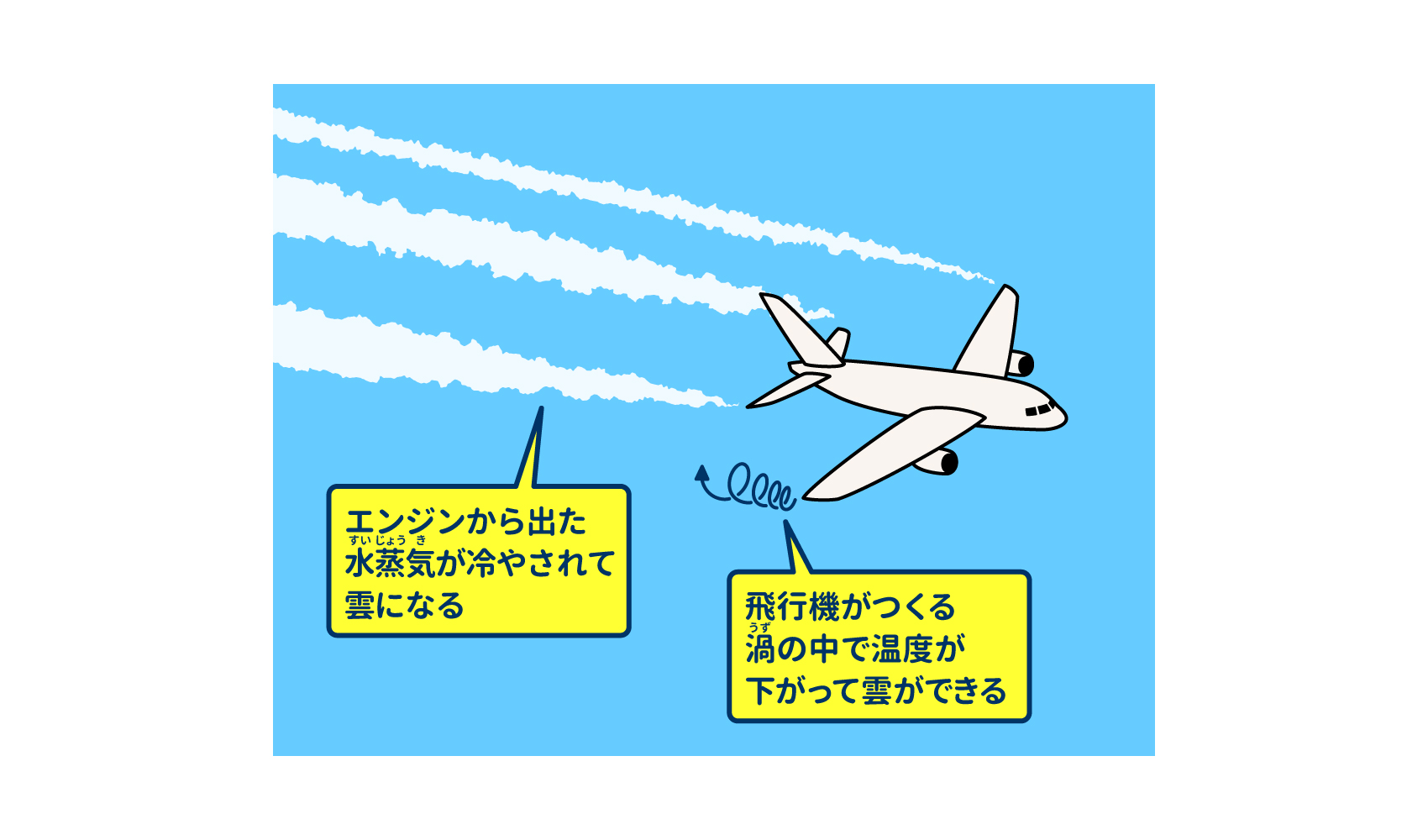
Answer: Some are created by the exhaust and some by the vortex around the brim.
The white, elongated airplane clouds that remain after an airplane flies away. This is not smoke ejected from the engine, but a cloud made of water droplets and ice crusts. How are they formed?
There are two main types of airplane clouds: the first is created by engine exhaust (exhaust gas), which often appears behind horizontally flying airplanes, and the second is created by the exhaust gas from the engine itself, which often appears behind horizontally flying airplanes. The principle is the same as the whiteness of one's breath on a cold winter day1).
Fuel for airplanes is made from gasoline and kerosene, the main components of which are hydrocarbons. When they burn, carbon is converted into carbon dioxide and hydrogen into water. However, because the temperature of the exhaust gas is high (300-600℃), the water is released into the air as water vapor.
On the other hand, airplanes usually fly at a height of about 10,000 m (10 km) above the ground, and the ambient temperature is below -40°C (-40°F). The lower the temperature, the less water vapor the air can contain (saturated water vapor content), so when exhaust gas containing water vapor is released from an airplane engine, the air around the exhaust gas quickly reaches its saturated water vapor content. This causes the water vapor in the exhaust gas to turn into crumbles of water and ice, which eventually form clouds (see related article, "How Clouds Are Form ed").
The number of airplane clouds may appear to be two, three, or even four. This number is approximately the same as the number of aircraft engines, so it may be interesting to deduce the aircraft model from the number of airplane clouds. However, it is also possible to see two of each of the four airplane clouds together.
Now, there was another type of airplane cloud. It is created by vortices that occur at the edge of the plane's wings and can form when the plane makes a sharp turn.
The wings of an airplane have a rounded upper side when viewed in cross section. As the airplane moves forward, the airflow through the upper side of the wings speeds up, causing the air pressure above the wings to drop. This creates an upward force (lift force) 2). At the edge of the wings, the difference in pressure between the top and bottom of the wings creates a vortex that rotates from bottom to top. At the center of this vortex, the air expands due to the drop in atmospheric pressure, which also lowers the temperature. As a result, the air in the vortex reaches saturated water vapor content and clouds are formed.
Have you ever heard that "long airplane clouds make it easy to rain"? This is one of the "viewpoint watchpoints" that predict weather changes based on familiar natural phenomena. For airplane clouds to form, the temperature must be low and the humidity must be high. The fact that airplane clouds do not disappear easily and remain for a long time means that these conditions are in place. When a low-pressure system is approaching, the sky often begins to be covered by moist air, so the fact that airplane clouds do not disappear easily can be considered a sign that rain is approaching3).
reference data
(1) "ANA Trivia Vol. 25 What are the airplane clouds in the sky made of?" ANA Travel &Life:
https://www.ana.co.jp/travelandlife/trivia/vol25/l
(2) Hiroyuki Uchida. The Story of the Vortex," IHI Technical Journal.2011.Vol.51 No.3: https: //www.ihi.co.jp/var/ezwebin_site/storage/original/application/c7eb5b93cedfa605f2ef33119e3bd38d .pdf
3) "How Airplane Clouds Form: What's Their Relationship to the Weather?" Weather News": https://weathernews.jp/s/topics/202004/220135/
Supervisor: Mitsuharu Oyama
Born in Tokyo in 1957. Completed a master's degree at Tokyo Institute of Technology. After working as a physics teacher at a high school, a chief instructor at Chiba Prefectural Board of Education, and principal of Chiba Prefectural Chousei High School, he is currently a professor at Shumei University School Teachers' College, where he teaches lectures and exercises on teaching methods for "Science and Mathematics Exploration" and "Integrated Learning Time". He has appeared in many science experiment classes and TV experiment programs. He is also a project advisor for the Chiba City Science Museum, an executive director of the Japanese Society of Physics Education, a member of the Japanese Society for Science Education and the Japanese Society for Science Education, and a member of the editorial board of the monthly magazine "Science Education.