





Why does it snow?
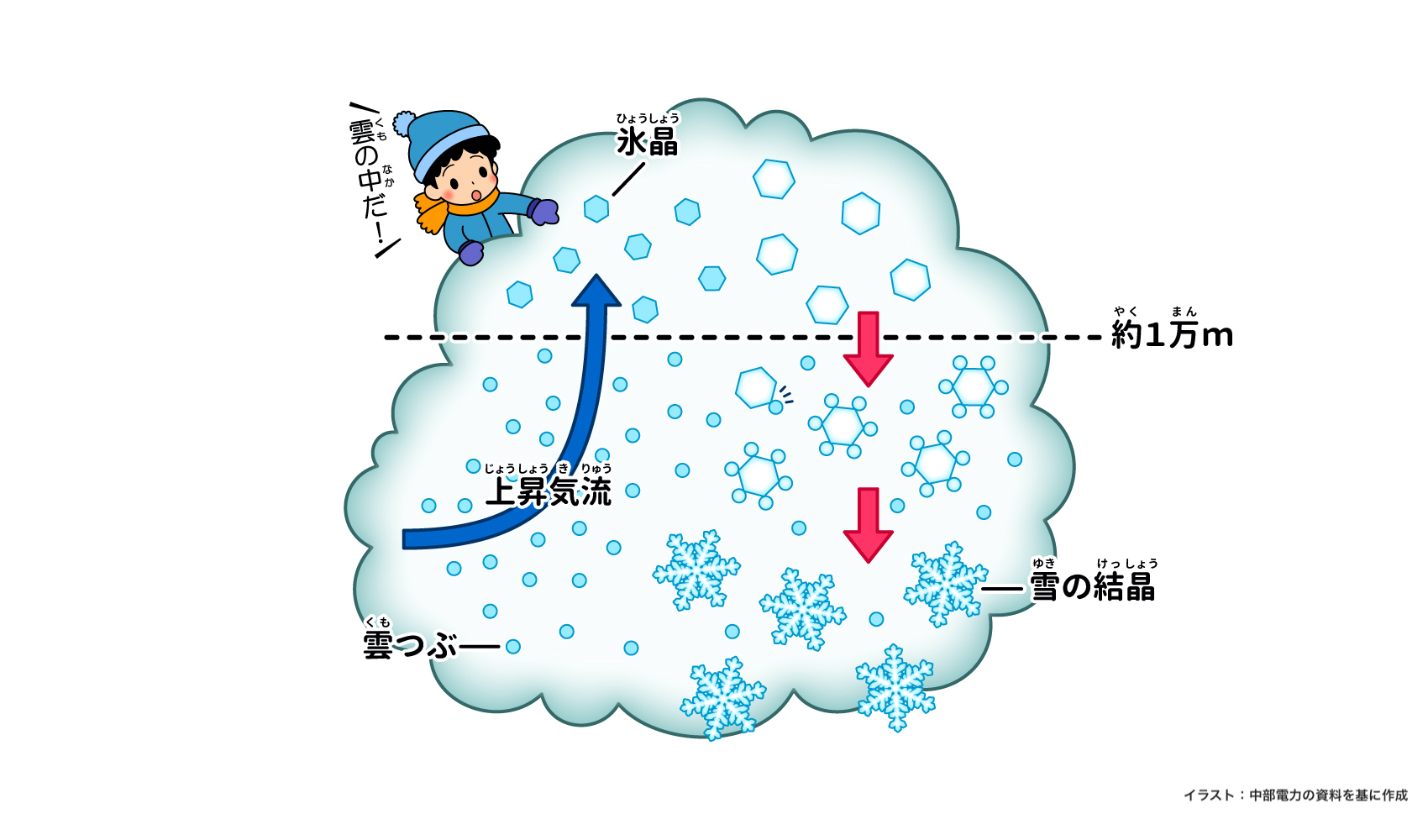
Answer: This is because the ice crumbles form into crystals and fall in the clouds.
Snow, like rain, is born in the clouds and falls to the ground. In other words, the "source" of both snow and rain is in the clouds. How is snow born? And what is the difference between snow and rain?
Clouds are made up of many water droplets called "cloud particles" and ice crystals called "ice crystals" (see the article "What are clouds made of?) They are also the "source" of snow and rain. Cloud particles and ice crystals grow large and heavy, and eventually fall to the ground1). Let us follow this process.
First of all, cloud particles have a radius of only about 0.001 to 0.01 mm (1 to 10 μm, or about one-fifth the thickness of a human hair) at first. As an updraft, a flow of air up into the sky, occurs where clouds form, the small, lightweight cloud particles are carried up by the updraft. Eventually, cloud particles reach a height of 10,000 m (10 km) above the ground, where the temperature drops below -40°C (-40°F), and collapse to form ice crystals*.
The ice crystals grow larger as they take in surrounding water vapor, and when they are large enough to fall against the updrafts, they collide with surrounding cloud particles as they fall through the clouds. The cloud particles that collide with each other are then knocked off the surface of the ice crystal, and grow while merging with the surrounding cloud particles (see related article, "Why are snow crystals hexagonal?) The snow crystals thus formed continue to grow as they rotate and fall to the ground.
The snow crystals grow large, but because the temperature is higher in the air as they fall than in the air above the floating clouds, they usually melt and turn into raindrops. Most of the rain that falls in the vicinity of Japan melts during the fall of ice and snowflakes in this way. The ice cubes only fall as snow when the temperature near the ground is low enough to prevent the snow from melting (see related article, "Why Does Snow Only Fall in Winter?) It is said that snow falls on the Sea of Japan side when the temperature on the ground is below 2 to 3°C, and on the Pacific side when it is below 1 to 2°C2).
However, it is not only the temperature near the ground that determines whether it is snowing or raining; in fact, there are records of snow falling even when the temperature is around 10℃. One of the conditions that determines whether it snows or rains is the humidity (relative humidity) at the time of snowfall3). When the humidity in the center is low, the water created by melting snowfall evaporates more easily. When this water evaporates, it cools the air around it, making it easier for the snow that falls later to reach the ground surface without melting.
Hail and hail are similar to snow. In weather observation, hail is defined as snow crystals with a diameter of 5 mm or more, and hail is defined as snow crystals with a diameter of less than 5 mm4). Hail is seen from summer to autumn when temperatures are high, and hail is seen in winter when temperatures are low5).
Hail and hail grow in size as their surfaces melt and scald as they rise and fall in cumulonimbus clouds (see related article, "How Does Hail Fall?) (Related article: "How does hail fall?"). (See related article, "How does hail fall?") Once it reaches a certain size, it cannot be carried upward by the updrafts because of its high falling speed, and it falls as an icy mass. Hail with a diameter of 50 mm falls at speeds of 100 km/h or more, so be careful.
Normally, water melts at 0°C, but in clouds, cloud particles exist in a watery state even at temperatures lower than 0°C. Such water droplets are called "supercooled cloud particles. Such water droplets are called "supercooled cloud particles. Supercooled cloud particles can be observed even in clouds at -20°C.
Article published: March 2021/p>
reference data
1) Kentaro Araki (Meteorological Research Institute, Japan Meteorological Agency, Laboratory 2). Studies on Microphysical Processes of Clouds:
https://www.mri-jma.go.jp/Dep/typ/araki/cloud_microphysics.html
2) Matsuo, Keiyo. What Separates Snow from Rain. Meteorological Society of Japan:
https://www.metsoc.jp/tenki/pdf/2001/2001_01_0033.pdf
3) Takeda, Takao. Weather Books 015: The Science of Rain. 2005. Yamado Shoten
(4) Weathernews, "Hail and Hail: The Difference and Dangers," Weathernews:
https://weathernews.jp/s/topics/202004/160165/
5) Katsuhiro Kikuchi, Weather Books 028: The World of Snow and Lightning. 2009. Seizando Shoten
Supervisor: Mitsuharu Oyama

Born in Tokyo in 1957. Completed a master's degree at Tokyo Institute of Technology. After working as a physics teacher at a high school, a chief instructor at Chiba Prefectural Board of Education, and principal of Chiba Prefectural Chousei High School, he is currently a professor at Shumei University School Teachers' College, where he teaches lectures and exercises on teaching methods for "Science and Mathematics Exploration" and "Integrated Learning Time". He has appeared in many science experiment classes and TV experiment programs. He is also a project advisor for the Chiba City Science Museum, an executive director of the Japanese Society of Physics Education, a member of the Japanese Society for Science Education and the Japanese Society for Science Education, and a member of the editorial board of the monthly magazine "Science Education.