


How salty is seawater?
Answer: The salinity of seawater is about 3.4%.
The term "salinity" is used to describe the concentration of salt in water. The approximate salinity of seawater is 3.4%. This means that 100 g of seawater contains about 3.4 g of salt. However, this does not mean that the salt concentration is the same in all oceans around the world. It varies from sea area to sea area, ranging from 3.1 to 3.8%.
Why is there a difference in salinity? This is because seawater evaporates in hot areas, freshwater flows in from rivers near estuaries, and ice forms and melts in the Arctic and Antarctic. Salinity increases as water evaporates and decreases as fresh water flows in. When ice is formed, salt is pushed out and only fresh water is stirred up, thus increasing the salinity2) . When the ice melts, the salinity is reduced by the amount of fresh water.
For example, the salinity in the North Pacific Ocean between 0 and 70°N averages 3.41%, while in the North Atlantic Ocean at the same latitude, the salinity is on average 3.54%. This is related to the "trade winds" generated in the Atlantic Ocean, which blow from east to west over the equator. The trade winds carry warm, moist air from the water vapor-generated North Atlantic to the Pacific, bringing rain to the North Pacific. The evaporation of water in the Atlantic increases salinity, while rainfall in the Pacific lowers salinity.
So far, we have discussed the "surface layer" (mixed layer), which is shallower than 150 m in depth. However, seawater moves differently in the thermocline, which is several hundred meters deep, and in the deep layer, which is approximately 1,000 meters or less. Deep water, which accounts for 80% of all seawater on the earth, moves around the world's oceans due to differences in temperature and salinity.
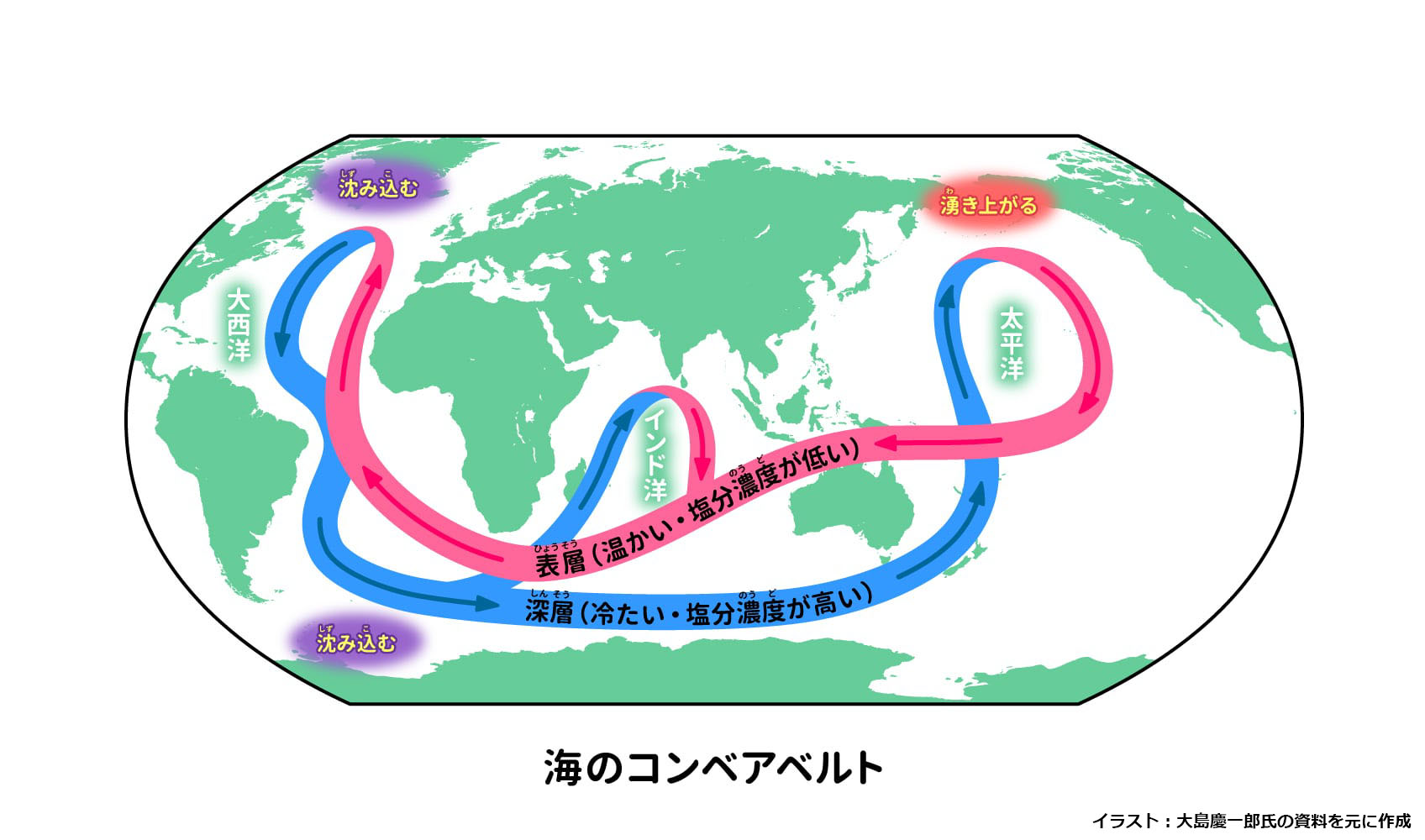
Let's follow the movement of deep water starting in the Arctic Ocean. In the icy Arctic Ocean, seawater with low temperature and high salinity is produced. Part of this water flows out into the North Atlantic Ocean and sinks off the coast of Greeland3). The cold, salty seawater is heavier, so it sinks downwards*.
This deep water then moves southward across the Atlantic Ocean and joins with deep water created near Antarctica, and then moves northward, separating into the Indian and Pacific Oceans. Under the influence of topography and weather, the deep water gradually rises to the surface and becomes surface water. Then, the flow warmed by the surface layer of the Pacific Ocean heads toward the Indian Ocean, merges with the surface water of the Indian Ocean, returns to the North Atlantic, and sinks again. This circulation of seawater is called the "ocean conveyor belt.
The ocean conveyor belt is a very slow cycle, taking on average 1,500 to 2,000 years to complete one revolution. Small differences in salinity create a global circulation that takes an unnervingly long time.
The mass (weight) per volume (1 cm3 for water) of a substance is called its "density. The density of seawater is determined by temperature and salinity; the lower the temperature and the higher the salinity, the greater the density.
reference data
(1) Japan Landfill Dredging Association. Umidas #015, Basic Course of the Sea, Umidas #015 Seawater (Ingredients)," Marine Voice 21, January 2008, Vol. 259: https://www.umeshunkyo.or.jp/207/259/index.html
(2) Japan Coast Guard, 1st Regional Coast Guard Headquarters, Sea Ice Information Center, "Sea Ice Knowledge": https://www1.kaiho.mlit.go.jp/KAN1/drift_ice/knowledge/knowledge.html
(3) Division of Ocean Sea Ice Dynamics, Institute of Low Temperature Science, Hokkaido University, Keiichiro Oshima. Oceanic General Circulation Produced by Ice (1) Oceanic General Circulation Determined by Salt": http://wwwoa.ees.hokudai.ac.jp/readings/2010/ohshima_ice-ocean01.html
Supervisor: Mitsuharu Oyama

Born in Tokyo in 1957. Completed a master's degree at Tokyo Institute of Technology. After working as a physics teacher at a high school, a chief instructor at Chiba Prefectural Board of Education, and principal of Chiba Prefectural Chousei High School, he is currently a professor at Shumei University School Teachers' College, where he teaches lectures and exercises on teaching methods for "Science and Mathematics Exploration" and "Integrated Learning Time". He has appeared in many science experiment classes and TV experiment programs. He is also a project advisor for the Chiba City Science Museum, an executive director of the Japanese Society of Physics Education, a member of the Japanese Society for Science Education and the Japanese Society for Science Education, and a member of the editorial board of the monthly magazine "Science Education.