





How can a boat run on water?
Leaves and sponges will float in water, but glass, stones, nails, and other objects will be sullied by water.
Let us first consider the case of a sponge.
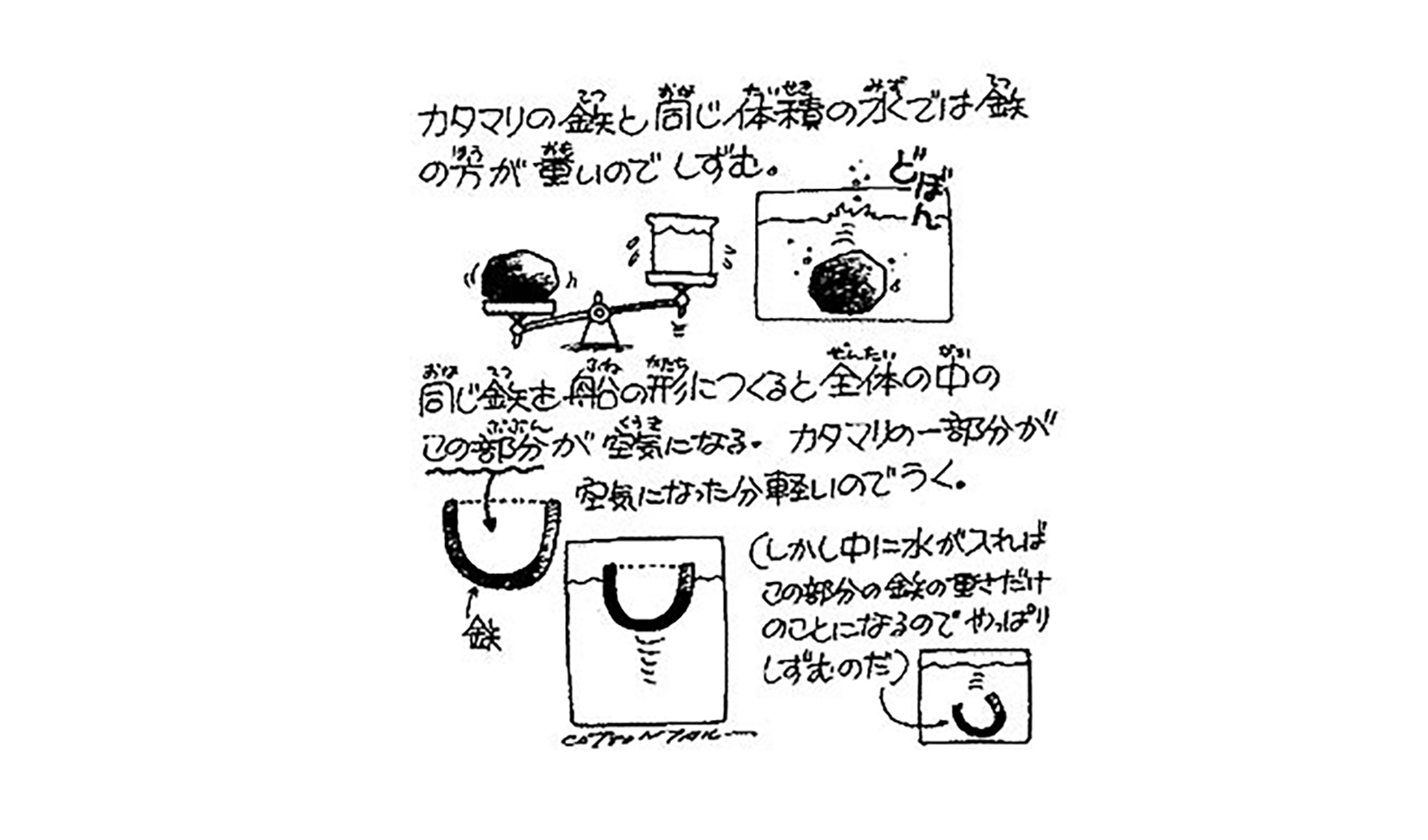
Suppose there is a sponge and a mass of water of exactly the same size and shape (the same volume). Comparing the weights of the two, the sponge is naturally lighter than the water. In such a case, the object will float in water.
Now let us consider the case of a stone. Comparing the stone with a lump of water of the same size and shape (the same volume), the stone is heavier than the water, and in such a case, the object will sink into the water.
In other words, whether an object will sink or sink in water is determined by whether it is lighter or heavier than a lump of water of the same size and shape (of the same volume). Of course, if it is lighter than water, it will float, and if it is heavier, it will sink.
How about a ship? A large ship is made of steel. Iron weighs more than water, so if the ship were made entirely of iron, it would sink. However, even if the ship is made of iron, the outside and the framework are only made of iron, and there are many rooms and other spaces inside. In other words, it can be said that the inside of the ship is almost empty, just the outside. Therefore, if we compare this ship to a body of water of exactly the same size and shape, the ship is lighter than the water.
Therefore, the boat can float in the water and run at a higher speed by turning the screws with the engine.