





What is a "linear precipitation zone?"
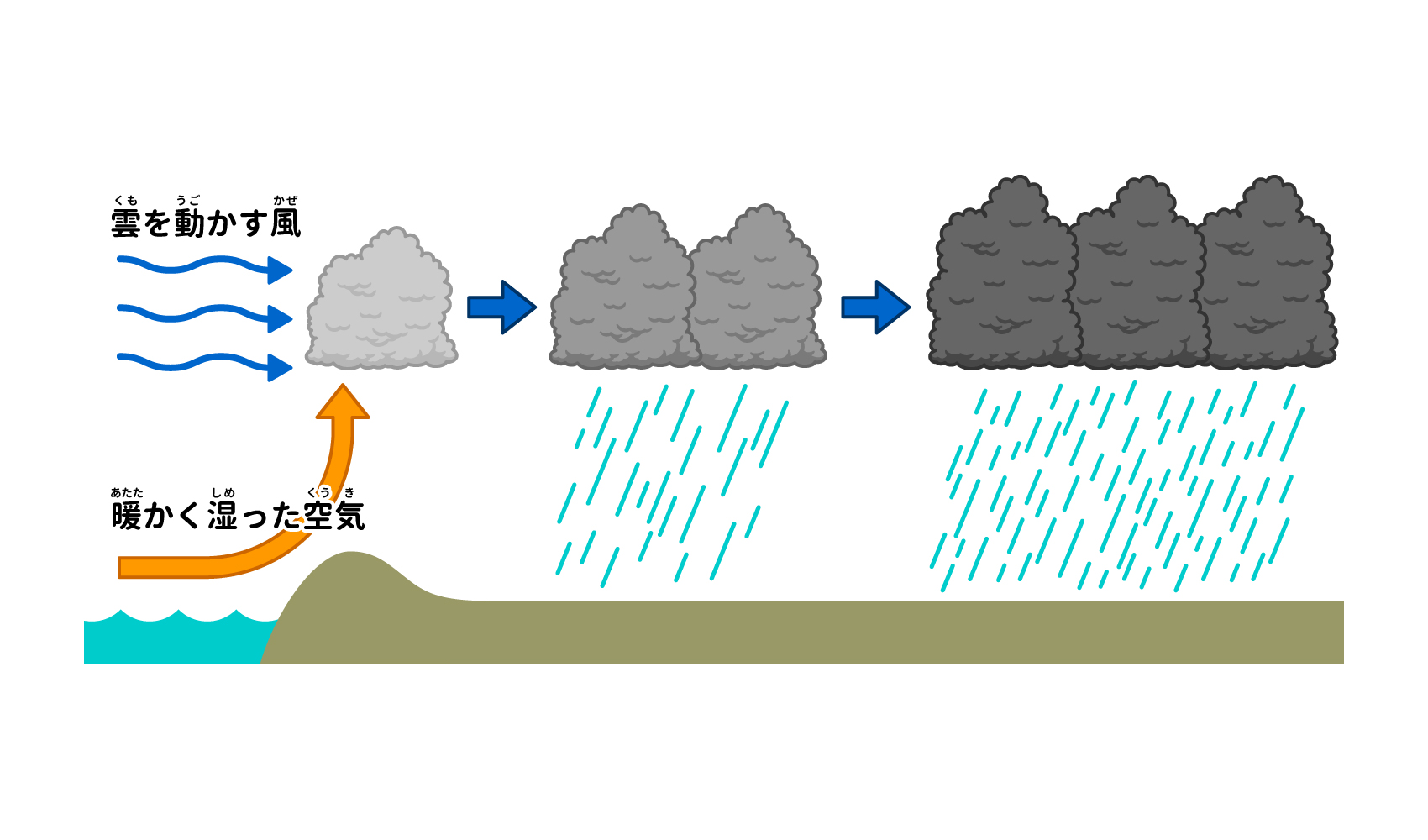
Answer: This is an area of intense rainfall formed when cumulonimbus clouds form in lines and pass over the same area.
On June 1, 2022, the Japan Meteorological Agency launched the "Linear Precipitation Zone Forecast. The purpose is to reduce damage from heavy rainfall by informing people in the region that "linear precipitation zones are likely to occur. The term "linear precipitation zone" is one that we hear more and more as summer approaches, but what exactly is it?
A linear precipitation zone is an area of rain created by a series of cumulonimbus clouds that pass through or stagnate in approximately the same location1). 1) It is so called because the rainfall area is elongated in weather radar images. While ordinary cumulonimbus clouds are only a few kilometers to a dozen kilometers wide and produce rainfall for 30 minutes to an hour, linear precipitation bands produce very heavy rainfall for several hours, which can cause landslides and other disasters.
The formation of linear precipitation zones can be divided into several patterns depending on the direction and shape of the wind2). The most common of these is the "back-building" type3). After cumulonimbus A develops at a certain location and moves with the wind in the sky, cumulonimbus B develops behind it (upwind), and then cumulonimbus C develops behind it carried by the wind...and so on, until a line of cumulonimbus clouds is formed. Even if the momentum of cumulonimbus A weakens due to rainfall, cumulonimbus B and C come up behind it, so that heavy rain continues to fall for a long time.
There are four major conditions for the development of linear precipitation zones: first, there must be a continuous flow of warm, moist air near the ground, which is the source of cumulonimbus clouds; second, there must be a front or topography that can easily lift the warm, moist air to higher elevations; third, atmospheric conditions must be unstable, making it easier for cumulonimbus clouds to develop; and fourth, there must be a high enough level of precipitation to cause the formation of cumulonimbus clouds, Third, unstable atmospheric conditions tend to cause the development of cumulonimbus clouds. The fourth is that cumulonimbus clouds can form into lines under the influence of the winds above.
The term "linear precipitation zone" is a new term that has been used frequently since around 2014, when a torrential rain disaster occurred in Hiroshima Prefecture. Based on the results of this research, the linear precipitation zone forecast has been made possible by strengthening the observation system.
The entire country is divided into 11 blocks, and the following message is issued: "In the XX region, there is a possibility that a linear precipitation zone will develop on the night of ▲ and the risk of occurrence of a heavy rainfall disaster will increase sharply. Locations where particularly heavy rainfall is expected and the expected rainfall for 24 hours will also be announced.
When you see or hear this information, you are required to check heavy rainfall warnings and evacuation information issued by municipalities and determine what action you should take. For example, stay away from cliffs or evacuate before the rain begins to fall to ensure your own safety.
Article published: July 2022
reference data
(1) Japan Meteorological Agency, "JMA's Flood Countermeasures (Efforts to Improve Forecast Accuracy of Linear Precipitation Zones and Support Local Disaster Prevention):
https://www.jma.go.jp/jma/kishou/know/bosai/kishojoho_senjoukousuitai.html
2) Hiroshige Tsuguchi, "Linear Precipitation Zones," Weather, September 2016. Meteorological Society of Japan: https://www.metsoc.jp/tenki/pdf/2016/2016_09_0011.pdf
(3) Weathernews, "What is a linear precipitation zone that brings torrential rain?" : https: //weathernews.jp/s/topics/201707/070145/
(4) Japan Meteorological Agency, "Various Information on Linear Precipitation Zones": https://www.jma.go.jp/jma/kishou/know/bosai/kishojoho_senjoukousuitai.html
Supervisor: Mitsuharu Oyama
Born in Tokyo in 1957. Completed a master's degree at Tokyo Institute of Technology. After working as a physics teacher at a high school, a chief instructor at Chiba Prefectural Board of Education, and principal of Chiba Prefectural Chousei High School, he is currently a professor at Shumei University School Teachers' College, where he teaches lectures and exercises on teaching methods for "Science and Mathematics Exploration" and "Integrated Learning Time". He has appeared in many science experiment classes and TV experiment programs. He is also a project advisor for the Chiba City Science Museum, an executive director of the Japanese Society of Physics Education, a member of the Japanese Society for Science Education and the Japanese Society for Science Education, and a member of the editorial board of the monthly magazine "Science Education.