





How did humans evolve?
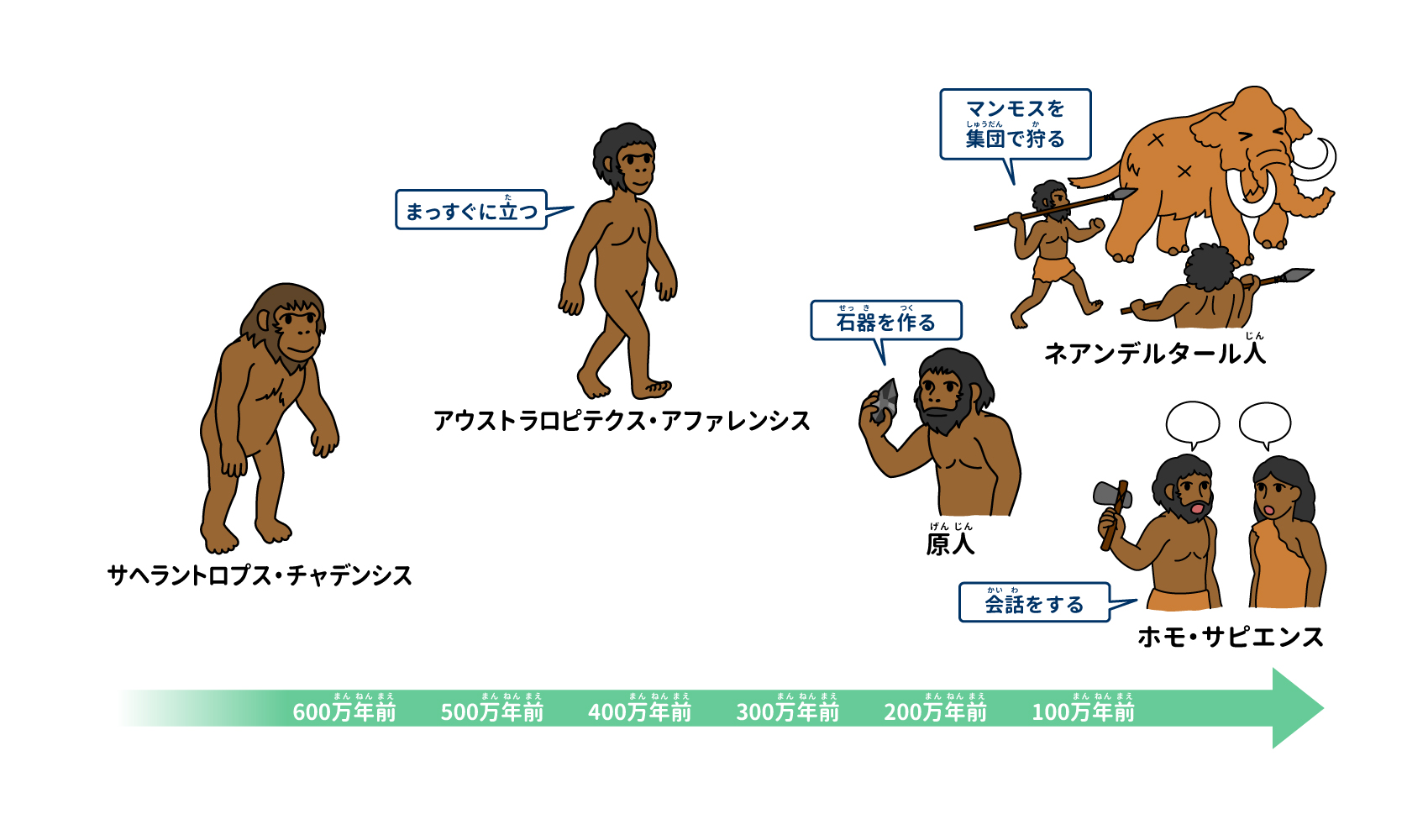
Answer: ancestors born in Africa 7 million years ago evolved slowly.
Humans (humans) evolved by branching off from a common ancestor with chimpanzees and other apes (see related article, "When Did Humans Divide from Monkeys?"). The most common ancestor found today is the human. Sahelanthropus chadensis is said to be the closest hominid to our common ancestor yet discovered, and is thought to have lived in Africa 7 to 6 million years ago1). 1) How did humans evolve from this ancestor to what we see today?
Before the 2002 announcement that Sahelanthropus chadensis was 7 to 6 million years old, the oldest known human was thought to be Australopithecus afarensis, which is 4 million years old. The fossil of a female named "Lucy" excavated in Ethiopia in 1974 indicates that her brain size was about the same as that of a chimpanzee (about 400 mL) and that she was a good tree climber2). 2) These ancestors are sometimes called "ape-men" because they possessed characteristics of both apes and humans.
Apes were able to stand upright and walk on two legs. This "upright bipedal walking" is a major event in human history. The reason is that walking on two legs enables us to do many things3). For example, they can see farther, making it easier to spot enemies; they look bigger and stronger than if they stood on four legs; they have an advantage in hot grasslands because the area exposed to the sun is smaller when they stand on two legs; and they can walk on their hands. Even better, they can carry things and use tools with both hands*. One can imagine that the use of their hands allowed them to be more dexterous, and their brains developed as well.
Two million years ago, a group called "proto-humans" emerged, with a brain size of about 1,000 mL. They made tools made of stone (stone tools) and were able to use fire, which allowed them to live in Europe and Asia, which were colder than Africa.
Similarly extinct were the "Neanderthals," who lived in Europe from 400,000 to 40,000 years ago. Their brain size was larger than that of present-day humans, about 1500 mL, and they wore clothes and accessories made of animal teeth and shells, and painted in caves4). Although Neanderthals are thought to have died out due to the cold, traces of their lives remain today. A genetic study of the present humans has revealed that they inherited Neanderthal genes5).
Homo sapiens, which appeared in Africa 300,000 years ago, 6) lived at the same time as Neanderthals and eventually spread around the world in place of Neanderthals. The Homo sapiens "Cro-Magnon" found in France in 1868 is thought to be part of the ancestors of modern Europeans. What differentiates Homo sapiens from earlier humans is that it became fluent in language. They were able to think in complex ways and adapt to different environments. Eventually, they left Africa for Europe, Asia, Australia, and the Americas.
Thus, since humans parted from the chimpanzee genus and began to evolve, several species of humans have been born and disappeared. This is a very long path, and the only way to solve the riddle is to infer it from fossils, remains, genes, and so on. Therefore, if new fossils or remains are found, or if new information is obtained from genes, history will change dramatically. Homo sapiens means "wise man" or "wise man" in Latin. We can be sure that smart people will continue to use science to solve the riddles of evolution.
The word "evolution" has appeared many times so far. Have you ever thought about its meaning? A Japanese dictionary says, "The change of an organism from a simple body structure to a more complex and advanced one over a long period of time" or "The gradual improvement of a thing" (Sanseido "Exegetical Dictionary of the Japanese Language for Elementary School Students, Seventh Edition"). In everyday life, "progress" and "development" are often used in the same way.
In reality, however, evolution can make organisms more complex or simpler7). In "The Origin of Species," Darwin uses the term "change transmitted across generations" to mean evolution.
In other words, "evolution" in biology and evolutionary theory simply means changing into a form suitable for the environment. It does not mean that an organism that has evolved is superior to an organism that evolved before it. Neither does evolution = progress, nor does evolution = development.
* Some people believe that the upright bipedal gait did not lead to the free use of both hands, but rather to the upright bipedal gait in order to use both hands freely8).
Article published: October 2021
reference data
1) Makoto Mitsui, Seven Million Years of Human Evolution: The Rewritten Origin of "Human". 2005. Kodansha Ltd.
2) "3.3-Million-Year-Old Bipedal Ape Man, Children Good at Climbing Trees," National Geographic Japan, July 6, 2018:
https://natgeo.nikkeibp.co.jp/atcl/news/16/b/070600202/
(3) Michael Bright/author, Hannah Bailey/painter, Satomi Horie/translator, "This is How We Became Human: An Awesome Evolutionary Journey". 2020. 2020. Kagaku-dojin
4) "[Commentary] The World's Oldest Cave Murals, and Why Are They So Shocking?" National Geographic Japan".February 26, 2018:
https://natgeo.nikkeibp.co.jp/atcl/news/18/022600087/
5) Ota, Hiroki. Introduction to Genetic Anthropology".May 2018, Chikuma Shobo.
*Part of the book can be read at "Jinbundo" (https://book.asahi.com/jinbun/article/13286641).
(6) "Humans originated 300,000 years ago, fossil discovery overturns established theory," AFPBB News, June 8, 2017: https: //www.afpbb.com/articles/-/3131217
(7) Isao Sarashina, "When people say 'evolution is not progress,' do you agree?"[Gendai Business].May 9, 2018:
https://gendai.ismedia.jp/articles/-/55458
(8) Keiichi Omoto, How Humans Were Born: The Anthropology of Genetics and Evolution. 2015. Kodansha Ltd.
Supervisor: Mitsuharu Oyama
Born in Tokyo in 1957. Completed a master's degree at Tokyo Institute of Technology. After working as a physics teacher at a high school, a chief instructor at Chiba Prefectural Board of Education, and principal of Chiba Prefectural Chousei High School, he is currently a professor at Shumei University School Teachers' College, where he teaches lectures and exercises on teaching methods for "Science and Mathematics Exploration" and "Integrated Learning Time". He has appeared in many science experiment classes and TV experiment programs. He is also a project advisor for the Chiba City Science Museum, an executive director of the Japanese Society of Physics Education, a member of the Japanese Society for Science Education and the Japanese Society for Science Education, and a member of the editorial board of the monthly magazine "Science Education.