





Sea breezes, land breezes, monsoons... How do winds change direction? Winds created by differences in the warming properties of the sea and land
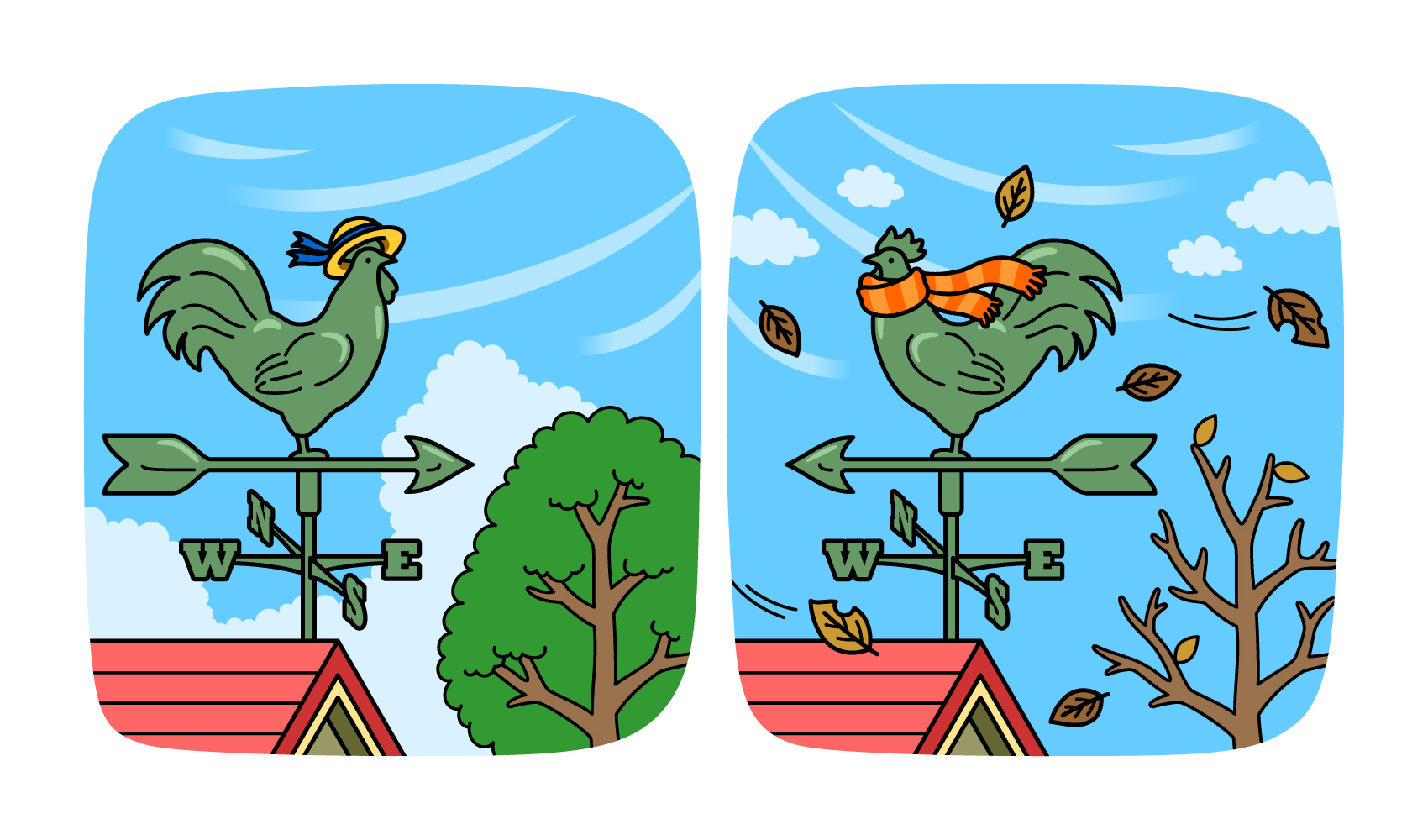
The wind that blows during the daytime turns the other way at night. Every year, the wind blows from a certain direction in summer and winter. The direction of the wind is actually determined by the difference in how easily things warm up and cool down. How does this work?
From the cool to the warm.
Have you ever felt that the soles of your feet are so hot that they almost burn when you walk on the beach in the middle of summer? However, while the beach is hot, it is not as if the seawater is hot water.
Also, if you put a metal spoon in a mug of hot cocoa and take it out after stirring it, the spoon will cool down quickly. However, the cocoa in the mug will still be warm.
This is because there is a difference in the way water (seawater) and the ground (sandy beach), and water (cocoa) and metal (spoon) warm up and cool down. Water is less likely to warm up and cool down, while the ground and metal are more likely to warm up and cool down compared to water.
This difference in ease of warming and cooling is also related to the way the wind blows.
At the seashore, the "sea breeze" blows from the sea to the land during the daytime on sunny days, and the "land breeze" blows from the land to the sea at night. This phenomenon is caused by the fact that land warms and cools more easily than the sea.
Let me explain in a little more detail.
During the daytime, when the Earth's surface is illuminated by sunlight, the land, which is easier to warm, warms faster, and the air over land is warmer. On the other hand, the oceans are not as warm as the land, and the air over the oceans is colder than the air over land.
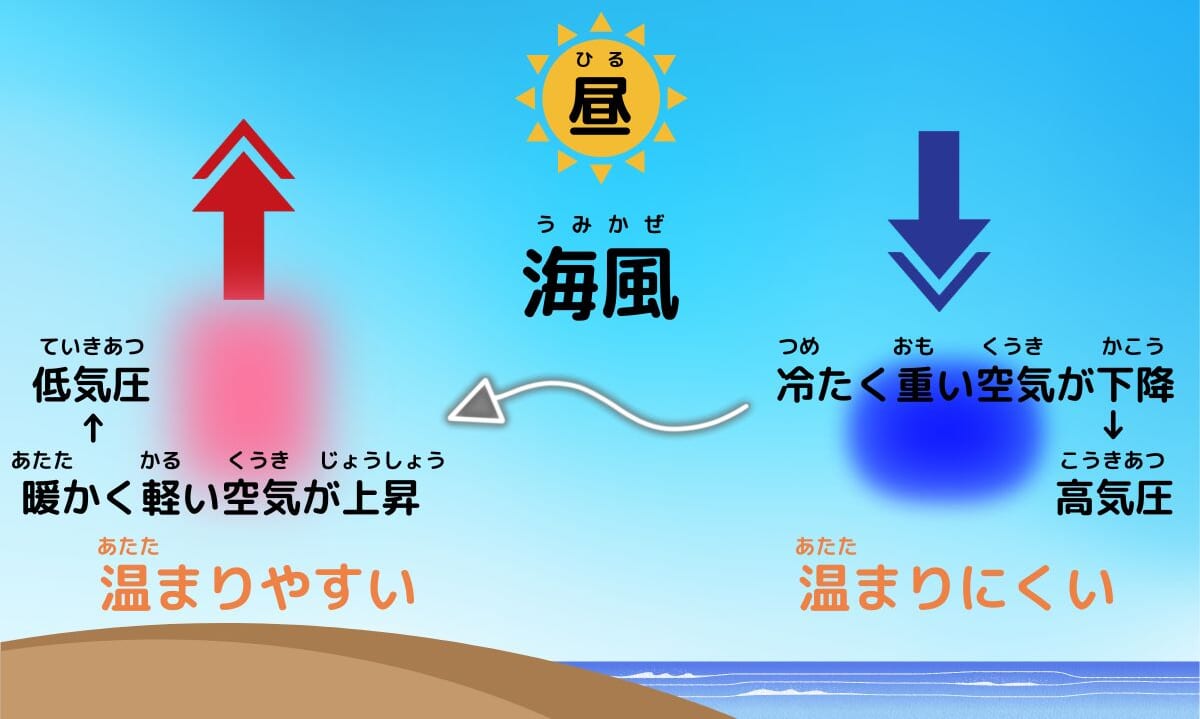
Cold air squeezes and becomes denser. This makes it heavier, so the air accumulates at the bottom. Heavy air becomes "high pressure". Conversely, warm air expands and becomes less dense and lighter, so it rises. Lighter air becomes "low pressure". When high pressure and low pressure adjoin each other, the force to eliminate the difference in pressure works, and the wind blows from the high pressure toward the low pressure. That is why wind blows from the sea to the land during the daytime.
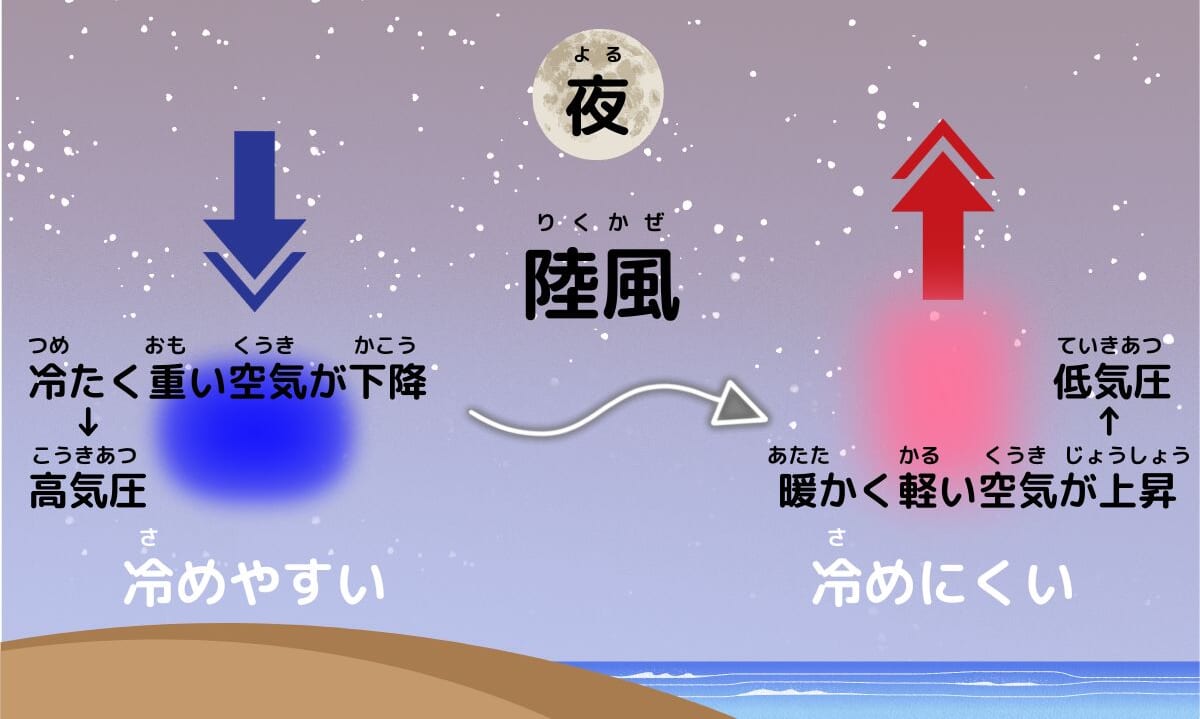
At night, the opposite phenomenon occurs. At night, when the sun does not shine, the land cools more easily than the sea, so high pressure builds over the land, which is colder than the sea, and low pressure builds over the warm sea, causing the wind to blow from the land to the sea.
In the morning and evening hours, when the sea and land breezes alternate, the winds are weaker. This is called "calm.
Global winds also affect Japan's climate
Now, sea breezes and land breezes are phenomena that occur within a relatively narrow range of tens to 100 kilometers and switch wind directions on a daily basis. There is a phenomenon that occurs over a wider area than this, between the Eurasian continent and a large ocean such as the Pacific Ocean, where the wind direction changes on a yearly basis. This is the monsoon.
In summer, the sun's altitude is higher and the earth's surface receives more of the sun's energy, raising the temperature of the land. Therefore, the land gets warmer than the oceans. In the vicinity of Japan, this means that the Eurasian continent will be hotter than the Pacific Ocean and other regions. Then, wind blows from the Sea of Japan and the Pacific Ocean to the Eurasian continent. This is the summer monsoon and is one of the causes of the rainy season in the Japanese archipelago.
Conversely, in winter, the oceans are warmer than the land because the sun's altitude is lower and the Earth's surface is less warm. This causes winds to blow from the Eurasian continent toward the Sea of Japan and the Pacific Ocean. This is the winter monsoon and is called "kinareashi" in Japan. It is the winter monsoon that brings heavy snowfall to the Sea of Japan.
This difference in the way things warm up has a lot to do with how the wind blows throughout the day and even the climate in Japan.
Text/Akiko Imai