





Why are kamakura made out of snow and why are they warm?
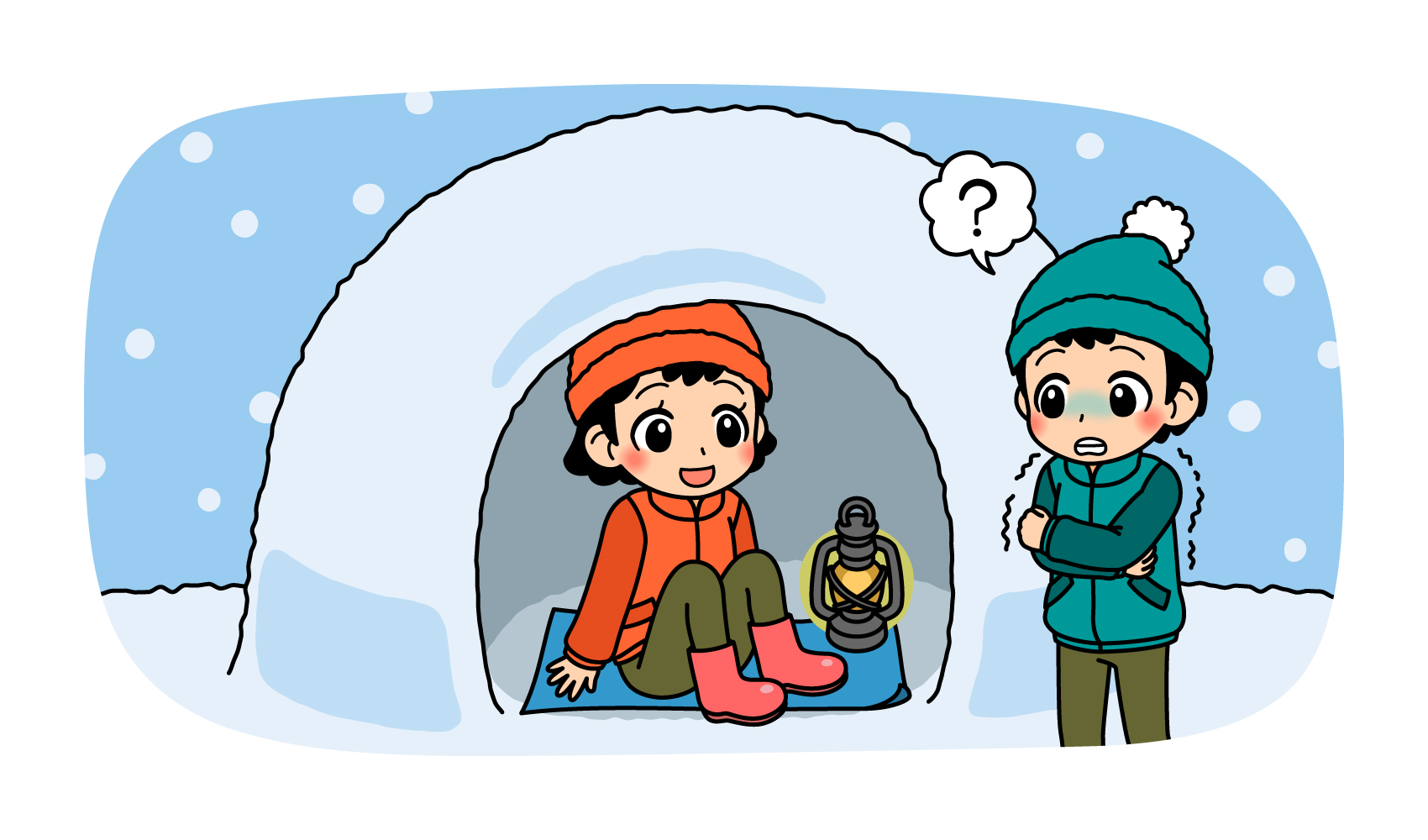
What kind of snow play do you do when it snows? There are many things you may want to try, such as building a snowman or having snowball fights. Some of you may even try your hand at building a room made of snow, called a kamakura. However, you may wonder if it is possible to freeze in a room made of snow. Actually, it is surprisingly warm inside a kamakura.
Accumulated snow has an insulating effect.
Originally, kamakura was an event held in Akita Prefecture to worship the god of water on the occasion of koshogatsu (around January 15). People pray to the water god enshrined in the front of the kamakura for safety in the home, prosperity in business, and a good harvest, and spend a relaxing time inside drinking amazake (sweet sake) and eating mochi (rice cakes). Yokote City in Akita Prefecture is especially famous for its kamakura, and the sight of the lights leaking from the kamakura lined up in rows at night is very magical.
Now let's look at why it is warmer in a snow room.
First, a wall of snow blocks the cold wind outside. Because kamakura are made with small entrances, and because these entrances are oriented to keep the wind out as much as possible, it is difficult for the cold wind to enter.
And, although it may seem surprising, snow has an insulating effect. When snow piles up, it traps air between it and the ground. Since air has a heat-transfer effect, cold air outside is less likely to be transmitted inside. This is the same mechanism that makes you warmer when you wear layers of clothes in winter, because the air between your clothes and your body prevents the cold air outside from being transferred to your body.
Furthermore, if a fire is built inside to roast rice cakes or other food, the air will become warmer. The warm air rises because it is light and falls down when it hits the kamakura's ceiling. The descending air is further heated by the fire and rises, causing the warm air to circle around the cirque. The warm air is kept cool by the insulating effect of the snow, and the narrow doorway prevents it from escaping to the outside, making the inside of the Kamakura warmer.
However, another question arises. If you light a fire in the snow, will the snow not melt?
To tell the truth, the snow is melting little by little. However, we do not keep a fire going inside all day long, and it is very cold outside the kamakura, so even if some of the snow melts, it will not cause the ceiling and walls to suddenly collapse.
Hollowing out snow piles and piling up snow bricks
So how do you make a kamakura? The Yokote City Tourist Association instructs how to make one by hollowing out a snowbank. First, a circle with a diameter of 3.5 m is drawn on the ground, and snow is piled up inside the circle while firmly stepping on the snow. Then, when the pile has reached a height of about 3 meters, the snow is hollowed out. In addition to this method, snow is hardened into a brick-like shape and piled up.
How much snow is needed to make a kamakura of this size? We do not know exactly how many kilograms of snow would be needed to make a kamakura, but the normal amount of snowfall in Yokote City, Akita Prefecture, in January is 100 cm, so if there is 1 m of snow, a kamakura with a diameter of 3.5 m × height of 3 m can be made. In large cities on the Pacific Ocean side, even heavy snowfall that paralyzes transportation rarely accumulates that much, so it may be quite difficult to make a kamakura out of snow.
There are various theories as to why these snow rooms are called "kamakura. For example, "kamado" looks like "kamado," "kamikura" is derived from "kamiza," a place where gods reside, and "kamikura-dono" is a lyric from a bird-driving song sung during New Year's events to pray for a good harvest. It is interesting to note that the word "Kamakura" in the name of the Kamakura Shogunate does not seem to be completely unrelated to the word "Kamakura," even though it is a custom of the Tohoku region.
Text/Akiko Imai