





Is it true that typhoons have names in addition to "No. X"?
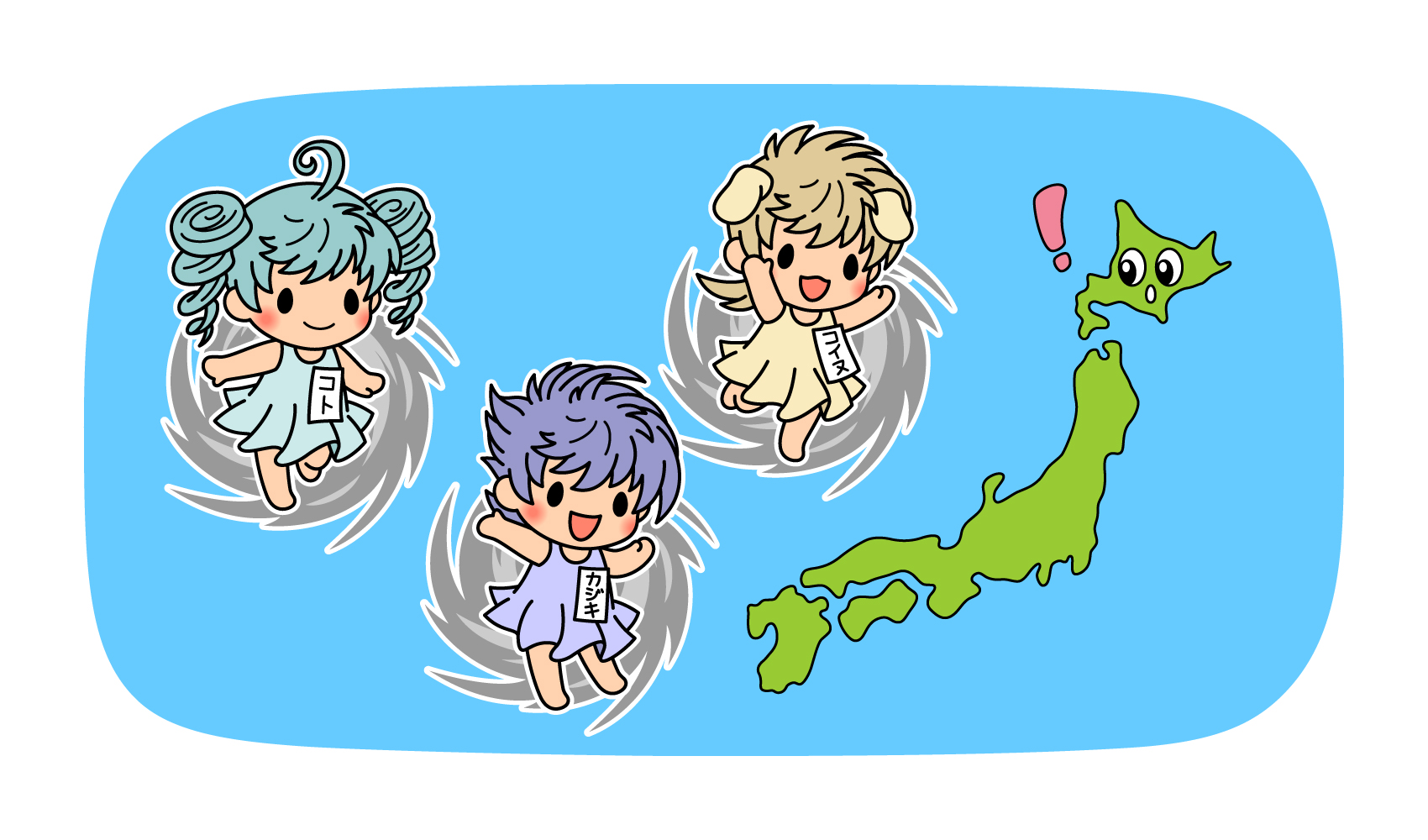
From summer to autumn, typhoons come to Japan. As you know from weather forecasts and news, typhoons are called by numbers, such as Typhoon No. 1, Typhoon No. 2, and so on. But this is the way they are called only in Japan. Do you know that each typhoon has another name that is used in international news reports? We will explain what typhoons are called and how they are named.
Typhoon" is a tropical cyclone in the Pacific Northwest
Let us begin by explaining what a typhoon is.
A typhoon is a type of tropical cyclone that originates near the equator, comes to the northwestern Pacific Ocean (mainly in Southeast and East Asia), and has maximum wind speeds (10-minute average) of about 17 m/s or higher near its center. The "m/s" indicates the speed in meters per second. As the wind speed increases, the typhoon is ranked as "strong typhoon (33 m/s to 44 m/s)," "very strong typhoon (44 m/s to 54 m/s)," or "intense typhoon (54 m/s or more).
Incidentally, internationally, a typhoon is called a typhoon when the maximum wind speed (one-minute average) near the center reaches about 33 m/s or more, but "typhoon = typhoon" does not necessarily mean typhoon, since there are different standards for wind speed. According to the standards of the U.S. Meteorological Agency, typhoons with maximum wind speeds (one-minute average) of approximately 67 m/s or higher are called "super typhoons.
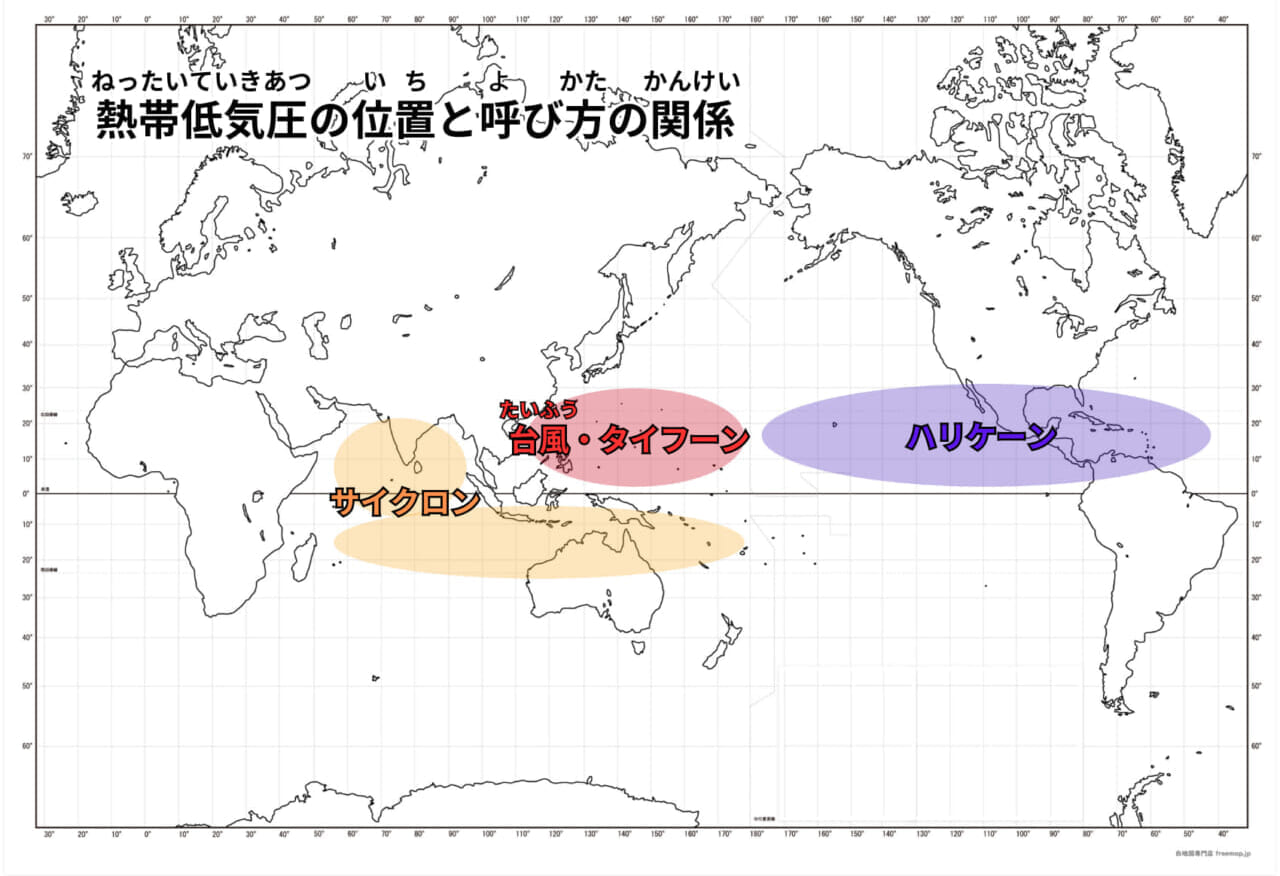
*Processing maps downloaded free of charge from the website "White Map Specialist" (https://www.freemap.jp/)
Tropical cyclones, like typhoons, are called "hurricanes" or "cyclones" depending on where in the world they are located. Hurricanes are located in the northern Atlantic, northeastern Pacific, and north-central Pacific (mainly around the North American continent), while cyclones are those that come from the Indian Ocean and southern Pacific, both of which have maximum wind speeds (one-minute average) of about 33 m/s or higher near their centers.
Typhoons are named in the order of a list created by 14 Asian countries.
So how is the name of each typhoon determined?
Typhoon No. XX is numbered from the first occurrence of the year as No. 1, then No. 2, No. 3, and so on, until the next year, when the number returns to No. 1 again. This number is used in Japan by the Japan Meteorological Agency and in newspaper and news reports.
After the 140th name is given, the names go back to the first name and so on. After the 140th name is given, the names are repeated, going back to the first and so on. This is also known as the Asian name.
Prior to 1999, typhoons were named after English-speaking people in Japan using the same system as hurricanes in the United States. This was due to the fact that Japan was under the U.S. occupation after World War II (female names until 1978, male and female names after 1979). For example, Typhoon Kathleen (1947) and Typhoon Kitty (1949), which once caused great damage to Japan, were both named after English-speaking women.
However, since typhoons are atmospheric phenomena that have a great impact on Asia, the system was changed in 2000 to give typhoons names associated with Asia, rather than English names. It is hoped that by having people around the world use the names chosen by Asian countries together, people will learn about the cultures of Asian countries, and by having names that are familiar to Asian people, awareness of typhoons will be raised, especially in the area of disaster prevention.
Japan proposed names from "constellations".
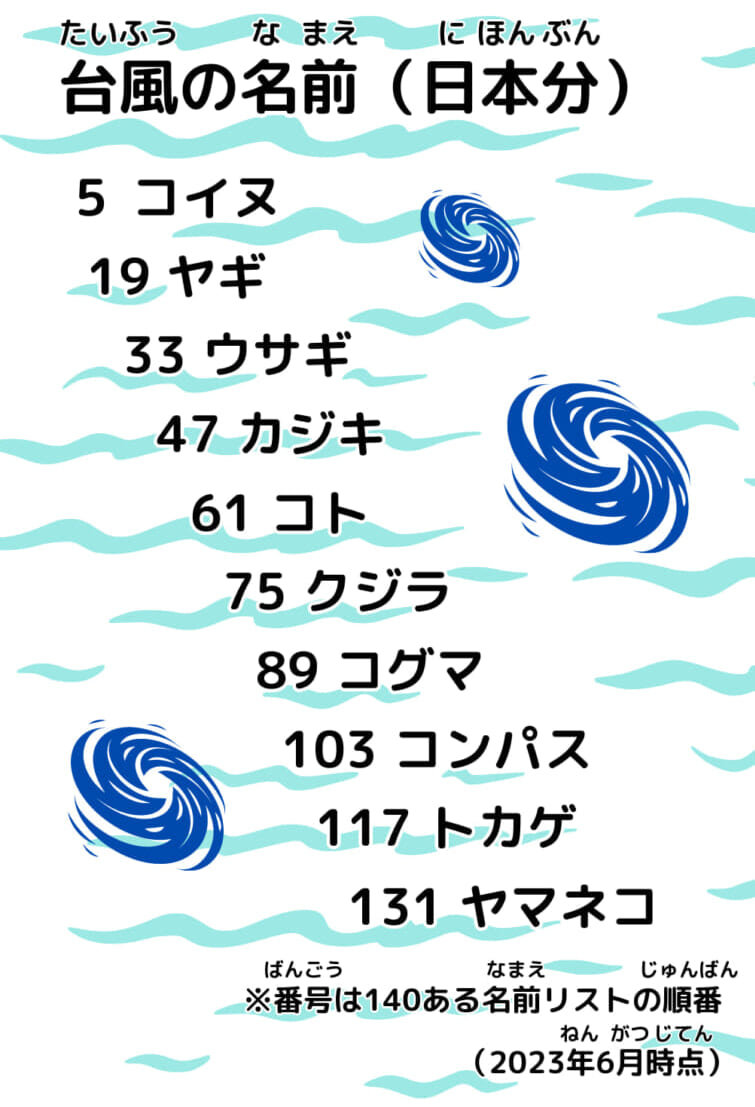
The list of names given by Japan as Asian names for typhoons is shown in the table.
What do you think these have in common?
The answer is "the name of a constellation. The reason for using the name of a constellation as the name of a typhoon is stated on the JMA website as follows.
The name must be "neutral" and not the name of a specific person, corporation, trademark, place, or weather phenomenon.
The name must be a "natural" object that is relatively free from conflict of interest.
The name must be familiar to the public and have an image association with the atmospheric phenomenon of typhoons.
Not too many letters (no more than 9 letters in the alphabet).
Not too many letters (no more than 9 letters in the alphabet) ・Not too many syllables and easy to pronounce
The name should not have a meaning that would be offensive in the languages of other member countries or regions.
Knowing this situation, it may make sense why some names, such as Compass, for example, are not immediately recognizable as being named by Japan.
Now, these Asian names, but the names of typhoons that caused major disasters are retired and their replacements are added to the list. For example, "Hagibis" (named by the Philippines, meaning "swift") for Typhoon No. 19, which caused many casualties in eastern Japan in 2019, has also been retired. Indeed, in the future, if there is news that "Typhoon XX (Hagibis) occurred on October 0," I will say, "Will that catastrophe happen again?" I will be very nervous.
From now on, when a typhoon occurs, please take an interest in typhoon information and try to prevent disasters by looking up Asian names.
Text/Akiko Imai