





Record number of extremely hot days continue! Too Hot Summer 2023 Why Extreme Weather?
The summer of 2023 was very hot throughout Japan. In some areas, the maximum temperature exceeded 40°C (104°F), and even in Hokkaido, which is supposed to be cooler, the temperature was as high as 37°C (45°F). Some areas had the highest number of "extremely hot days" with a maximum temperature of 35°C or higher than ever before, and some areas recorded their hottest days in late September. Heat records were broken in many parts of Japan, and the Japan Meteorological Agency announced that "the summer and early fall of 2023 were abnormal weather. The following is an explanation of the reasons for this excessively hot and unusual weather.
The JMA has forecast terms for temperatures.
Summer days...days with a daily maximum temperature of 25°C or higher
Midsummer day...A day with a daily maximum temperature of 30 degrees Celsius or higher
Extreme heat day...A day with a daily maximum temperature of 35 degrees Celsius or higher
Tropical night...A nighttime minimum temperature of 25 degrees Celsius or higher
Winter days...days with a daily minimum temperature of less than 0°C (32°F)
Midwinter day...A day with a daily maximum temperature of less than 0 degrees Celsius
In fact, the term "extremely hot day" was first used in 2007 in conjunction with "heat stroke" against the backdrop of rising temperatures. At this rate, it may not be long before a new name is given to days with a minimum temperature of 30 degrees Celsius or higher and a maximum temperature of 40 degrees Celsius or higher.
New records for heat waves across the country
Temperatures exceeding 40 degrees Celsius one after another, with a record low of 31.4 degrees Celsius
Let's take a look back at the summer of 2023 to see just how abnormal the heat actually was.
The first thing to note is the maximum temperatures: on August 5, 40.0°C was recorded in Yanagawa, Date City, Fukushima Prefecture, and on August 10, 40.0°C was observed in Komatsu City, Ishikawa Prefecture. In Itoigawa City, Niigata Prefecture, the minimum temperature on August 10 was 31.4°C, the highest minimum temperature ever recorded in the country. From July 16 to August 23, 106 of the 915 observation stations nationwide set new daily maximum temperature records.
Source: Japan Meteorological Agency website
The normal used in 2023 is the average of the weather data for the period 1991-2020. Normal values are updated every 10 years, and from 2031, the average value from 2001 to 2030 will be used as the normal value.
22 consecutive hot days, highest average summer temperature in history
In addition to recording high temperatures, the year 2023 was also characterized by long periods of hot days.
Toyooka City, Hyogo Prefecture, recorded the longest record of 22 consecutive extremely hot days, from July 22 to August 12. In addition, the number of extremely hot days observed in Kyoto City and central Tokyo were 43 and 22, respectively, both record highs. Furthermore, on September 28, Kuwana City, Mie Prefecture, recorded a temperature of 35.3 degrees Celsius, making it an exceptionally hot day even at the end of September.
According to the Japan Meteorological Agency, the average temperature in September was also 2 to 3 degrees above normal nationwide, and the average temperature from July to September in 2023 was the highest in the 125 years since the Agency began compiling statistics. This is truly abnormal weather. The abnormal weather is not limited to high temperatures; September 2023 was also characterized by an unusually low number of typhoons, with only two occurring in the month.
Is the heat wave caused by natural phenomena + global warming?
What exactly brought on this hot summer? This is a combination of several factors.
The first is that the Pacific High over the Japanese archipelago in summer was very strong. Another cause is that the strong westerly winds, known as the jet stream, which flow over the middle latitudes in the Northern Hemisphere, have turned to expand in a northerly direction near the Japanese Islands. The combination of tall high pressure and Pacific high pressure created by this meandering jet stream resulted in clear skies and scorching sun over the Japanese archipelago without cloud cover.
In the first half of 2023, La Niña, a phenomenon that causes high sea surface temperatures near the Philippines, occurred. This phenomenon caused sea surface temperatures to rise near the Philippines. This caused sea water to evaporate actively, which facilitated the formation of many cumulonimbus clouds. Since the atmosphere and oceans are connected throughout the globe, conditions in places far away from Japan, such as the Philippines, often affect Japan as well.
Another feature of 2023 is that sea surface temperatures in northern Japan were also record high. This is believed to be due to the effects of continuous clear skies caused by high pressure and the warm Kuroshio Current that flowed to northern Japan. Higher sea surface temperatures also result in higher air temperatures in contact with the ocean, and this is believed to be one of the reasons for the high temperatures recorded in 2023, especially in northern Japan.
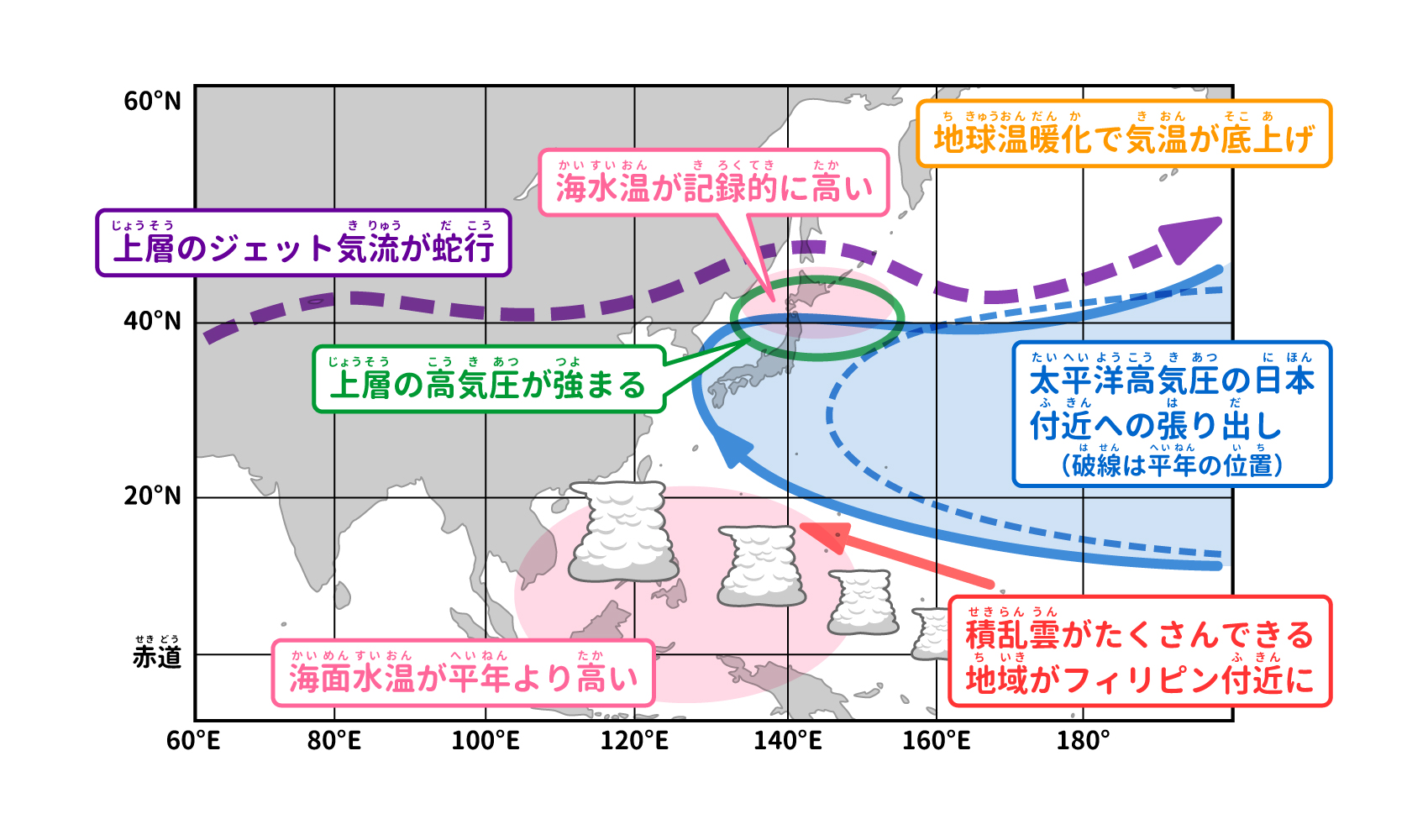
Abnormal weather conditions caused by the strengthening of the Pacific High, the meandering of the jet stream, and the La Niña phenomenon have been repeated on the earth since time immemorial. However, these natural phenomena are not the only reasons why this year's heat wave was unprecedented in recent years. It is also believed that global warming caused by human activities, such as the emission of greenhouse gases like carbon dioxide, has contributed to the rise in temperature.
Related article, "What Does Global Warming Mean?"
Warmer winter? What will temperatures be like in the future?
According to the JMA's three-month forecast released on October 24, 2023, the westerly winds are still expected to meander northward near Japan, and the cold air from the Siberian High is expected to be weaker to the south. It seems likely that temperatures will trend higher nationwide at least through January. On November 7, a foehn phenomenon occurred, and a series of summer days were recorded mainly in the Kanto region, with temperatures so high that even half-clothed people were sweating. The temperature in central Tokyo reached 27.5 degrees Celsius, breaking the record for the highest temperature in November for the first time in 100 years.
After experiencing this year's heat wave, some people may be worried about how hot the earth is going to get.
The average temperature change in Japan increased at a rate of 1.24 degrees per century between 1898 and 2019. This is a larger change than the global average.
The average temperature in Japan at the end of the 21st century is expected to increase by up to 4.5 degrees Celsius compared to the end of the 20th century, if no global warming measures are taken at all. In this case, the number of extremely hot days and tropical nights will increase, with the national average of 19 extremely hot days and about 40 tropical nights. Summer is likely to become more severe and longer.
There are many learning sites and other resources on the Internet about climate change, some of which are geared toward children. For example, the Kanagawa Climate Change Adaptation Center's "Kanagawa Climate Change WEB KIDS" introduces countermeasures against extreme heat and natural disasters caused by climate change through videos that allow children to learn with characters. Basic questions such as how much temperatures and greenhouse gas emissions are changing are also explained in an easy-to-understand manner using graphs.
In addition, the manga series "Chikyu Boeitai SDGs" on Gakken Kids Net, where you can learn about the SDGs, has a section on Goal 13 "Specific measures for climate change," and its explanatory section introduces ideas for achieving the Goal and other topics.
Find out what will happen to the Earth's weather in the future and what you can do to prevent climate change.
Kanagawa Climate Change WEB KIDS
The Earth Defenders SDGs, Episode 8: Commentary, "Can Climate Change Be Nipped in the Bud?"
reference data
Japan Meteorological Agency, "Characteristics and Factors of Heavy Rainfall in the 2023 Rainy Season and Significantly High Temperatures since the Second Half of July": https: //www.jma.go.jp/jma/press/2308/28a/kentoukai20230828.pdf
Weather News, "Summer 2023 will be overwhelmingly hot, far exceeding the previous record high": https://weathernews.jp/s/topics/202309/010215/
Japan Meteorological Agency, "Climate Change in Japan 2020 Observation and Forecast Assessment Report on Atmosphere, Land and Ocean": https://www.data.jma.go.jp/cpdinfo/ccj/2020/pdf/cc2020_honpen.pdf
Japan Agency for Marine-Earth Science and Technology, "Kuroshio-Oyashio Watch Recent Ocean Heat and Cold Waves (2023/8): High Water Temperatures in Northern Japan, Typhoons": https://www.jamstec.go.jp/aplinfo/kowatch/?p=12842
JMA 3-month forecast (released on October 24, 2023): https://www.data.jma.go.jp/cpd/longfcst/kaisetsu/?term=P3M
Text/Akiko Imai