





On-site Report] Child and Family Agency: Initiatives to Listen to Children's Opinions
In April 2023, a new national organization, the "Administration for Children and Families," will be established to oversee policies related to children. This organization will work to create a society that considers what is best for children, and the "Kodomo Yōnen *Kenpurasu" system was launched in conjunction with this organization. This system is designed to listen to the opinions of children themselves and incorporate them into the content of national policies for children. The system was immediately utilized in the formulation of the "Children's National Policy," which defines what is important when advancing children's policies, and opportunities were provided to hear directly from children. Here is a report on how the opinions of children were heard.
A system to utilize children's opinions in national policy What is happening in other countries?
All children are welcome to participate in "Kodomo Yōnen★Kenpurasu".
Anyone from elementary school students to those in their 20s can register and participate in Kodomo Yōnen★Kenpurasu. The program provides a forum for connecting the government and children on topics on which ministries and agencies want to hear children's opinions and on topics on which children want to express their opinions to the government. There are a variety of ways to listen to their opinions, including face-to-face meetings, online meetings using the Internet, and filling out and answering questionnaires on the Web. In some cases, the Child and Family Agency or the ministries and agencies visit the children to listen to their opinions. The collected opinions of the children are made public, along with the reasons why and how they were or were not incorporated into the system.
So far, more than 20 themes, including those requested by various ministries and agencies, have been discussed at the meetings.
What does the place look like to hear opinions?
The Children's Outline was developed using the "Kodomo Yōnen *Kenpurasu" (Children, Youth, and Education Plus) program at the building where the Tokyo Metropolitan Government's Administration for Children and Families is located. Here is a report on the event.
Many tricks to ease children's tension
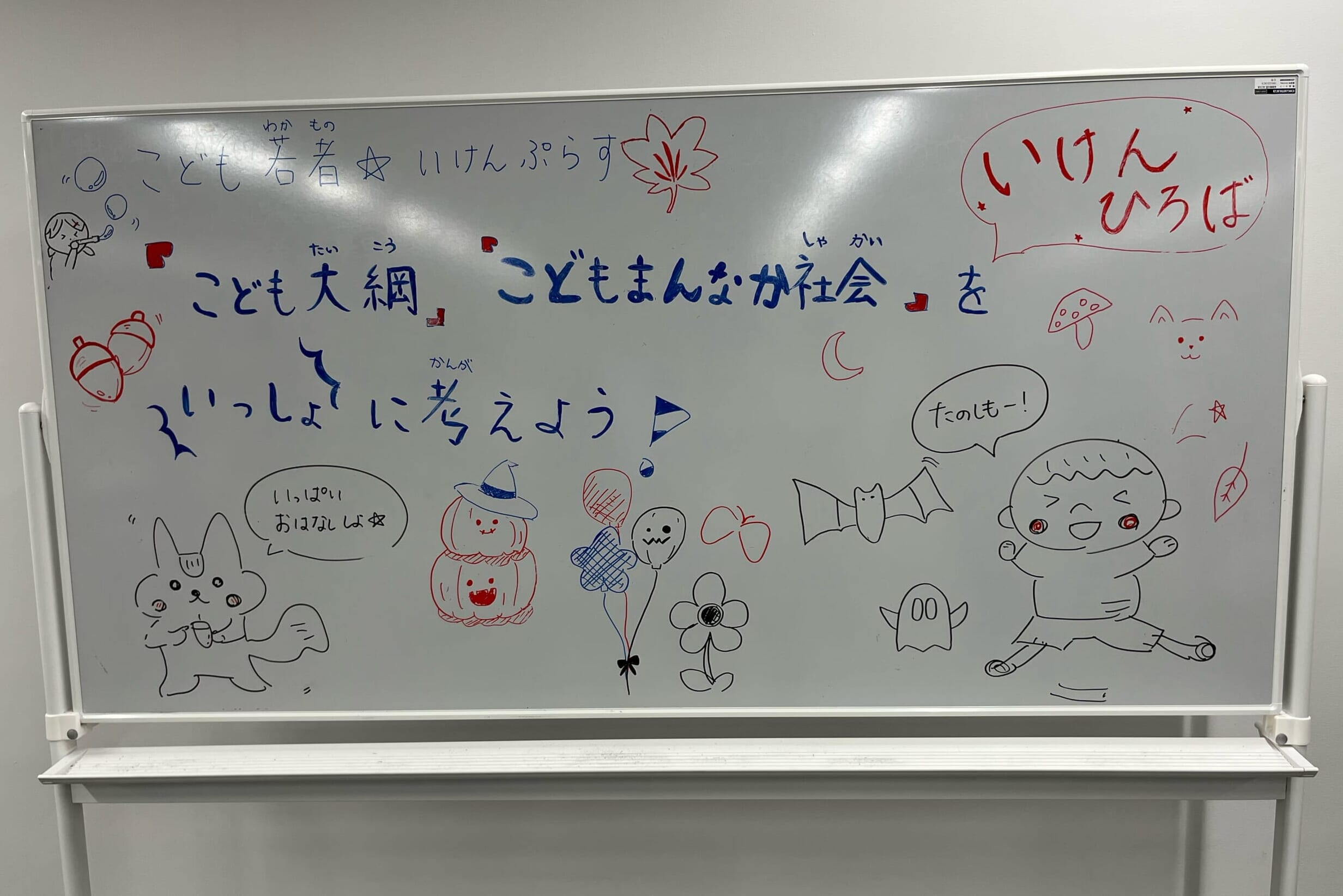
The venue was a spacious space about the size of two school classrooms. The walls and whiteboards were decorated with pictures and other decorations so that the children could relax as much as possible.
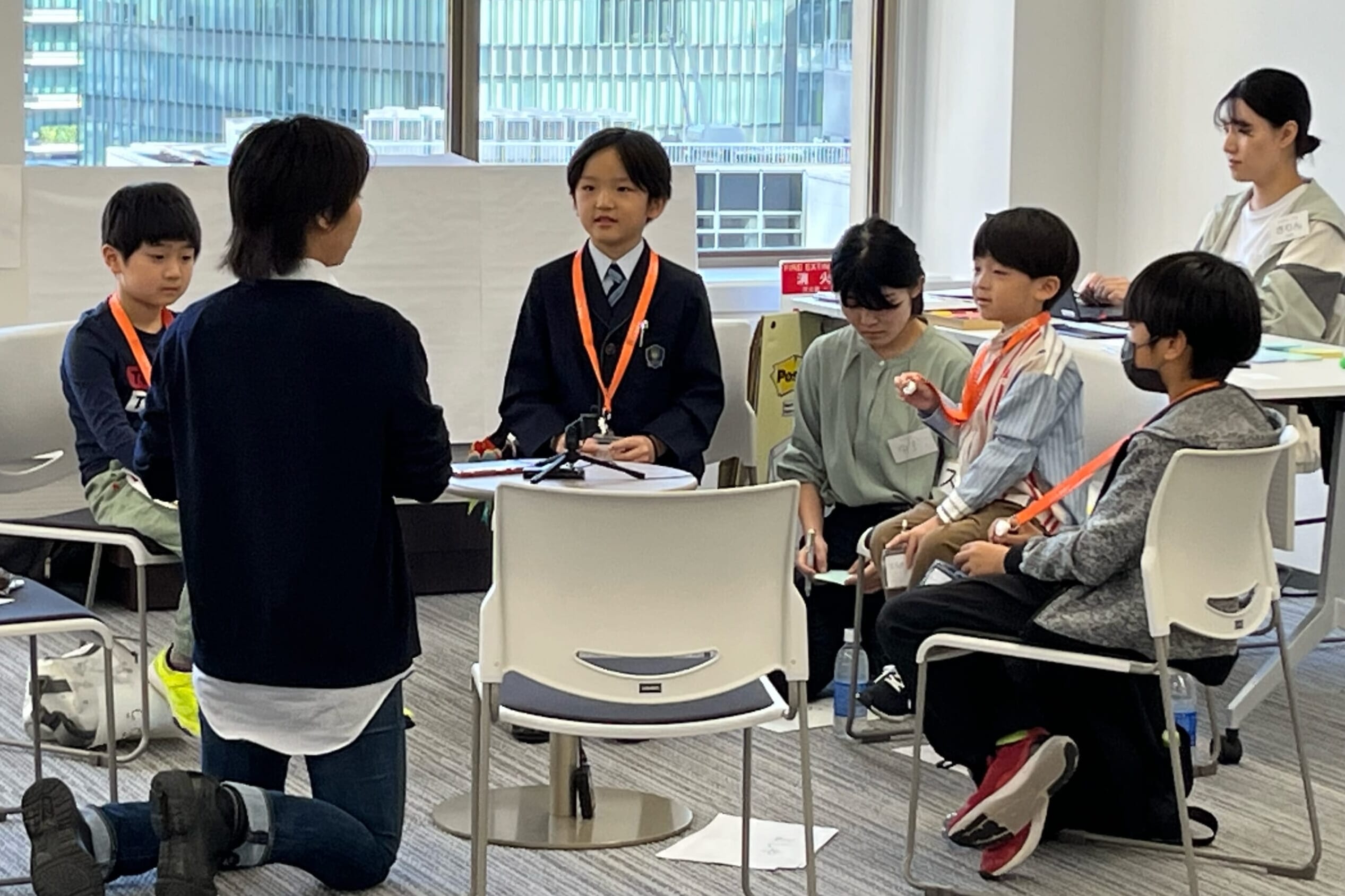
About 30 people, ranging from elementary school students to those in their 20s, participated in the event. They were divided into six groups, each group consisting of people close in age, and each group shared their opinions on a specific theme.
There are a few rules in the discussion, such as not denying or suppressing other people's opinions. Other than that, you are free to speak freely, you do not have to say what you do not want to say, and you can revoke or change what you have said.
In language that is easy for children to understand.
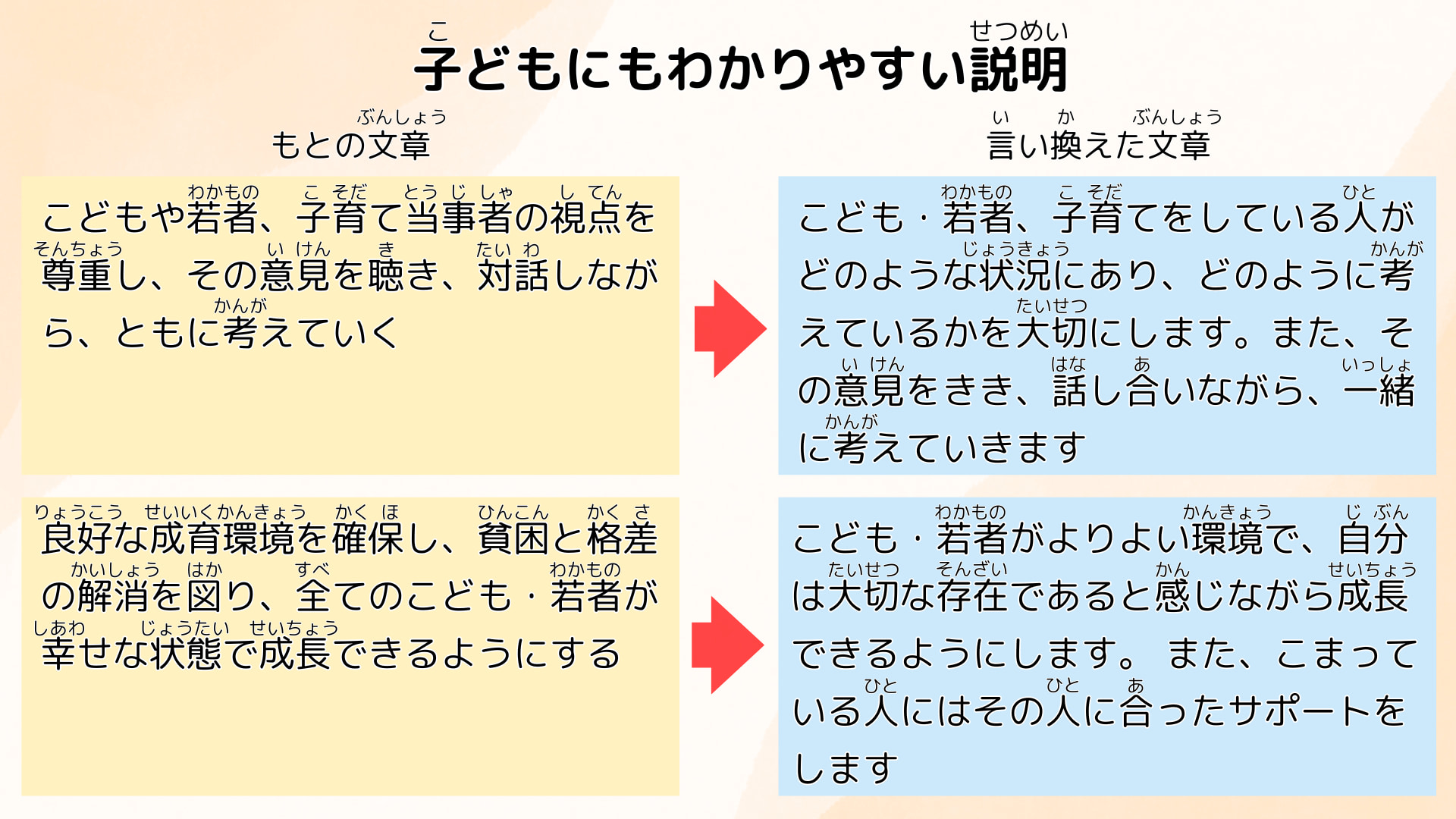
Participants were given a briefing session in advance so that they could learn about the topics on which they would express their opinions and their detailed content. Since the original materials on government policies are aimed at adults, they contain many difficult expressions and technical terms that are difficult for children to understand. At Kodomo Yōnen★Kenpurasu, in order to make it easier for children to understand the themes, the words in the advance explanations and materials are rephrased in a gentle way so that even children can easily understand them.
Facilitator who carefully elicits input
After confirming the rules with the entire group, each group began its discussion. Each group is assigned a facilitator to lead the discussion and a record-keeper to record the opinions expressed. The children, facilitators, and recorders sit in a circle. Since everyone is meeting each other for the first time, we first introduce ourselves in a quiz format to ease the tension and create an atmosphere conducive to conversation. Participants call each other by their nicknames, which is another way to make them feel more familiar and to close the distance between them.
The theme for the lower elementary school group was "Kodomo-Mannaka-Society. We asked the children what they thought of the "Kodomo-Mannaka Society," what they liked about it, and what they would like to see it do better.
Simply, "What do you think?" "Do you have an opinion?" but it is difficult for children to express their opinions. This is where the facilitator comes in. The facilitators are adults and young people who have learned how to facilitate such discussions. They can help the children to visualize the discussion by giving specific examples, and when they are not able to summarize the discussion, they can help them to organize it by saying, "So, this is what I mean. They also help children to organize their thoughts.
At first, some children did not grasp the meaning of "Kodomo-Mannaka" well, saying things like, "Does it mean that the adults around me are watching me? The facilitator asked, "What makes you happy? Do you have any problems? What would make your daily life easier? The children seemed to get the picture as the facilitator asked a series of questions such as, "What would make you happy? Gradually, they began to express a variety of opinions, such as "If the school grounds were turfed, there would be fewer injuries when they fall," "I want more parks and other places to play," and "I want the cost of rides to school to be reduced. The opinions were written down on a large white piece of paper by the recorder so that everyone in the group could review them.
Other people's opinions will expand your own ideas.
The theme for the upper elementary school and junior high school groups was how to promote the Children's Policy. Regarding the policy of "providing support tailored to the needs of those in need," some participants, citing actual examples of their friends, said, "I want you to create a place for those who don't want to go to school, but also don't want to stay at home. The policy also led to opinions such as, "Each student has different needs and shortcomings, so I would like to see support tailored to each student to fill in the gaps," and "There are things that are difficult to discuss with friends and teachers, so I would like to see more third-party counselors, such as school counselors, to whom students can go to for advice, The participants also engaged in lively exchanges, nodding to each other's opinions.
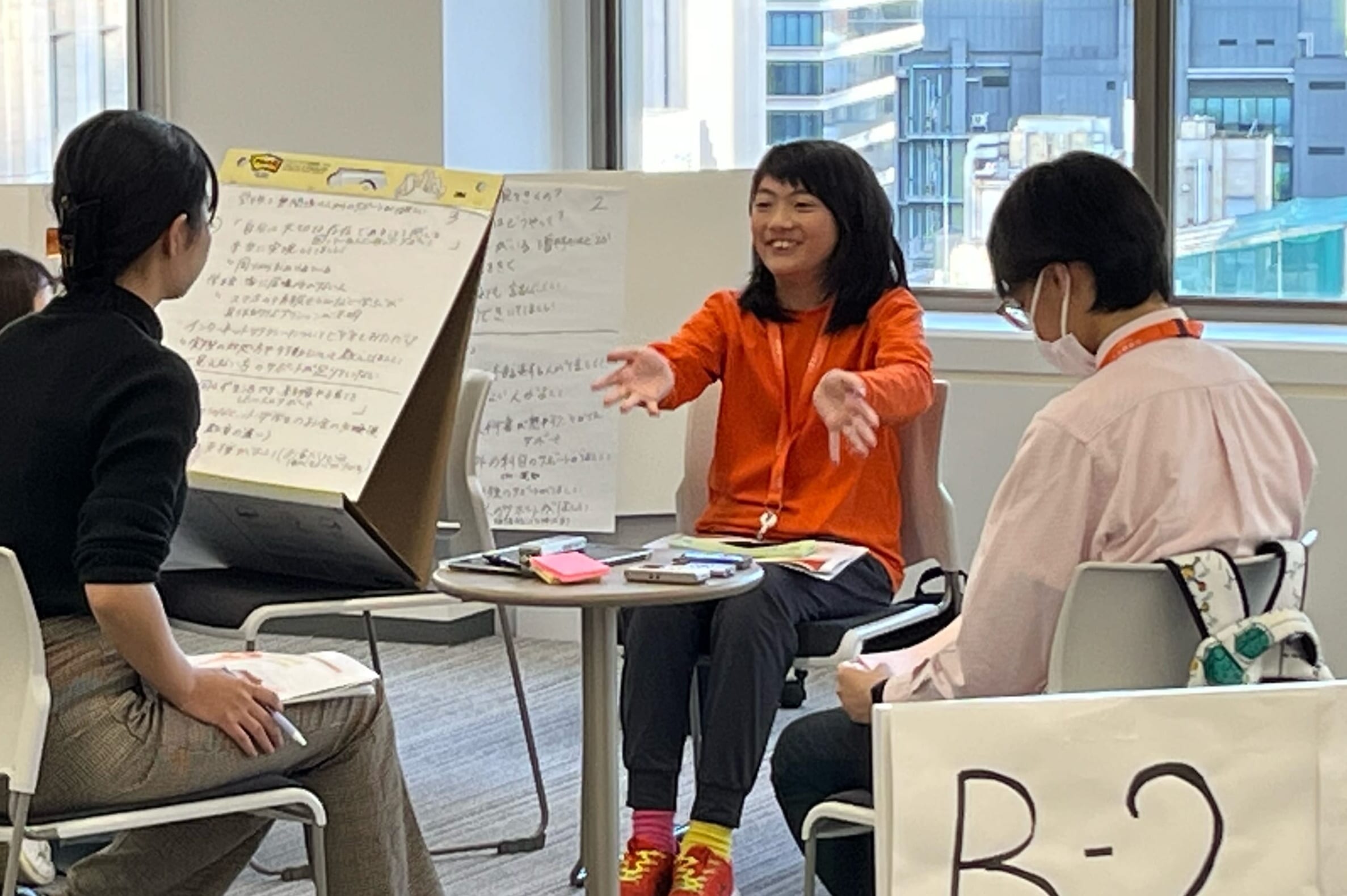
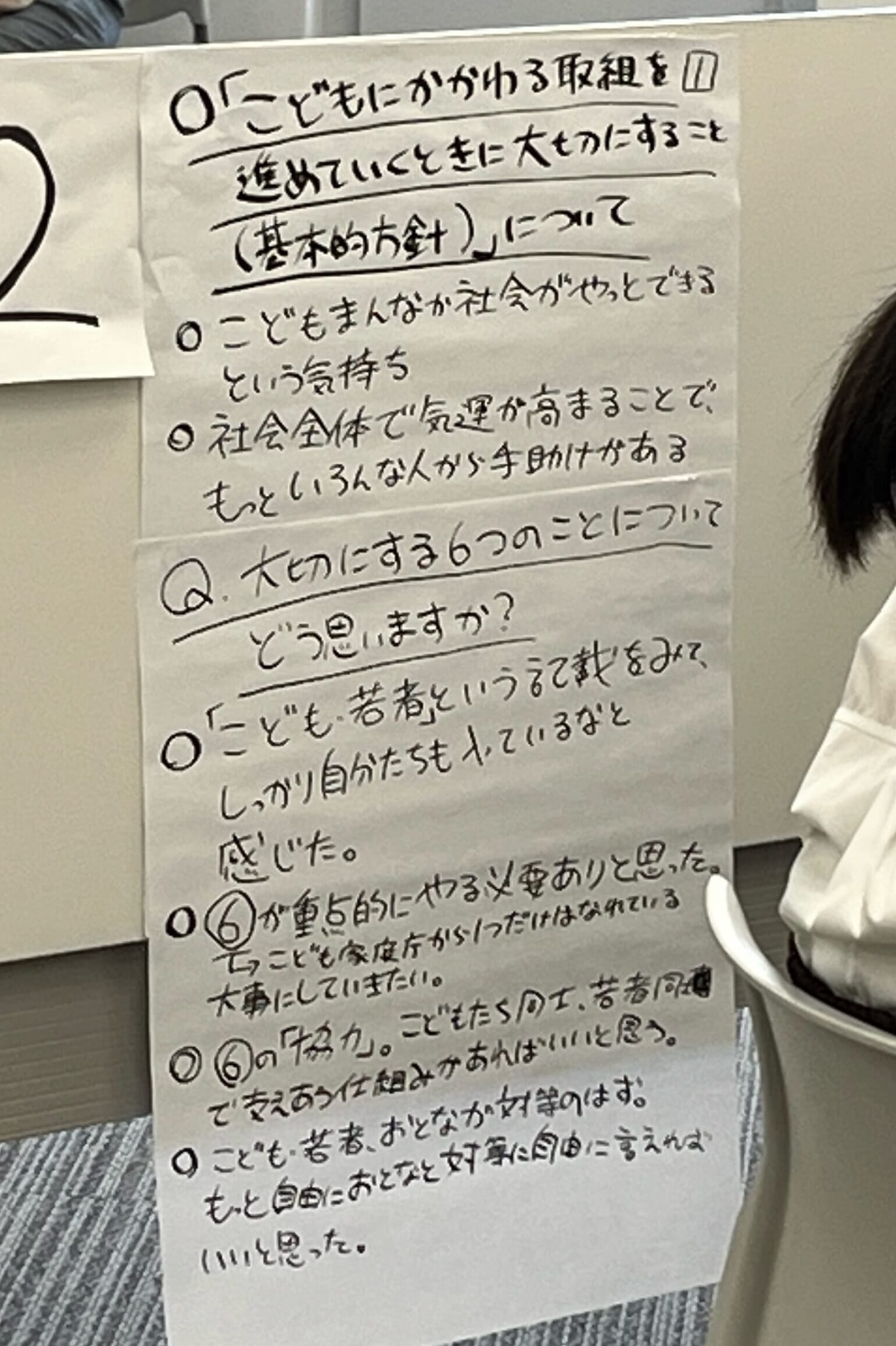
The discussion lasted for over an hour, and the white paper was lined up with many words to write down opinions. After these opinions were compiled, they were used in the Children's Outline. The session ended with a presentation by a representative of each group. Some of the participants commented that they enjoyed sharing their opinions, that hearing other people's opinions broadened their thinking, and that next time they would like to discuss the issue in a group with people of different ages.
Children and youths in their teens and twenties are also members of the management of Kodomo Yōnen★Kenpuras, who think about how to proceed with the event. The venue and the discussion progression were designed to make it easier for the children to speak their true opinions. The children seemed to be able to express their opinions freely in the soft atmosphere.
What were the thoughts of the children who participated?
I hope I can be of service to the future."
What were the thoughts of the children who participated in this year's event?
A first grader whose mother told him about Kodomo Yōnen★Kenpurasu, said that as he and his family talked about "thinking about Japan and the future of our children together," he "started to have things that I wanted to talk about in front of everyone. She said, "I had a lot of fun" in participating in this event, expressing her opinions and listening to the opinions of the other participants.
A second grader, who also participated at the recommendation of his family, said he was a little frustrated, "I was so nervous that I couldn't talk much," but looked back on it as a "good experience.
A third grader who is interested in the issue of bullying at school participated in the event, hoping to "have my own opinion and be useful in the world. As expected, she was "happy" that her friends and herself were able to express many opinions and that they were listened to. She also commented, "It was very good to feel that children also have the right to participate in making national policies.
We know how our opinions were taken up!
How were the opinions expressed by the children actually incorporated into the Children's Policy?
The results of the survey have been published and are divided into three major groups: opinions that were newly incorporated, opinions that had already been incorporated, and opinions that were not incorporated this time.
For example, one of the newly incorporated comments from children this time was "I want assistance with the cost of cram school. In response to this opinion, the Children's Outline additionally includes a provision to support free tutoring schools offered by local governments. In response to a comment that "I want textbooks to be digitalized," the Children's Outline also includes a section on promoting the use of digital textbooks.
On the other hand, the comment "I want high school to be free" was not incorporated, as it did not go so far as to "make it free," although support would be provided for tuition and non-tuition expenses.
The publication of the results will likely lead to a sense of acceptance and satisfaction from the children who expressed their opinions, as they will know that their opinions were heard and considered in terms of what to do.
More details on the results can be found in the document linked below.
People can share their opinions, too.
Everyone can express their own opinions to the government through Kodomo Yōnen★Kenpurasu. Children's own opinions are indispensable in creating policies for children. Your opinions may make society a little better than it is now. If you are interested in becoming a member, you can register on the website of the Administration for Children and Families. When registering, you will also be asked for a health insurance card or other document that shows your age.