





Why? Why? Israeli-Palestinian Conflict
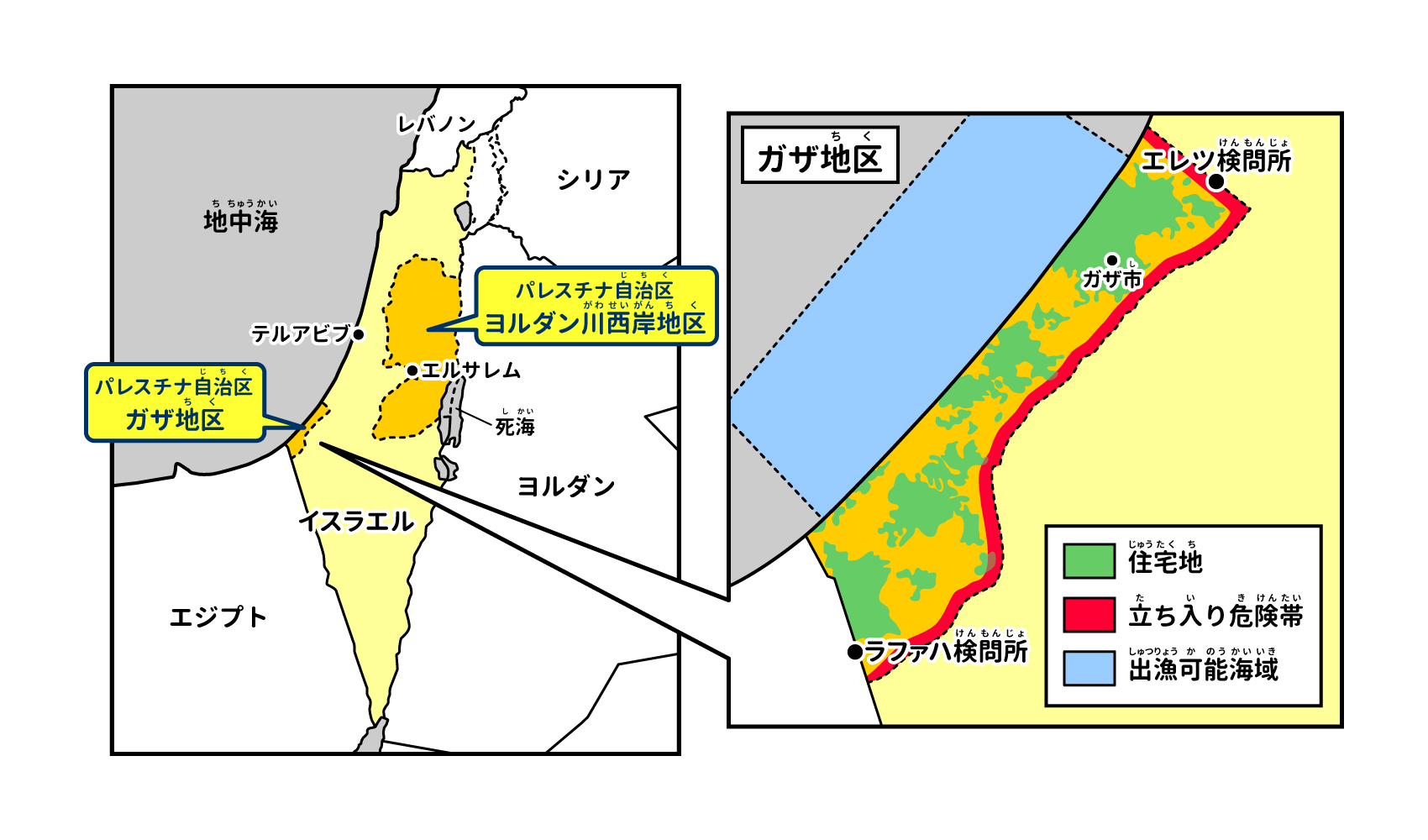
On October 7, 2023, the Palestinian Authority's Islamic organization Hamas launched an attack against Israel in the Middle East, using rockets and fighters. In response, Israel launched airstrikes by fighter jets and retaliatory attacks by ground troops on the Gaza Strip, a Hamas stronghold. In both attacks, many civilians, including children, were killed, especially in the Gaza Strip, where more than 18,000 people were killed. Israel and Palestine have been fighting each other for a long time, but this time the casualties and damage are unprecedented. We asked Mr. Hiroyuki Suzuki, an expert on Middle East studies, to tell us what is happening now so that everyone can understand what is going on.
(Article published: December 19, 2023)
Learn from the ground up! Reasons and History of the Israeli-Palestinian Conflict
Q&A to know more about the Israeli-Palestinian conflict
No fighting does not equal peace.
When, where, what happened?
On October 7, 2023, Hamas fighters suddenly entered Israel from the Gaza Strip and carried out an attack. An open-air music festival was attacked, resulting in the deaths of approximately 1,200 people, including foreigners. In addition, Hamas took approximately 240 people hostage.
In retaliation (payback), Israel immediately began bombing the Gaza Strip to destroy Hamas, and on October 28, the ground war began. These attacks also killed more than 28,000 civilians in the Gaza Strip (as of February 20), including at least 5,000 children. At least 5,000 of them are reported to be children. In addition, towns and homes have been severely destroyed, and 1.7 million people, or about 80% of the total population of the Gaza Strip, have been internally displaced.
Israel has also targeted hospitals, schools, and refugee camps, claiming that they have become hiding places for Hamas. The international community, which initially supported Israel's retaliation, has become increasingly critical as the civilian casualties mount.
Israel and Hamas agreed to a temporary truce on November 24. Some of the hostages taken by Hamas were also released, but attacks resumed on December 1.
Why did Hamas attack now? What is the purpose?
Hamas cites "the ongoing Israeli occupation of Palestine" and "Israel's attacks on Muslim holy sites" as reasons for the attack. However, these problems did not begin recently, and it is not known exactly why the attack was carried out at this time. Nor was there any indication that Hamas had prepared a response to Israel's retaliation, which was naturally expected. Since there was no apparent planning for what happened after the attack, it is possible that the goal this time was to "shock Israeli society by killing a large number of people," i.e., the attack itself.
Hamas attacks have resulted in many casualties. It could be said that anger and hatred erupted in the form of attacks from the Gaza Strip, which had been sealed off by Israel with a wall for more than 15 years.
When does the battle end?
When the fighting will end is entirely up to Israel. Previous attacks on the Gaza Strip have lasted up to 50 days. Based on past Israeli wars, we can expect the fighting to end in a few months at the most. The pattern has been for a formal ceasefire to be reached after several short periods of truce. The release of hostages is also key, but in the past there have been cases of ceasefires with hostages remaining.
In addition, Israel sends soldiers to war zones in the form of "reservists. Since reserve soldiers are usually working as civilians, they cannot continue to be deployed in battle for very long periods of time. As a rule of thumb, three months is the maximum. Also, as Israeli military casualties increase, there will be calls within Israel for an end to the war. The damage to the Israeli economy will also be severe. There is a possibility that Israel will finally step up its offensive as the time limit approaches.
What is the Palestinian issue?
The Israeli-Palestinian conflict is originally a dispute over land in the Middle East. The conflict is between the Jews, who founded the state of Israel in the region called Palestine, and the Palestinians, who have no formal state.
Jews are people who believe in Judaism. Since the Jews considered Palestine to be an important land in their faith, they tried to settle in Palestine and create their own country. This movement was called "Zionism In 1948, Jews founded the state of Israel in Palestine.
However, Palestine has long been inhabited by Palestinians, who are mainly Muslim. The Palestinians and neighboring Arab countries, who were deprived of their land, opposed the establishment of the state of Israel. Arab-Israeli Wars (1948, 1956, 1967, 1973, 1974) The company is now in the process of
All four Middle East wars were basically fought in Israel's favor, resulting in the occupation of a larger area than when the country was founded. 1993, Israel and the Palestinian side held talks for peace, and the Oslo Accords were concluded. Under this agreement, Palestinian autonomy was granted in parts of the West Bank and the Gaza Strip. However, the Israeli occupation continued, resulting in a negative cycle of resistance by the Palestinians (the second intifada) and military retaliation by Israel. Although Israel withdrew from the Gaza Strip in 2005, occupation and Jewish settlement (mass displacement) continue in the West Bank.
What is the Gaza Strip?
Since around 2006, Israel has closed and sealed the wall with the Gaza Strip. It is called a "prison without a ceiling" because of the severe restrictions on the movement of people and goods. The Gaza Strip is a long and narrow area, 5 to 8 km wide and approximately 50 km long. With an area of 350 km2, it is about the size of Japan's Tanegashima Island in Kagoshima Prefecture, where more than 2 million people live. The living conditions of the residents are serious. Due to power shortages, sewage treatment is not available, and it is difficult to secure even the drinking water necessary for survival. Work is limited, and the unemployment rate is 47%, with nearly half of the residents unable to find work. Eighty percent of the residents must rely on some form of humanitarian assistance to survive.
What kind of organization is Hamas?
Hamas is an Islamic organization that is currently in substantial control of the Gaza Strip. Although it is considered a terrorist organization, it actually has "three faces.
One is the face of a welfare organization. The original organization of Hamas was a sports club for young people in refugee camps in Gaza, established by Palestinians themselves in the 1970s during the Israeli occupation of the Gaza Strip. Later, they also began to manage kindergartens and other activities. Since Israel only maintained security in the occupied territories, they were responsible for administrative services to citizens such as welfare and education.
The second is the face of an armed organization: in the 1980s, there was a struggle called the "Intifada" in which Palestinians collectively resisted Israel. At that time, it changed from a welfare organization to Hamas. Hamas also established a division for armed struggle that would use force, saying, "Supporting welfare alone is not enough to liberate Palestine. In the 2000s, Hamas carried out numerous suicide bombings against Israel.
In the mid-2000s, there was a movement within Hamas to involve Palestinians in political activities, and in 2006, Hamas participated in the Palestinian parliamentary elections as a political party and won a landslide victory through skillful election tactics. Since it participated in the parliamentary elections created by the Oslo Accords with Israel, it is believed that it effectively came to recognize the existence of Israel.
Hamas has shown a new face in accordance with the times. For an organization that has long been considered flexible and rational, this latest attack has surprised experts because it shows no long-term planning and differs from its traditional image.
What kind of country is Israel?
Israel is a Jewish state created in 1948. Since its establishment, Israel has been at war with itself and has always maintained the policy of "eliminating threats to the state by its own strength. Israel's wars have been characterized by dealing major blows to its opponents in a short period of time and ending the fighting in a few months at the most. This time, the initial Hamas attack caused unprecedented casualties on the Israeli side, especially among soldiers and police officers. In particular, the death toll of 800 civilians who are not soldiers or police officers has aroused feelings of anger in Israeli society, leading to a very violent attack on the Gaza Strip.
In the past, in fact, Israel has had politicians who were prime ministers who emphasized dialogue with Palestine. However, during the last decade or so, there has been a growing political insistence on the interests of one country, Israel. Today, parties that call for peaceful coexistence with the Palestinians can hardly win seats in elections, and parties with a tough stance toward Palestine are running the political scene.
Problems that adults couldn't solve, homework for everyone.
This fighting between Israel and Palestine is expected to end in a few months, as it has in the past. Once a ceasefire is established, public interest will quickly cool down. However, "no fighting does not equal peace.
The latest Hamas attack occurred because the world has not taken heed of the fact that the Gaza Strip has been blockaded for a long time and is experiencing serious humanitarian problems. Israel used to think that it was safe to contain the Gaza Strip, but it turned out to be an illusion. Sealing off the Gaza Strip again will only start preparations for another attack. From now on, the Gaza Strip, which has been cut off from the rest of the world, needs to be "put back into the world. The question is how Israel and the international community will face the Gaza Strip.
In the reconstruction of Gaza after the fighting, Japan may be called upon by the international community not only to provide economic support as it has in the past, but also to provide new support such as long-term dispatch of personnel. A war in a distant place is not a problem that can be left alone.
The Israeli-Palestinian problem is a conundrum that took many adults years to solve. It is, so to speak, the world's "homework" left to you. I cannot give you an easy answer, but I hope that all of you, who will be living on the world stage in the future, will think about it carefully.
監修:鈴木啓之さん

Born in 1987. Specially Appointed Associate Professor, Sultan Qaboos Endowed Chair in Global Middle East Studies, Graduate School of Arts and Sciences, The University of Tokyo. Doctor of Philosophy. He was a JSPS Research Fellow PD at Japan Women's University and a JSPS Postdoctoral Fellow for Research Abroad at the Harry S. Truman Peace Research Institute, Hebrew University, before assuming his current position in September 2019. She is the author of Uprising [Intifada]: Palestine under Occupation 1967-1993 (University of Tokyo Press, 2020) and co-editor of 60 Chapters for Understanding Palestine (Akashi Shoten, 2016).
Text by Shunichi Mishiro