





Learn from the ground up! Reasons and History of the Israeli-Palestinian Conflict
On October 7, 2023, the Islamic organization Hamas, which controls the Gaza Strip in the Palestinian territories, launched an attack against Israel in the Middle East. This triggered Israel to launch a fierce attack on the Gaza Strip, resulting in an ever-increasing number of civilian casualties. Israel and Palestine have long been engaged in a conflict over land in the Middle East. We asked Mr. Hiroyuki Suzuki, an expert in Middle East studies, to tell us the history from the beginning.
Israeli-Palestinian Conflict Click here for an article on the current situation.
Q&A to know more about the Israeli-Palestinian conflict
Jewish state created by pushing out Palestinians
The major cause of the conflict between Israel and Palestine is the creation of Israel, a state of people who believe in Judaism (Jews), in the Palestinian territories where many Arabs (Palestinians) used to live. Disgruntled Palestinians and neighboring Arab countries began to fight with Israel over land and sovereignty.
Key Points to the Founding of the State of Israel
First, let us look at the general events leading up to the founding of the State of Israel.
Spreading movement to "create a Jewish state in Palestine" (Zionism)
It has been believed that the Jewish people suffered from the breakdown of their nation in ancient times and were scattered throughout the world. The city of Jerusalem in Palestine was home to an important Jewish temple. For Jews, Palestine is an important land in their faith. Zionism, a movement to establish a Jewish state in Palestine, began among European Jews. Meanwhile, Arabs began to live in Palestine, many of them believing in Islam, which spread around the 7th century.
Britain Promises to Build Jewish "Homeland"
Prior to the 1917 Jewish promise to build a "homeland" (Balfour Declaration), the British had made two other promises. One was the promise of Arab independence from the Ottoman Empire (1915: Husayn-McMahon Letter), and the other was a secret agreement to share Ottoman territory with France (1916: Sykes-Picot Agreement). These were irresponsible promises by the British, who made different promises to different parties, and are known as "British three-party diplomacy.
British rule in Palestine.
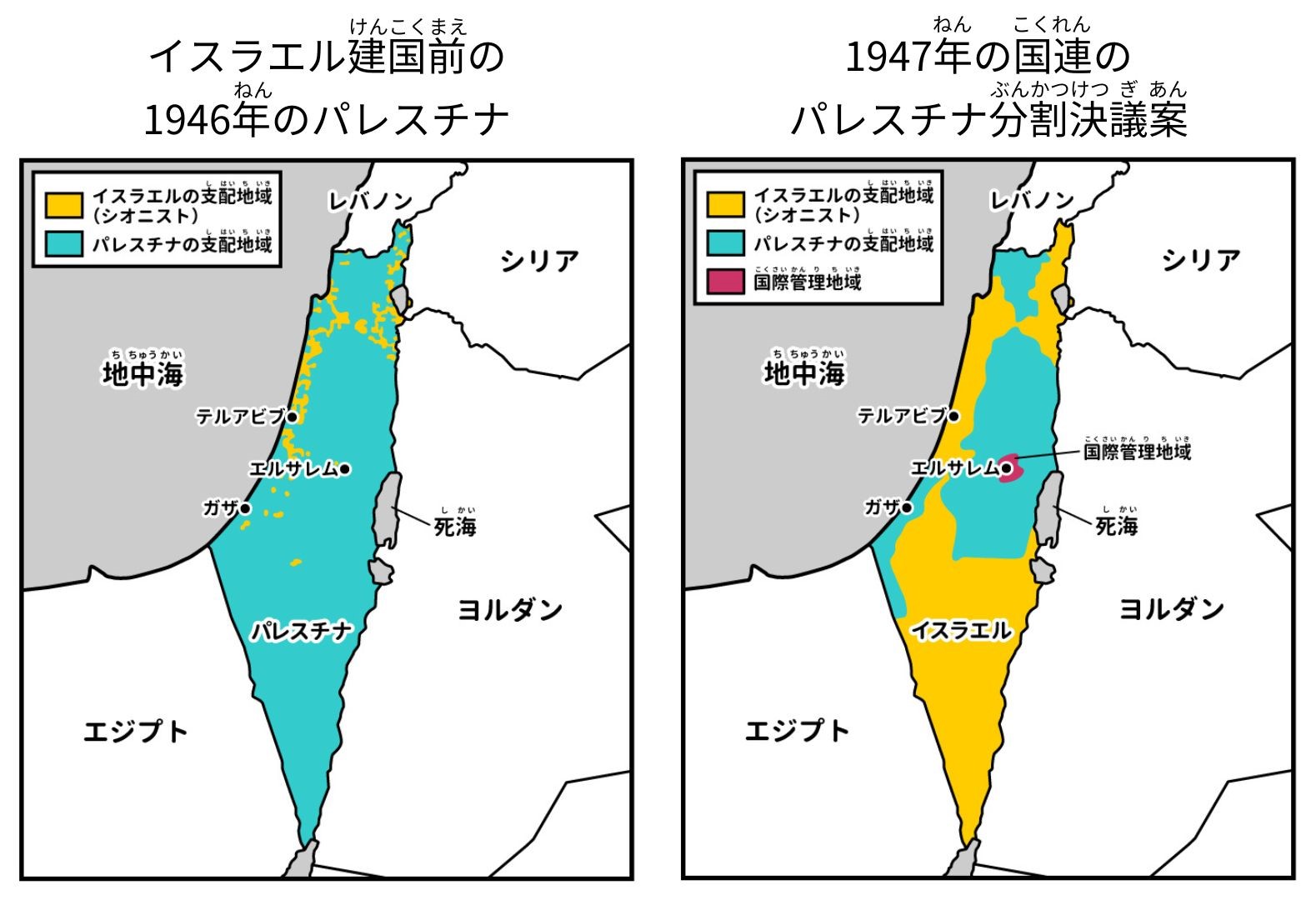
In response to the Balfour Declaration, the Jews who were promoting the establishment of a Jewish state believed that the British had granted them permission to establish a state. As a result, a large number of Jews moved to Palestine. The percentage of Jews in Palestine increased from 10% to 30%, and with the increase in the percentage of Jews in Palestine, clashes with the Arabs who had originally lived in the area intensified.
Holocaust by the German Nazi regime
In the Holocaust, approximately 6 million Jews were slaughtered in Germany, allied countries, and occupied countries under the Nazi regime. Prejudice against Jews because of their religion has long existed in Europe, but the Nazis were particularly extreme in their views. They hated and detested Jews, saying that they were the cause of all society's problems and that Jews were an inferior race.
Founding of the State of Israel decided by the United Nations
In November 1947, the United Nations General Assembly passed the "Palestine Partition Resolution" by a majority vote, and the State of Israel was proclaimed in May 1948. This included the granting of nearly 60% of the land in the region to the Jewish people, who only make up about 30% of the population. The large land allotment was made with Jewish refugees who had survived the Holocaust in Europe in mind, but it was an unfair division for the Arabs who had originally lived in the area.
Key points from the establishment of the State of Israel to the present
Then, let us look at the general events from the establishment of the State of Israel to the present.
War between Israel and Arab countries
Israel was militarily very strong, and the Arab states, which had failed to defeat Israel in the four Middle East wars, gradually weakened their confrontational stance. After this, the liberation movement by the Palestinian people themselves began to gain momentum.
Israel and Palestine Liberation Organization Sign Oslo Accord
The Oslo Accords have two main points. One is that Israel and the Palestine Liberation Organization (PLO), the organization representing Palestine, recognize each other's existence as negotiating partners. The other is to gradually withdraw from the areas occupied by Israel and to allow Palestinian self-rule for a limited period of time. Issues such as the right of Palestinian refugees to return to their former lands, the borders of a Palestinian state, and the treatment of the holy city of Jerusalem have been postponed. However, this was a period in the long history of conflict between Israel and Palestine when hopes for peace were at their highest.
Palestinian armed resistance movement
The first intifada in 1987 was fought by the people without weapons, but the second was led by armed groups such as Hamas. There were a series of incidents in which Palestinians strapped bombs to their bodies and blew themselves up in crowded places. And because of these suicide bombings, the Israeli army attacked the Palestinians with overwhelming military force, and the violent conflict intensified.
Hamas, a "terrorist organization," wins Palestinian Authority parliamentary elections.
Hamas, which carries out suicide bombings, is considered a "terrorist organization" internationally. Therefore, the Palestinian government in which Hamas participated was rejected by the U.S. and other countries. Fatah, an organization that had been at the center of Palestinian politics until then, clashed with Hamas in an armed conflict in an attempt to take back the government. As a result, Palestine was divided, with Fatah ruling the West Bank and Hamas ruling the Gaza Strip.
U.S. makes Jerusalem, the "Holy Land," the capital of Israel.
At the time, U.S. President Trump followed Israel's insistence and recognized Jerusalem as the capital of Israel. Abandoning the position as mediator that the U.S. had taken until then, he put forward the idea of "not changing the status quo and having the Palestinians give up their rights" as a "realistic solution. Jerusalem is a holy city for Islam and Christianity as well as Judaism, and Arab countries, Europe, and other nations criticized the proposal, saying that it would lead to a worsening of the problem.
Strong Israel, overwhelmingly weak Palestine
One of the reasons why the Israeli-Palestinian conflict is so difficult to resolve is that what Israel and Palestine each want to achieve is inevitably incompatible.
Israel wants a larger Jewish state, plus national security. Palestine, on the other hand, wants to regain its lost rights and have itself recognized as a state. Palestine has yet to officially join the UN and is treated differently than a state.
However, the essence of the problem lies in the fact that the legitimate rights that the people should have have have not been protected.
The international community has done little to stop Israel, the military strongman. Israel has changed the status quo by force, creating settlements on land taken in war and blockading the Gaza Strip. For this reason, the Palestinians have no choice but to accept the current extremely unfavorable situation.
As a result of the world's pretending not to see the Palestinian issue, we may have reached an irreversible state. As a member of the world, Japan and we are also responsible for the Palestinian issue. We should not be indifferent to the Palestinian issue just because it is happening in a distant country.
監修:鈴木啓之さん

Born in 1987. Specially Appointed Associate Professor, Sultan Qaboos Endowed Chair in Global Middle East Studies, Graduate School of Arts and Sciences, The University of Tokyo. Doctor of Philosophy. He was a JSPS Research Fellow PD at Japan Women's University and a JSPS Postdoctoral Fellow for Research Abroad at the Harry S. Truman Peace Research Institute, Hebrew University, before assuming his current position in September 2019. She is the author of Uprising [Intifada]: Palestine under Occupation 1967-1993 (University of Tokyo Press, 2020) and co-editor of 60 Chapters for Understanding Palestine (Akashi Shoten, 2016).
Text by Shunichi Mishiro