





Q&A to know more about the Israeli-Palestinian conflict
Israel and Palestine have been fighting over land in the Middle East for a long time. Gakken Kids Net has published an article on the history and causes of the conflict, "Learning from 1! Reasons and History of the Israeli-Palestinian Conflict," but there is much more that could not be written there. Here, we will introduce a few more points, such as the background of the peace negotiations and Japan's position, in a little more detail.
Learn from the ground up! Reasons and History of the Israeli-Palestinian Conflict
Israeli-Palestinian Conflict Click here for an article on the current situation.
Q: Why did the Jews want "their own country"?
A: Jews wanted "their own country" because they suffered discrimination in Christian-dominated Europe and elsewhere.
In Christian Europe, Jews with different religious beliefs have suffered discrimination and persecution. Some Jews changed their religion to Christianity or left their religion and tried to integrate into European society, but the discrimination did not disappear.
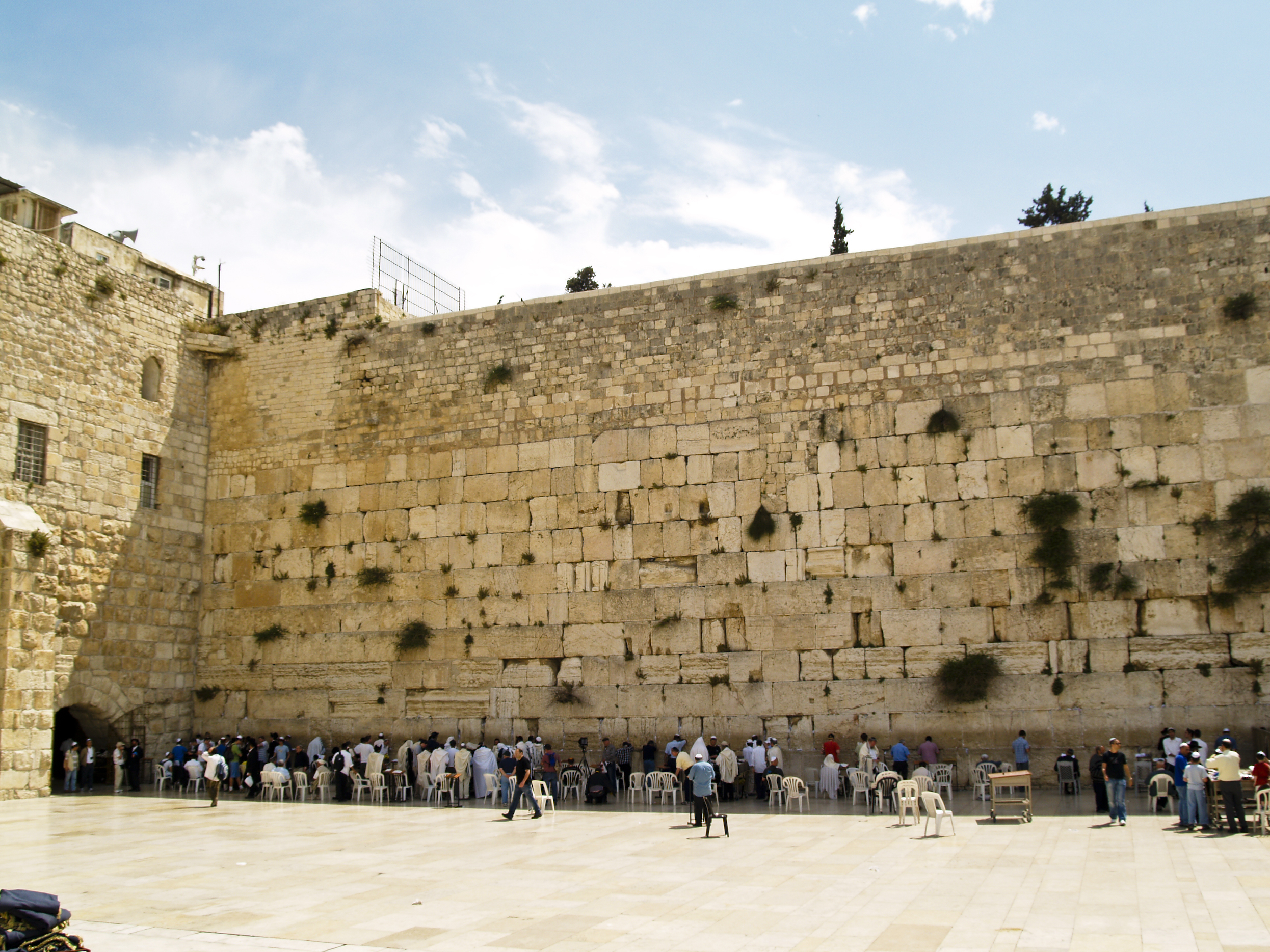
Doin/Shutterstock.com
The Wall of Lamentation, part of the outer wall of an important Jewish temple that remains in Jerusalem.The 19th century saw the persecution of "pogroms," in which many Jews were killed or driven from their lands in Russia and Eastern Europe. In Western Europe, Jews were suspected of being spies for foreign countries and were discriminated against. Under these circumstances, "Zionism" spread among the Jews, who wanted to establish their own country. Among several candidate sites, the holy land of Palestine was chosen because it was easy to gain support from many Jews.
At this time, Palestine was ruled by the Ottoman Empire, and many religions and ethnic groups were living together in a mixed population.
Q: Why did the British promise to build a Jewish "homeland"?
A: The reason Britain allowed the creation of a Jewish "national homeland" in Palestine in the Balfour Declaration was because it wanted to use the Jews to win World War I.
In World War I, Britain and France fought Germany and other countries. The Ottoman Empire, which controlled Palestine, would participate on the German side.
The British said, "If we win against the Ottomans, we will allow the Jews to create a national homeland in Palestine," and made Jewish property owners who wanted their own country pay for the war. Although the British described it as a "national homeland" and not a "state," the Jews thought that they would be allowed to build a "state.
Meanwhile, in order to weaken the Ottoman Empire, the British promised the Arabs in the empire that they would build an independent Arab state if they would revolt in the empire (Husayn-McMahon Letter). Furthermore, with France and Russia, they made a secret agreement to share the territories of the Ottoman Empire after the Great War (Sykes-Picot Agreement). The three irresponsible promises made by the British, each with different contents, are known as "three-party diplomacy.
Britain won World War I and was forced to deal with these three promises. The territories of the Ottoman Empire were divided with France, and Palestine came under British rule. And many Jews moved into Palestine, seeking to build a "state".
The Arabs tried to make amends by recognizing the independence of Iraq and Jordan.
Q: How did the Palestinian people fight?
A: The Palestinian people also opposed Israel through the liberation movement led by the Palestine Liberation Organization (PLO), established in 1964, and through resistance movements by the people without arms.
The PLO was a kind of provisional government created in 1964 with the support of Arab countries before the Third Middle East War. Initially based in Jordan, the PLO also holds parliamentary elections, and political organizations such as "Fatah" participate in it in the form of political parties. Fatah leader Arafat, who became famous for his armed struggle against Israel, took control of the PLO through its parliamentary elections.
Organizations joining the PLO have targeted Israel and its allies, hijacking and fighting with weapons. This approach, however, annoyed the Arab states that provided the PLO with a base of operations. In 1970, Jordan expelled the PLO from the country by force. Later, civil war broke out in Lebanon, where the PLO had moved its bases, and in 1982 Israel invaded, driving the PLO out of Lebanon as well and weakening it.
After the Fourth Middle East War, the Intifada, a Palestinian popular resistance movement, began in 1987. The Intifada took place in the Israeli-occupied Gaza Strip and the West Bank. Since the people did not have weapons, they resisted by throwing stones at Israeli military vehicles and soldiers.
Q: How were Israel and Palestine able to come to terms on the Oslo Accords?
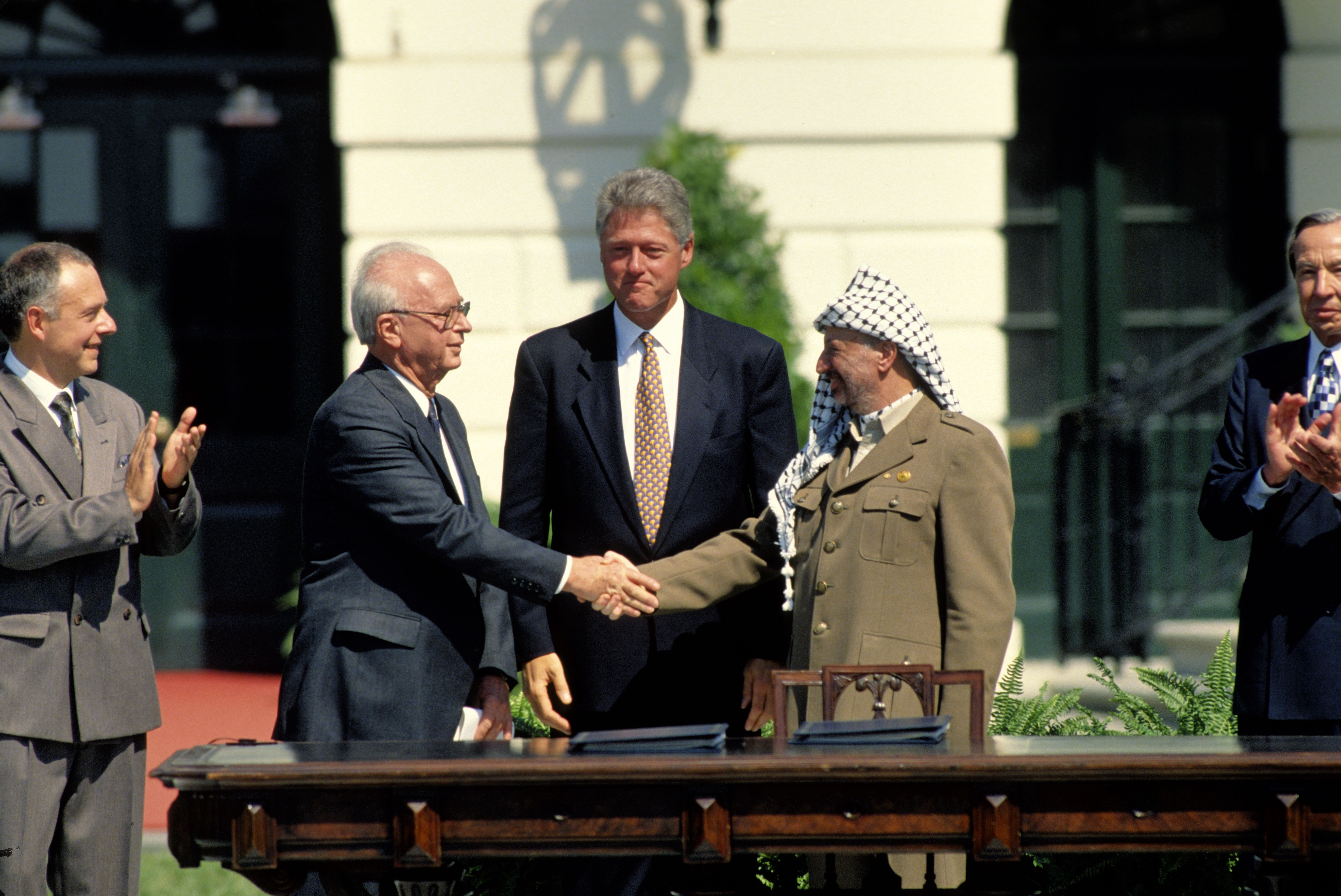
mark reinstein/Shutterstock.com
Israeli Prime Minister Yitzhak Rabin (center left) and Palestine Liberation Organization Chairman Yasser Arafat (center right) shake hands after signing the Oslo Accords in September 1993. At the back center is U.S. President Clinton, who acted as mediator.A: There were advantages to peace for both sides: Israel, which was anxious about the Palestinian resistance movement, and the Palestine Liberation Organization (PLO), which was about to be isolated internationally.
The Palestinian resistance movement (intifada) that emerged in 1987 did not stop even after Israeli military force was used to suppress it, and Israel began to worry about its continued occupation of the region.
In 1991, the Gulf War was a major event in the Middle East region. This war saw Iraqi President Hussein invade neighboring Kuwait, which was driven back by a multinational force led by the United States. The U.S. wanted to use the Gulf War as an opportunity to make the Middle East a stable region and called for peace talks between Israel and Palestine to stop the conflict.
Israel reluctantly complied when pressed by its ally the United States.
The PLO, led by Arafat, was also in a difficult situation at the time. During the Gulf War, the PLO supported Iraqi President Hussein, who had spoken out in favor of Palestine. As a result, like Iraq, the PLO had made enemies of many countries, including the Arab states.
In the same year, 1991, for their own reasons, Israel and a Palestinian delegation recognized by the PLO attended a peace conference in Madrid, Spain. However, the conference did not go well because of the many difficult issues involved in the peace process. Specifically, there were issues such as what to do about the right of Palestinian refugees to return to their original lands, how to draw the borders if a Palestinian state is to be created, how to deal with Jerusalem, which is considered holy by both Christians and Muslims, and what to do about settlements where Israelis have moved en masse to Palestinian lands. -These were the issues. Collectively, these issues are referred to as "final status."
A change of Israeli prime minister in 1992 provided the impetus for peace. The new Prime Minister, Yitzhak Rabin, had been Defense Minister during the Intifada and was well aware of the difficulties of continuing the occupation.
In 1993, Israel and the PLO reached a historic agreement to proceed with peace negotiations, although postponing any resolution on final status. It was promised that negotiations would continue for the next five years, while allowing the Palestinians interim self-rule. This is known as the Oslo Accord, after Oslo, the capital of Norway, where the negotiations took place.
Q: Why didn't the Oslo Accord work out after that?
A: This is because negotiations on the "final status," which was the most important issue, were postponed. The more negotiations proceeded, the more people on both sides were required to compromise with each other, and people in both Israel and Palestine became dissatisfied with this, and began to oppose peace.
The "final status" includes issues such as the right of Palestinian refugees to return to the land they came from, how borders should be drawn in the event of a Palestinian state, how Jerusalem, considered holy by both religions, should be treated, and what to do with settlements where Israelis have moved en masse onto Palestinian land. In Israel, Prime Minister Yitzhak Rabin has been a strong supporter of the Palestinian side.
In Israel, Prime Minister Yitzhak Rabin's decision to side with the Palestinians was seen as a betrayal by Israeli patriots, and in 1995 he was assassinated by a young patriotic Israeli. This nearly halted the peace negotiations, which had been fraught with problems to begin with.
Meanwhile, in Palestine, the Islamic organization Hamas continued its armed struggle against Israel and began using a new tactic: suicide bombings.
In 2000, the Palestinians' provisional autonomy expired, and negotiations for a "final status" could not be finalized. Just then, a visit by an influential Israeli politician to a Muslim holy site in Jerusalem sent the message that "all Jerusalem belongs to Israel," which angered the Palestinians so much that a resistance movement (intifada) against Israel was once again launched.
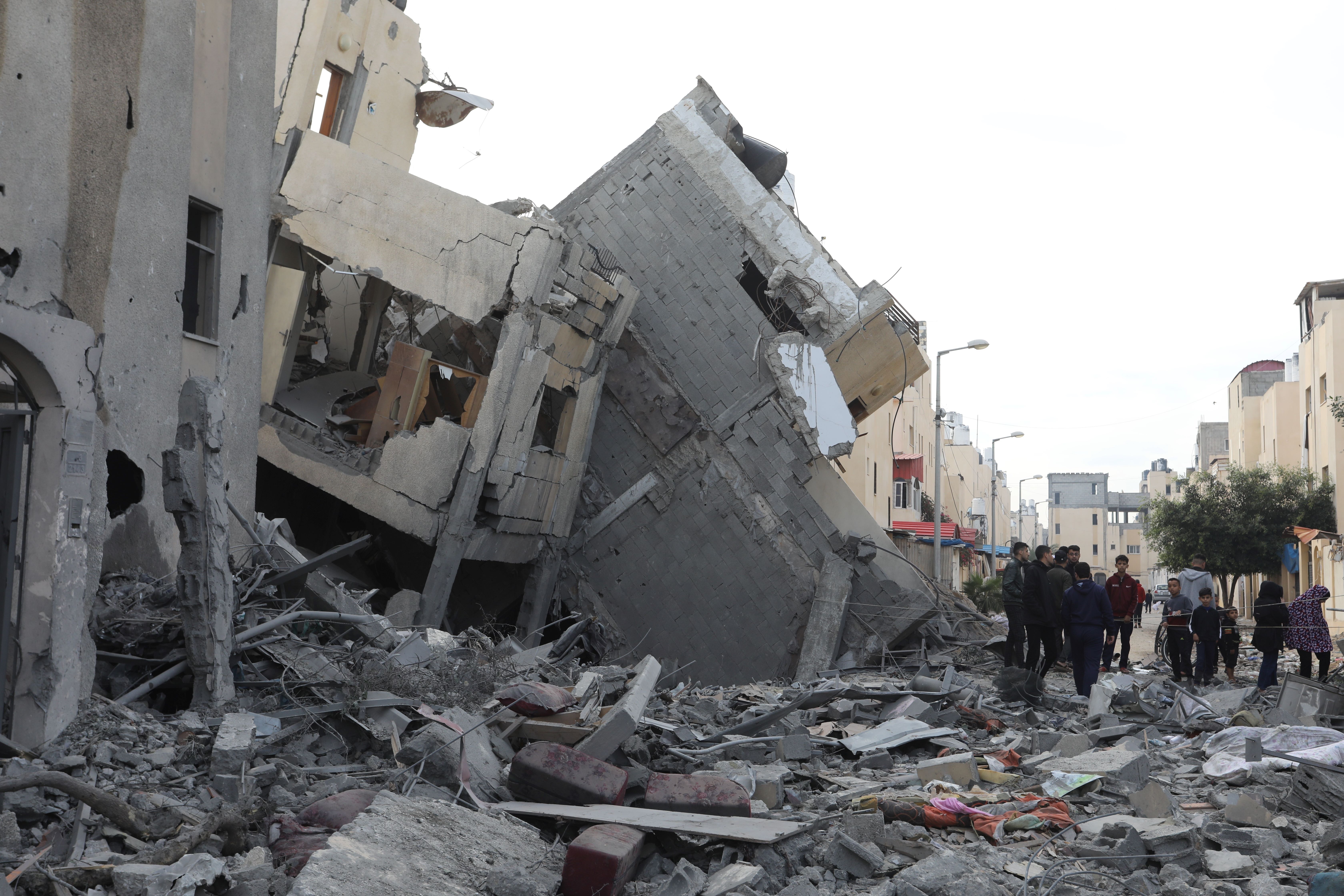
Anas-Mohammed/shutterstock.com
A town in the Gaza Strip destroyed by Israeli airstrikes in November 2023.The resistance that began in 1987 is sometimes referred to as the "First Intifada" and the resistance that began in 2000 as the "Second Intifada," but their methods are very different. While the first intifada was fought by the people who had no weapons of any kind, the second intifada was fought mainly by armed groups such as Hamas. Hamas repeatedly carried out suicide bombings in Israel, and the Israeli army repeatedly invaded the Palestinian territories with overwhelming military force. Thus, the peace negotiations completely broke down.
The Oslo Accords stalled, and efforts to restart negotiations continued with the U.S. as a mediator, but without success.
Q: What happened to Palestinian autonomy?
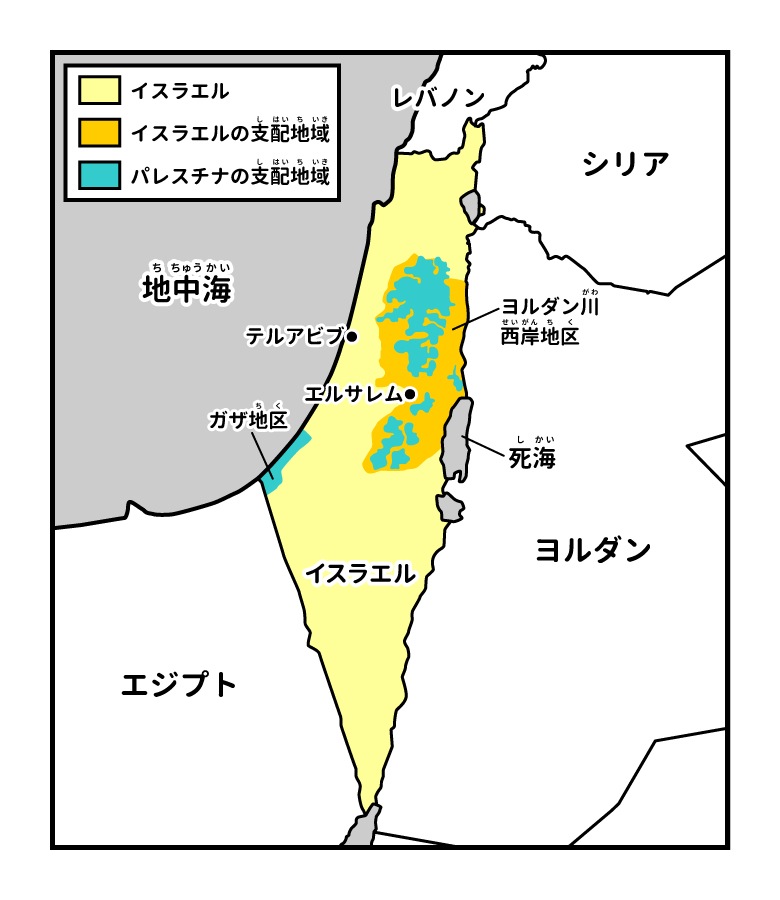
Source: "So it was so! Palestine and Israel" by Kazuo Takahashi.
A: The Hamas-controlled Gaza Strip and the Fatah-controlled West Bank are suffering from the Israeli blockade and continued conflict with Jewish settlers, respectively.
In 1994, the Palestinians began to establish provisional self-government under the Oslo Accords. Since then, the area including part of the West Bank and the Gaza Strip has been called the "Palestinian Territory" or the "State of Palestine. However, the Palestinians do not have the authority to administer all areas. The West Bank is divided into three areas: Area A, which the Palestinians can administer entirely; Area B, which is administered jointly by Palestine and Israel; and Area C, which continues to be governed by Israel.
In 2006, following the victory of the Islamic organization Hamas in Palestinian parliamentary elections, Palestine was divided with Hamas ruling the Gaza Strip and Fatah ruling the West Bank. Israel blockaded the Hamas-controlled Gaza Strip, making the Gaza Strip's economy almost unviable, and the people's lives were being pushed into a corner.
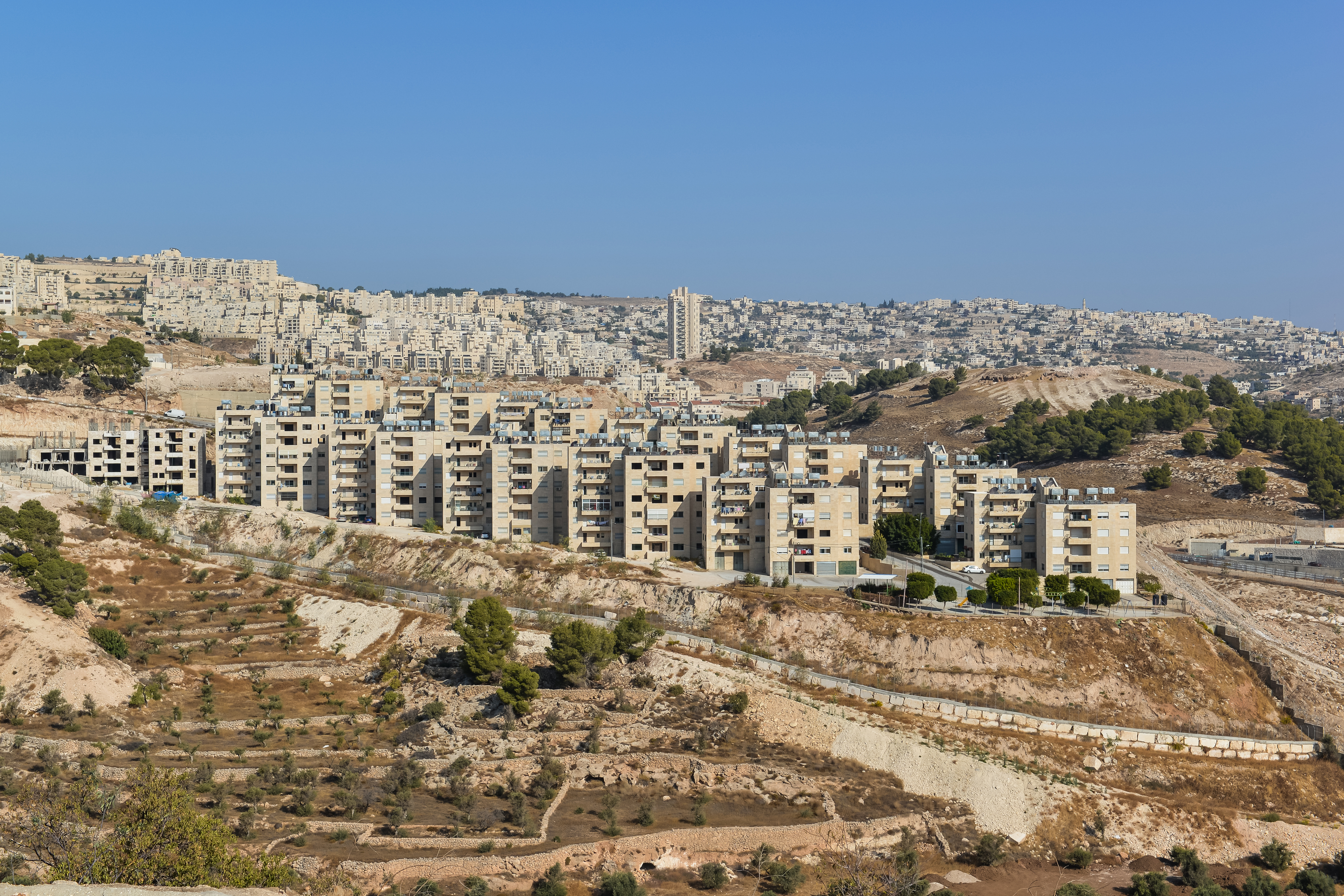
Julius Bramanto/shutterstock.com
Israeli settlements in the West BankThe situation in the West Bank is also serious. The reason for this is the settlements created by Israel for the Jewish people. Jews who move to the West Bank as settlers are allowed to carry weapons for protection. Some of these settlers believe that the West Bank belongs to Israel, and have harmed Palestinians and burned their homes. This settler violence has not been stopped, even by the Israeli government. Fatah is also weak in its ability to maintain security, and Palestinian youth have begun to form their own armed groups. If clashes between Jews and Palestinians intensify in the West Bank, which has a larger population than the Gaza Strip, the situation could become even more difficult.
Q: What is the U.S. position?
A: The United States has always taken the position of siding with Israel as an important ally in the Middle East region.
During the four wars in the Middle East, the U.S. was at odds with the Soviet Union (Cold War), and after Israel's victory in the Third Middle East War in 1967 over the Arab states that had close ties to the Soviet Union, the U.S. began to look to Israel as an ally.
At the time, the U.S. had an ally in the Middle East, Iran, which became hostile to the U.S. after a revolution in 1979. Since then, Israel has been almost America's only ally in the Middle East.
On December 8, 2023, the United Nations Security Council passed a resolution calling for an immediate ceasefire in the Gaza Strip against Israel. 13 of the 15 member states, including Japan and France, voted for the resolution, but the U.S. vetoed it. The resolution was rejected.
Lobby groups are those that work to influence the U.S. government. In the U.S., the "Israel lobby" has been formed by people who believe that allying with Israel is in the national interest of the U.S. This includes non-Jewish Americans who believe that the U.S. should be able to influence the U.S. government. Many non-Jewish Americans participate in this group. The strength of the Israel Lobby is one of the reasons why the U.S. maintains its relationship with Israel.
Q: What is Japan's position?
A: Japan has been pursuing a unique line of Middle East diplomacy that differs from that of Western countries that take a pro-Israel position.
During the Fourth Middle East War in 1973, the oil-producing Arab nations invoked their oil strategy of "restricting oil exports to countries that side with Israel. This caused an "oil crisis" (oil shock) that raised the price of oil worldwide, and interest in the Palestinian issue rapidly increased in Japan. Japan was very concerned about oil price hikes and the inability to import oil, so it began to conduct diplomacy that was not hostile to Palestine or the Arab world, unlike Western countries that took a pro-Israeli position. One example is the establishment in 1977 of an office in Tokyo of the Palestine Liberation Organization (PLO), the organization that represents Palestine. Since the Oslo Accords, Japan has supported the "two-state solution," in which both Israel and Palestine have a secure country, and has taken a position against Israeli settlement activities.
監修:鈴木啓之さん

Born in 1987. Specially Appointed Associate Professor, Sultan Qaboos Endowed Chair in Global Middle East Studies, Graduate School of Arts and Sciences, The University of Tokyo. Doctor of Philosophy. He was a JSPS Research Fellow PD at Japan Women's University and a JSPS Postdoctoral Fellow for Research Abroad at the Harry S. Truman Peace Research Institute, Hebrew University, before assuming his current position in September 2019. She is the author of Uprising [Intifada]: Palestine under Occupation 1967-1993 (University of Tokyo Press, 2020) and co-editor of 60 Chapters for Understanding Palestine (Akashi Shoten, 2016).
Text by Shunichi Mishiro