





What are the "weak yen" and "strong yen" that we often hear about in the news? How do they affect our lives?
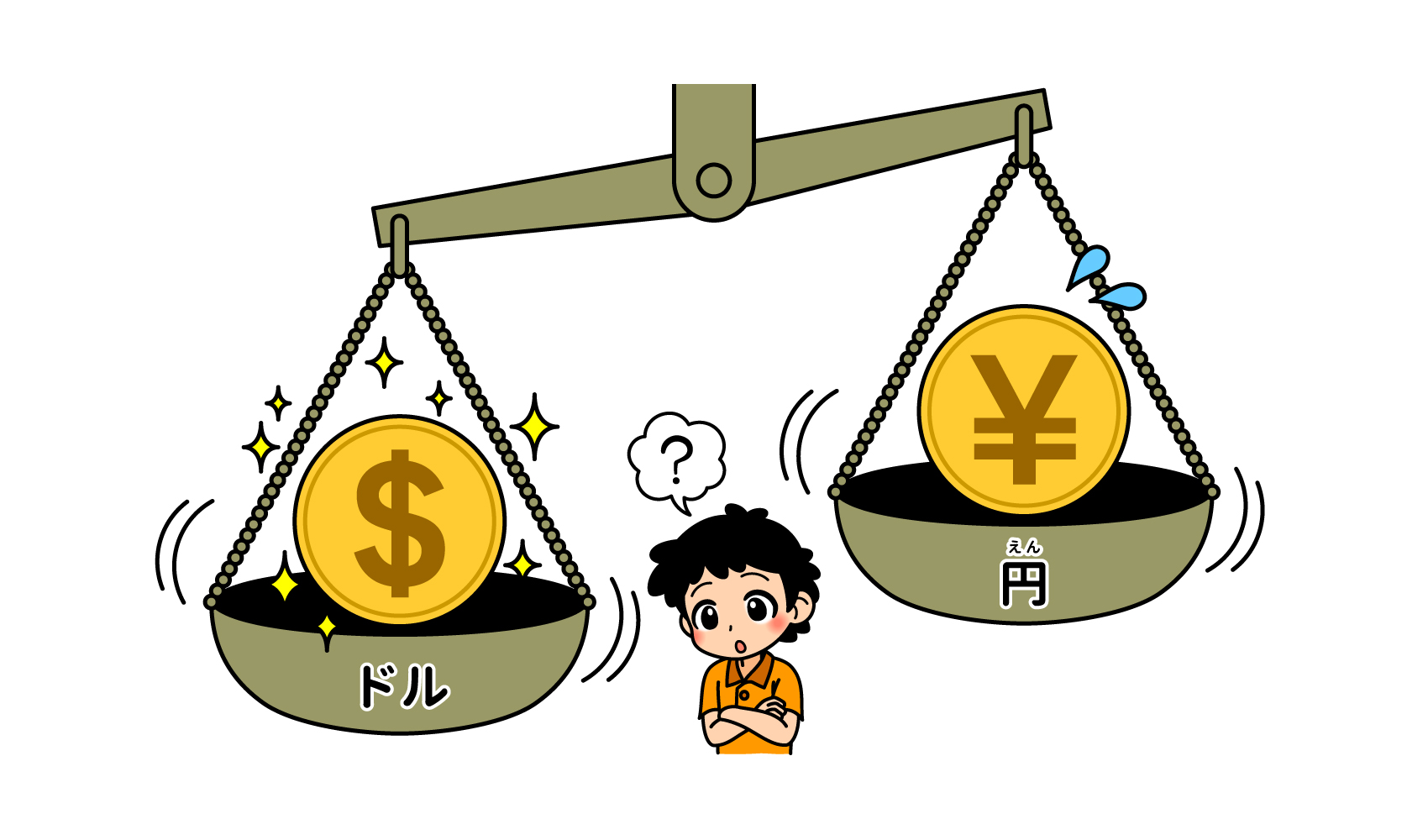
Have you ever heard the term "yen depreciation?" In October 2022, this word was often in the news. It was the first time in 32 years that the yen was at 150 to the dollar," or "The government is taking measures to put a stop to it. Literally, it means that the Japanese "yen" is "cheap," but what does it mean when money itself becomes cheap or expensive? Does it affect our lives? We will also introduce the opposite of a weak yen, a strong yen.
The ever-changing value of money
Different units of money in different countries
First, the unit of money differs from country to country.
The unit of money in Japan is the yen, but in the United States it is the dollar, in European Union countries it is the euro, in South Korea it is the won, in India it is the rupee, and so on.
While the yen is sufficient for daily life in Japan, it is necessary to have a common unit of money when companies buy and sell goods across countries. The U.S. dollar is often used around the world, and Japanese companies exchange yen for dollars on a daily basis.
Research study "Research on Money in the World
How much do you trade for, and at what price?
At this time, the "exchange rate" determines how much yen and how much dollars are exchanged. This is what is referred to in the news as "0 yen to the dollar.
Exchange rates are always changing.
In slightly more difficult terms, it is determined by the relationship between "demand" and "supply.
Demand is how many people want to buy the thing. If there are many or more people who want to buy the item, the price of the item will increase. If the number of people who want to buy the item is small or decreases, the price of the item will decrease.
Supply is how much of the item is sold. If the quantity is small or decreases, the price of the item increases, and if there are many or more people who want to buy the item, the price of the item decreases.
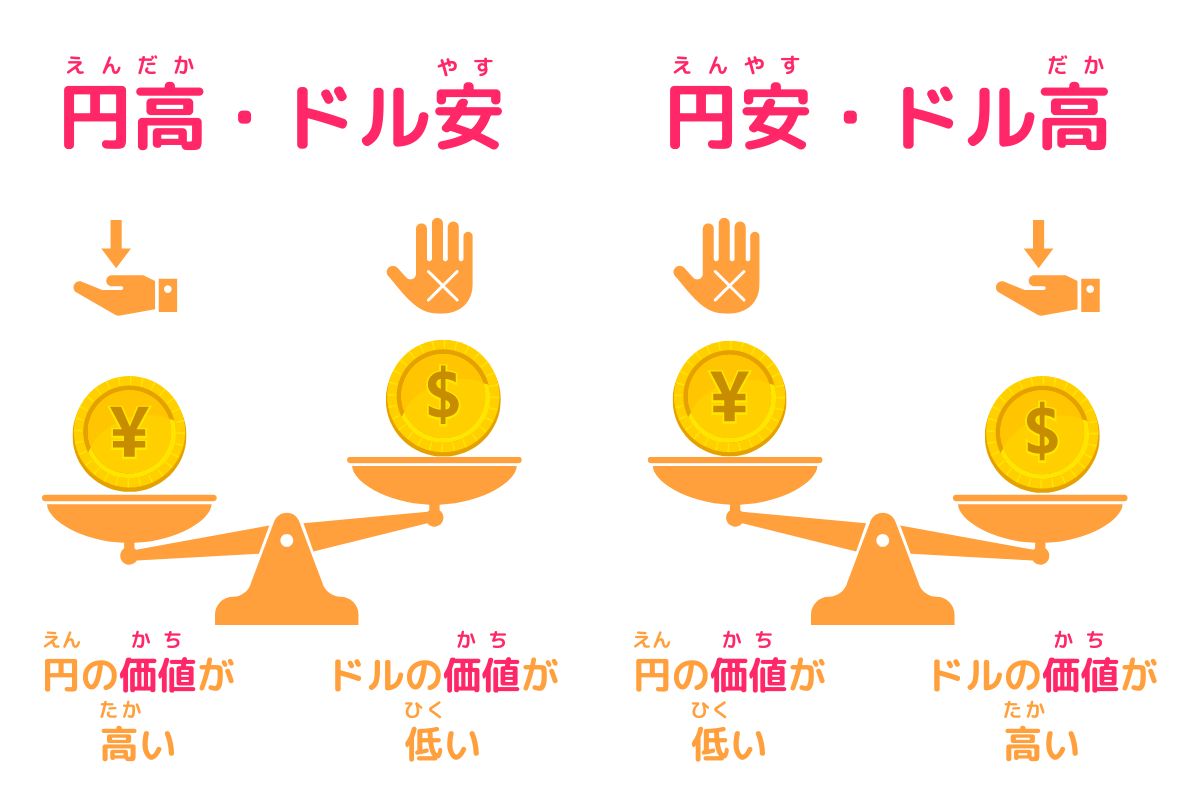
This also applies to the money itself, the yen and the dollar. The value of each goes up or down depending on how many people want them and how much can be exchanged for them.
The current depreciation of the yen means that the value of the yen is declining, which means that there are fewer people who want yen and, conversely, many people who want dollars.
Which is the weaker yen, 100 yen to the dollar or 200 yen to the dollar?
So, if the exchange rate is "$1 = 100 yen" (exchanging $1 for 100 yen) and "$1 = 200 yen" (exchanging $1 for 200 yen), which is a weaker yen and which is a stronger yen?
If we replace the word "exchange" with the words "selling and buying," it may be easier to imagine "cheap" and "expensive.
If you can buy only 100 things (yen) for $1 and 200 things (yen) for $1, which is the cheaper thing (yen)?
In other words, "200 yen to the dollar" is less valuable than "200 yen to the dollar," or a weaker yen. In the case of the expression "0 yen to the dollar," a larger yen figure means a weaker yen. It is. Conversely, a smaller yen figure is a stronger yen.
Which is better, a weak or strong yen?
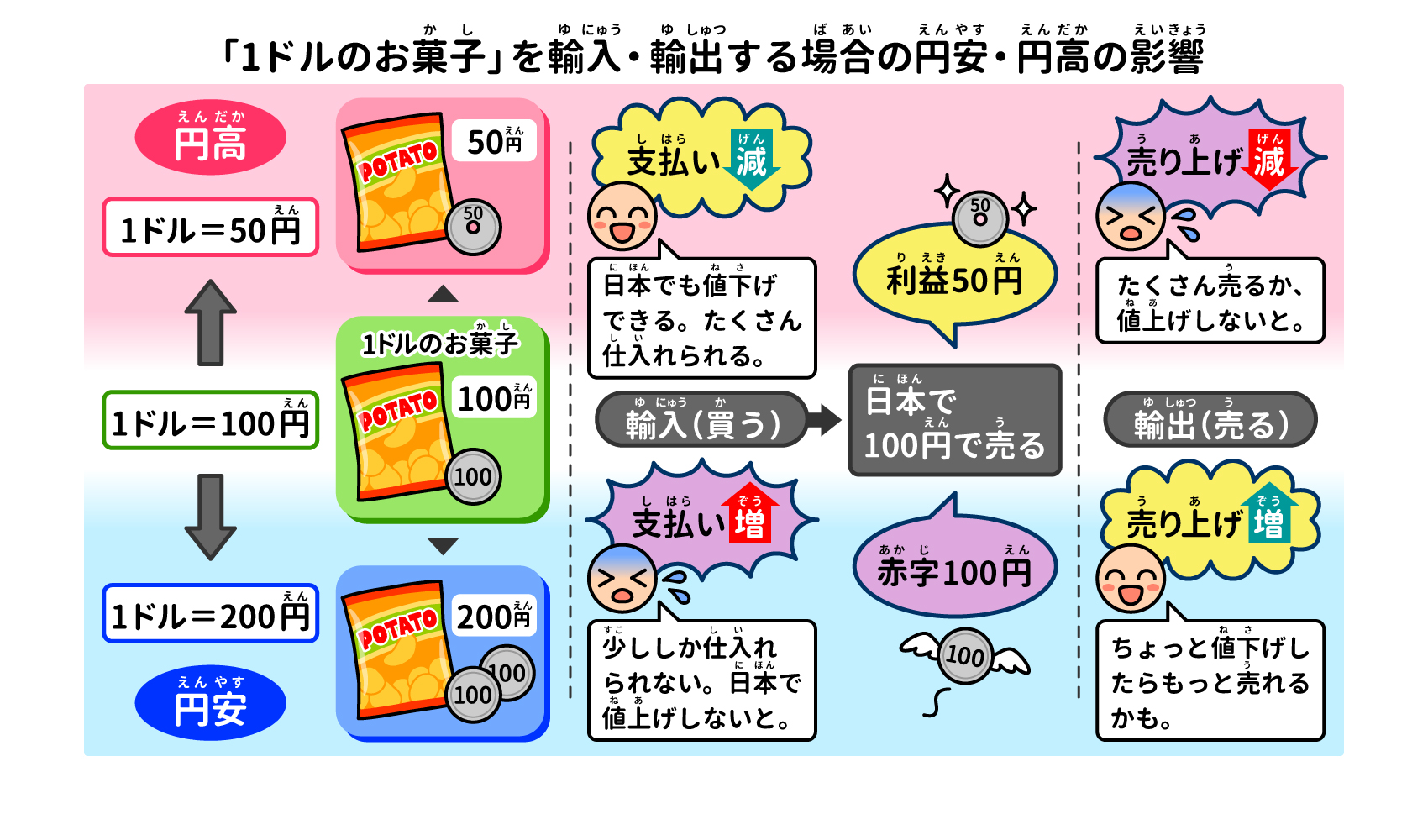
There are both positive and negative aspects to both a weak and strong yen, and neither is better than the other. In our daily lives, we are easily affected by the rising or falling prices of imported goods.
When the yen weakens, it is great for exporters who sell goods overseas. It allows us to exchange more sales in dollars for more yen, or to lower the price in dollars of goods to be exported.
Also, we are not happy about importing goods from abroad. You will have to pay more yen than before for the same goods.
In our daily lives, we may feel the effects of higher prices for energy resources and foodstuffs, as the prices of imported goods may be raised. In addition to price increases for products such as foreign-made sweets and meat, there may also be price increases for domestically produced goods that require imported materials and fuel to produce, such as livestock products that use imported feed.
When the yen appreciates, the opposite happens. Exporters are not happy because they make fewer sales and pay higher prices in dollars. Imports are happy because they pay less yen. In our daily lives, imported goods themselves, as well as domestically produced goods made from imported feed, materials, and fuel, may be reduced in price.
Why is the yen weakening now?
The yen has weakened to the point where it is big news now, The main reason is the difference in policy regarding money between Japan and the U.S. It is.
." interest rates In January 2022, the dollar was at ¥115 to the dollar, so the yen has weakened by about ¥35 in the 10 months through October 2022.
Japan imports a lot of foodstuffs and energy resources such as oil and natural gas, so a sudden depreciation of the yen is not a good thing for daily life. Japan is trying to stop the sudden depreciation of the yen by becoming a "Yen-hunter" and buying yen with dollars to support the popularity of the yen, but this is not going very well.
監修:泉美智子さん
(Representative of Children's Environmental and Economic Education Laboratory). Formerly an associate professor at the Kyoto University Institute of Economic Research, Tokyo Branch, and at the Faculty of Business Administration, Tottori University of Environmental Studies, before assuming her current position. Lectures nationwide on "Coffee-Time Economics for Women" and "Parent-Child Economics Classes. She also appears on TV and radio. Her recent books include "The Money Structure a 12-Year-Old Girl Found" (Takarajimasya) and "The Super Basics of Money You Can't Ask Me Now" under her supervision. She is a member of the Japan FP Society and the Japan Children's Literature Association.