




actuary

Actuarial professionals who calculate insurance premiums and claims in the financial sector, including life insurance, non-life insurance, and corporate pension plans.
Perfect For …
A person who is interested in explaining logically why something is so using numbers and symbols, and who is good at mathematics and calculations. The ability to read statistical data and other information and the communication skills to explain calculation results in an easy-to-understand manner are also necessary.
Job Details
Supporting insurance and pension systems with probability, statistics, and other mathematical knowledge and skills.
An actuary is an actuarial professional who works primarily for insurance companies, and is also called an "actuary or insurance actuary. Actuarial" refers to a method of theoretically clarifying various events using mathematics (a science learned in junior high school that is a development of arithmetic). For example, when a life insurance company develops insurance products such as "cancer insurance" and "death insurance," actuaries predict the income and expenditure of the products based on the probability of cancer, the rate of death from cancer, and statistics on economic trends, and calculate appropriate premiums and insurance benefits. In the same way, non-life insurance companies are involved in the development of products such as "automobile insurance" and "fire insurance. They also verify the design of the "corporate pension" system that the company provides to its employees, as well as the finances for sound management. Furthermore, they may be involved in predicting the risk of business losses for the company and asset management by utilizing methods to predict future events. Outside of insurance companies, consulting companies that provide advice to individuals and companies that serve as customers, they conduct accounting audits (examining whether accounting documents are prepared in compliance with the law) from the standpoint of a third party.
Key Points !
Studied mathematics in college or graduate school and gained experience in actuarial work at an insurance company
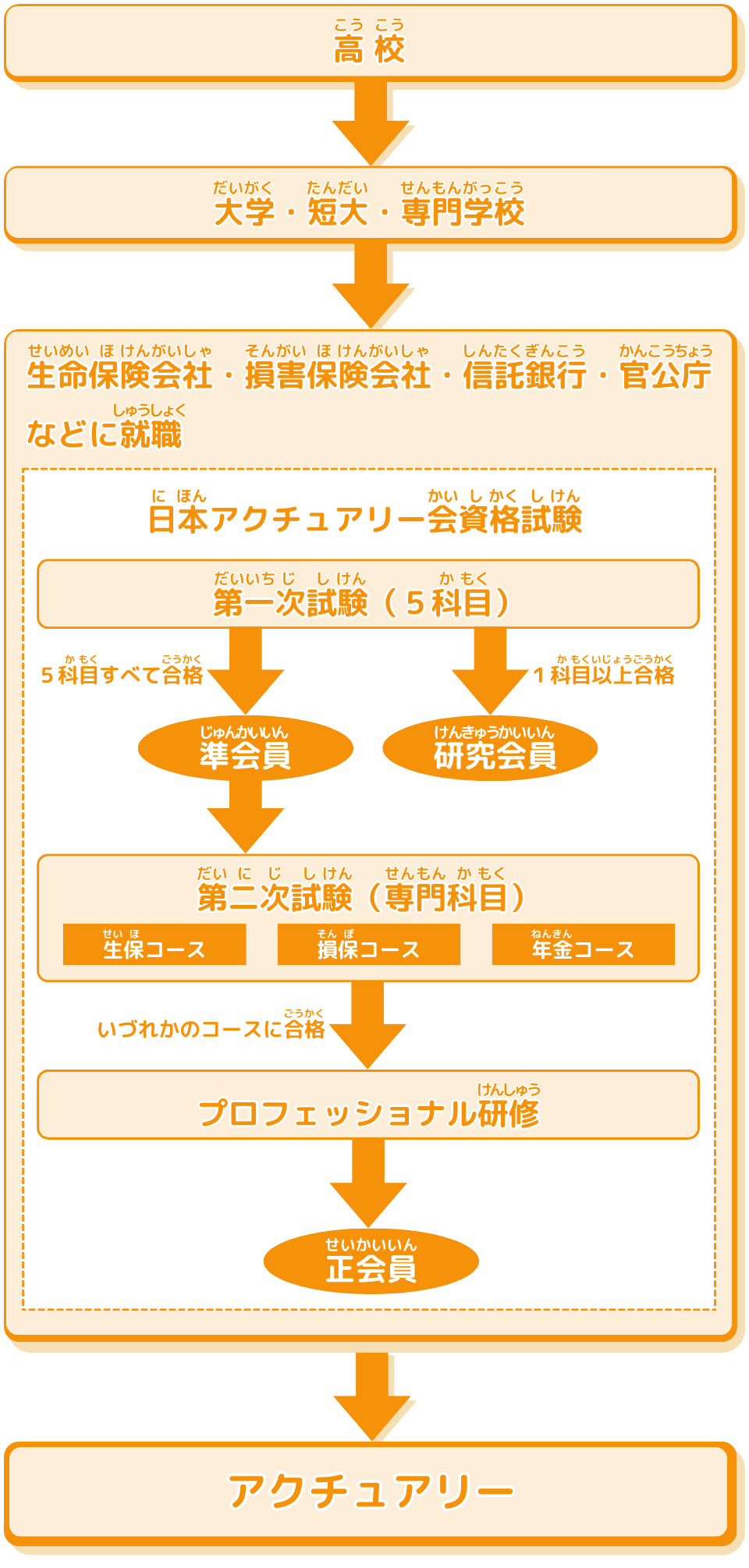
If you want to become an actuary, it is common to study probability, statistics, etc. at a junior college, university, or graduate school in the "Department of Mathematics in the Faculty of Science" and gain experience in actuarial work by working for an insurance company. There are no qualifications required to perform actuarial work. However, to officially call oneself an actuary, one must pass a private qualification examination conducted by the Japan Society of Actuaries and be certified as an active member. Many actuaries study for the certification exam while performing actuarial work for their companies, and often spend a number of years to become certified as a full member. Incidentally, the Insurance Business Law (a law that insurance companies must abide by) stipulates that an insurance actuary must be appointed by the company's board of directors and must be a regular member of the Japan Society of Actuaries. In addition to being a regular member, the actuary must also have at least three to seven years of experience in actuarial work. Once certified as a regular member of the Society of Actuaries of Japan, one should aim to become an insurance actuary who represents the company.
Qualifying exams are difficult, with some questions impossible to solve without work experience.
To become a full member of the Society of Actuaries of Japan, a person must pass a qualification examination conducted annually by the Society. To be eligible to take the examination, the applicant must have graduated from a university, including a junior college, or have been judged to have equivalent academic ability. The first exam consists of probability, statistics, and other calculation questions to determine whether the applicant has basic knowledge of mathematics, and the second exam is a writing-type exam to determine whether the applicant has the specialized knowledge and problem-solving skills necessary for actuarial practice. For the second examination, examinees must choose one of three specialized courses: life insurance, non-life insurance, or annuities. After passing two subjects in each course and completing the "professionalism training," the candidate is eligible to become a "regular member. The exam includes not only advanced mathematical questions, but also questions that cannot be solved without work experience. It is said that it takes 8 to 10 years to pass this difficult exam. It is important to be persistent and keep studying.
In the Future
Actuaries' forecasting skills are becoming increasingly important, and they are also playing an active role overseas.
Japan has become a "super-aging society" with an ever-increasing population of seniors aged 65 and over. Actuaries are essential to the development of insurance products for the elderly, which insurance companies are likely to focus on in the future. Some people believe that "AI will replace" the work of calculation and data-based forecasting, but it is hard to imagine that the work of actuaries will disappear, as it will be difficult to entrust AI with the communication necessary to carry out the work. The work could be divided among actuaries, with AI in charge of analysis and actuaries in charge of "explaining the results of predictions in an easy-to-understand manner to the other party.
In addition, since the technology of future forecasting can be used for corporate risk management, it is likely that actuaries will find more opportunities to work in this field as more and more companies recognize the importance of risk management. There is also a possibility that more actuaries will start their own businesses. Furthermore, the insurance market is expected to expand in Asian countries and other countries where economic growth is expected. More Japanese actuaries may develop insurance products for overseas markets and work abroad.
Job Facts
Income.
The average annual income ranges from 7.21 to 10.47 million yen.
Vacation?
Many companies have a full workweek, with Saturdays, Sundays, and holidays off.
Where do you work?
Life insurance companies, non-life insurance companies, reinsurance companies (for insurance companies), trust banks, government agencies, consulting firms, auditing firms, etc.
Your Future Path
It's a chart that shows at a glance the main routes to getting a job as an actuary!