




bank employee

Conduct various money-related transactions with individuals and companies, including "deposits," "loans," and "settlements.
Perfect For …
A meticulous and serious person. A person who is strong in numbers and eager to learn. People with a strong sense of responsibility and justice.
Job Details
Interfacing between depositors and individuals or companies in need of money to stimulate economic activity in society.
Banks perform a variety of money-related transactions. Three typical types are "deposits," "lending (loans)," and "settlement (foreign exchange). Deposits" involve taking custody and managing money from individual and corporate customers. The customer earns a profit, called "interest," depending on the length of time the money is deposited. Lending" refers to lending money to individuals or companies. The money used for lending is invested in deposits from other customers. The individual or company borrowing the money pays back the amount plus a royalty called "interest," and the bank makes a profit on the interest. A portion of the profit is used to pay interest to depositors. Settlement" refers to payment transactions between individuals and companies or between companies. Familiar examples include the payment of utility bills such as electricity, gas, water, and telephone bills, and credit card bills. This is handled by transferring money between the individual and each company's bank account. When payments are made to a fixed company each month, settlements are often made in the form of "automatic debits. Another task of the bank is to transfer money overseas.
A banker's job is to act as an intermediary between customers who deposit money and customers who want to borrow money, and to provide a beneficial method for each. By doing so, they play an important role in stimulating economic activity in society.
Teller service" to handle money inside the bank, and "sales" to propose services outside the bank.
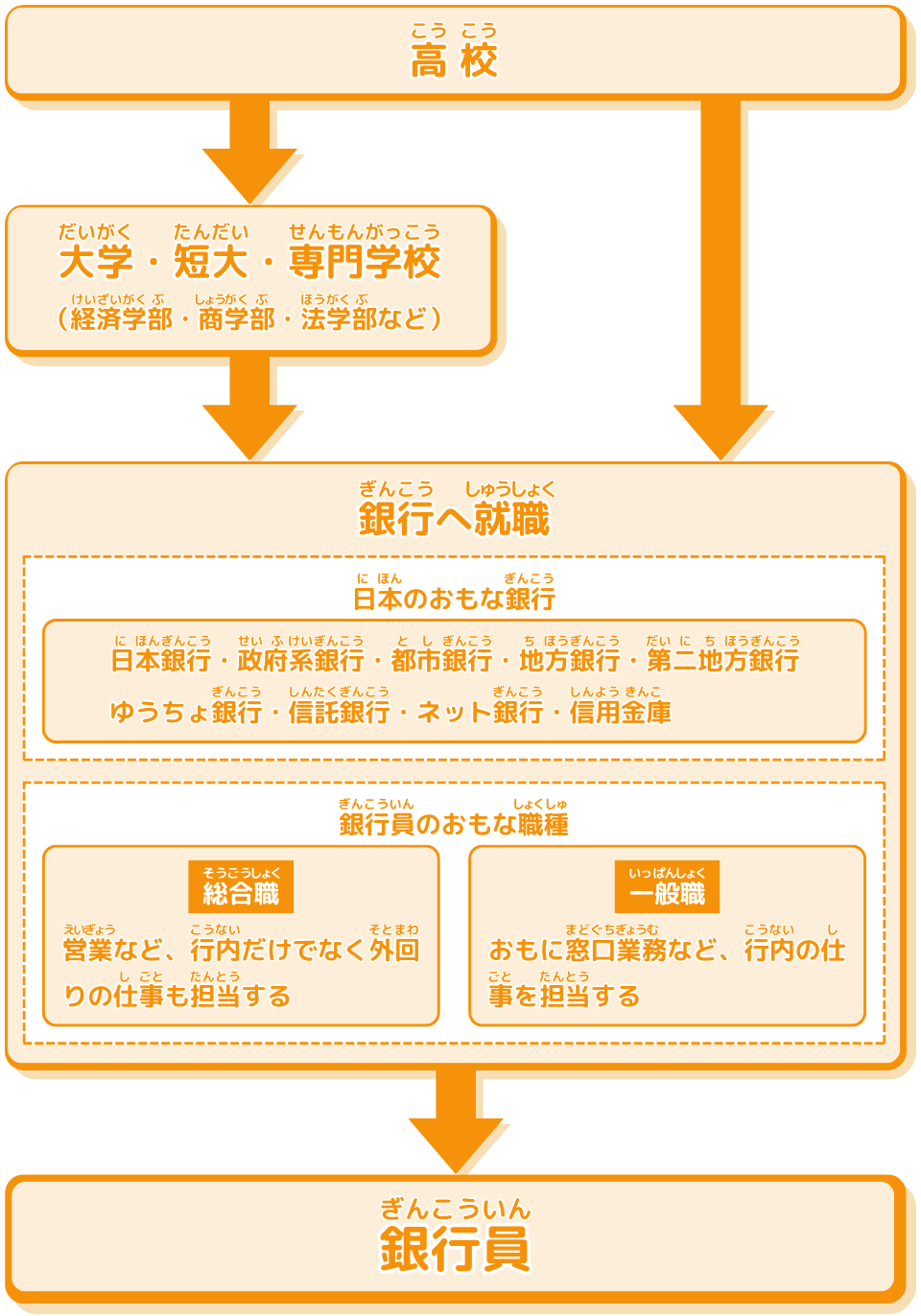
There are two types of positions for bank employees who perform such work: "general positions" and "career-track positions. General positions are mainly in charge of "counter service," which involves interacting with customers over the counter at the bank. In addition to performing duties such as deposits, remittances, and opening accounts, they are the face of the bank and are expected to provide courteous customer service. Although many banks close the teller window at 3:00 p.m., the tellers still calculate the amount of money received for the day and check to make sure that the amounts are correct. They also prepare cash for transportation and remit taxes and utility bills received from customers. In no way does their work end at 3:00 p.m. On the other hand, career-track employees are often involved in "sales," which involves making outside visits as well as inside the bank. Salespeople are responsible for making various proposals to customers to encourage them to use services such as deposits and loans. Sometimes they deal with customers in the bank's reception room, and sometimes they go out to visit customers. The job requires good communication skills. If the customer is a company, the job may involve handling large sums of money, sometimes in the hundreds of millions of dollars, so the responsibility is even more serious.
Key Points !
There are no qualifications to become a banker, but there are many qualifications to obtain as a banker
No special qualifications are required to become a banker. While general positions do not require any particular educational background, most career-track employees are university graduates. After employment, most general job holders undergo various training courses and are assigned to teller operations, while career-track employees are often assigned to sales and other positions after gaining experience working in a number of departments. In addition, although there are no qualifications to become a banker, there are many qualifications that one should obtain as a banker. For example, there are the "securities salesman certification," which is necessary to recommend and sell financial products (deposits in the case of banks) to customers; the "life insurance solicitor certification" and "non-life insurance solicitor certification," which are necessary to sell life insurance and non-life insurance; and the "financial certification," a national certification that certifies one as a specialist with extensive knowledge of finance, taxes, insurance, mortgage loans, and other areas. Financial planner" is a national certification that certifies that a person is a specialist with extensive knowledge of finance, taxes, insurance, home loans, etc. There are many other qualifications that must be obtained. There are many other certifications that must be obtained, and one must study for them every day.
Types of banks in Japan and their respective roles
There are many types of banks, each with a different role. First, the "Bank of Japan" is the only bank that can issue bills. Individuals and companies cannot make deposits, but national and foreign central banks and international organizations can open accounts. There are five government-affiliated banks, many of which are funded by the government, and they are used to ensure the stable lives of citizens and to promote economic development. The four "city banks" are Mitsubishi UFJ Bank, Sumitomo Mitsui Banking Corporation, Mizuho Bank, and Resona Bank. With head offices in major cities such as Tokyo and Osaka and branches in major cities throughout Japan, they can provide services anywhere in Japan. They also have a foothold in countries around the world and lend to national governments, large corporations, and overseas companies. Regional banks and second-tier regional banks" are banks located in each prefecture, with 99 banks supporting the local economy by providing services suited to their respective regions. Japan Post Bank is a privatized bank that was once a publicly owned post office that handled savings. This is the reason why there are Yucho Bank ATMs in post offices throughout Japan. Trust banks" provide deposits and loans, as well as trust services for individuals and companies. An "online bank" is a new type of bank that allows customers to open accounts and make payments over the Internet. There are also "shinkin banks," which are not banks but provide financial services similar to those of banks to individuals and small- and medium-sized companies in their areas of responsibility.
In the Future
Opportunity to work around the world? Is the ability to adapt to digital technology also important?
In Japan today, the "interest rate," the percentage of money paid for the use of borrowed money, is low, and the profits that banks earn from lending to individuals and companies are declining. As a result, city banks and some regional banks are expanding their business overseas in order to increase their profits. This would be a great opportunity for those who aspire to work on the global stage. Meanwhile, the emergence of online banking (digital banking) has made it possible to process payments without going to the bank. The number of users is increasing as "cashless payments," which do not involve the use of actual money, become more widespread. In addition, online banking, where all services can be performed via smartphone operation, has been created, making it even more convenient. New digital technologies will continue to be introduced. The bankers of the future may need to be able to adapt well to the advancing digital technology.
Job Facts
Income.
The average annual salary for general and counter service is 3.7-4.4 million yen. The average annual salary for career-track positions and sales is 3.89-4.94 million yen.
Vacation?
Basically, Saturdays, Sundays, and national holidays are off. It is easy to take consecutive vacations and paid vacations.
Where do you work?
General employment and teller service is basically a window in the bank. General employment/sales staff sometimes visit reception rooms in the bank, customers' private homes, or companies. In addition, bank employees are often transferred. Most career-track employees are transferred to other branches every two to three years. Even general employees can be transferred.
Your Future Path
It's a chart that shows at a glance the main routes to getting a job as a banker!