




monk
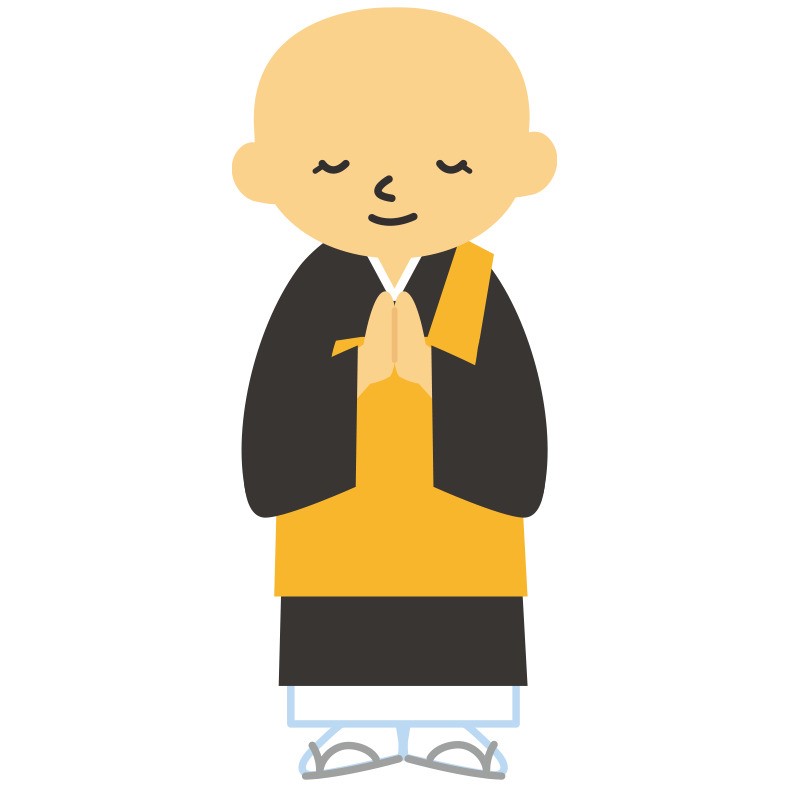
A monk is a member of a temple, and while performing the rituals and events of his religious sect, he also trains himself to spread the teachings of Buddhism throughout the world.
Perfect For …
People who can empathize with Buddhist ideas, people who are considerate of other people's feelings, and people who can listen to others with kindness.
Job Details
To offer memorial services to the deceased and to pass on the teachings of Buddhism to others.
Monks belong to temples and chant sutras at funerals and memorial services requested by danka (*) and give sermons to spread Buddhism in the community. In temples that have cemeteries, they also maintain and manage the cemeteries. Recently, there has been an increase in the number of priests who do not belong to a temple but work freelance under contract with a funeral service company or who are dispatched by a dispatch service company to travel to the place where the client is holding the funeral or memorial service.
Danka = A person or family who becomes a follower of a temple and provides financial support by making offerings.
Difference between "priest," "monk," and "abbot."
The term "monk" is used to refer to all those who have been ordained and are practicing Buddhism. Monk" is a friendly term for a monk. The term "abbot" refers to a monk who lives in the temple and is responsible for its management and upkeep. In many cases, children follow in the footsteps of their parents and take over as priests, but recently the number of temples with no successors is increasing. In some cases, a new abbot is dispatched from the head office of the sect to continue the temple. In temples where there are several priests, the priest who is next in rank to the abbot is called "vice abbot" or "vice abbot.
Key Points !
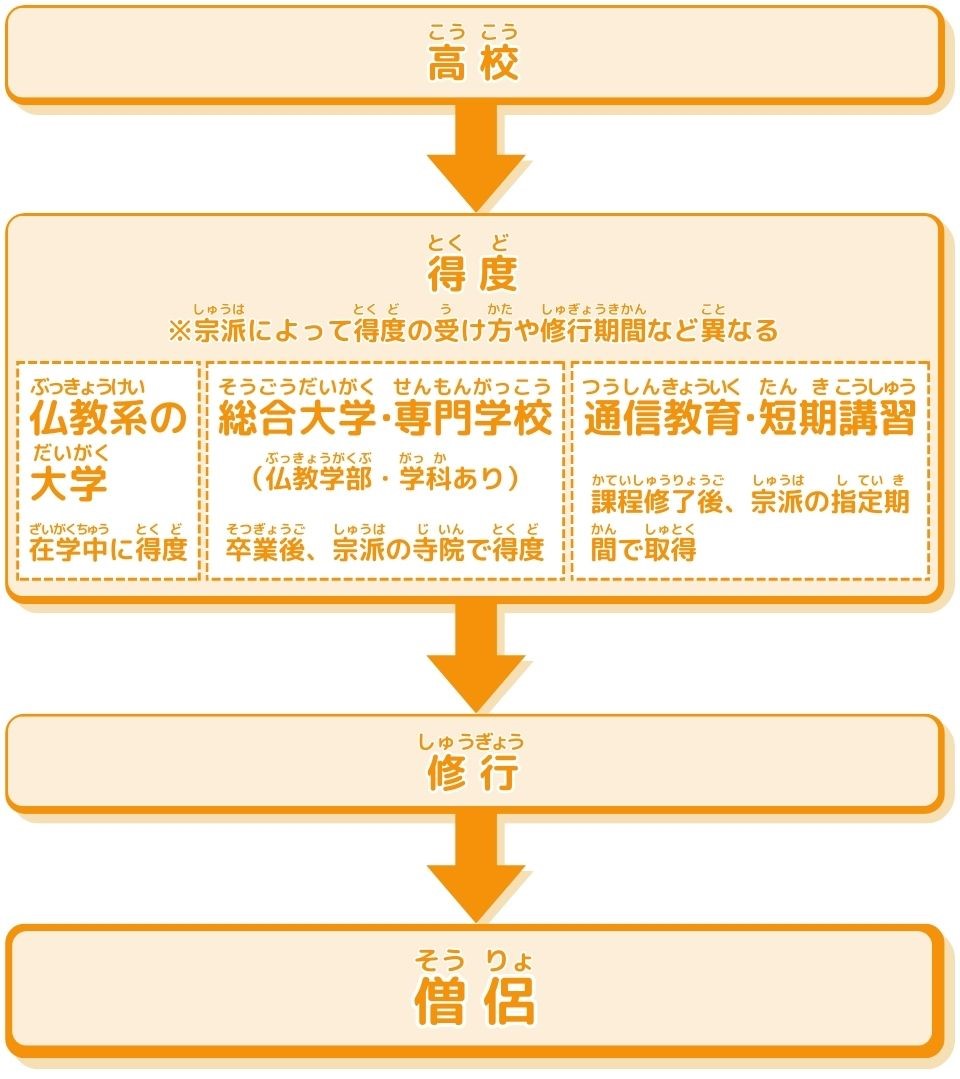
Becoming a monk requires the "Degree of Completion" ceremony.
There are no official qualifications required to become a monk, but one must undergo a ceremony called "Dekido," in which one is permitted to enter the world of Buddhism to study it. Generally, "Tokudo" involves shaving one's hair (shaving) and receiving the name of a monk, "Kai Mei" (in the case of Jodo Shinshu, "Hou Mei"), also known as "ordination". The "ordination" takes place under the supervision of a "master monk" who serves as a teacher. Most Buddhist universities have "ordination" as a part of their curriculum, so it is a shortcut to becoming a Buddhist monk. In some cases, after graduating from a general university or vocational school, a student may visit a Buddhist temple to become a disciple and receive "Dekko" from the abbot. Recently, there is also a system whereby a monk can be recognized as a priest by taking distance learning or short-term training courses. The process of obtaining priesthood, the method of training, and the path to recognition as a priest vary from sect to sect, so it is important to check carefully when choosing a school. In some cases, hair is not shaved.
Different denominations have different colleges to study.
There are many sects of Buddhism in Japan. Each sect has its own way of ordination and ascetic practice, and the universities available differ according to the sect. It is advisable to carefully check which sect you wish to become a Buddhist monk before proceeding with the preparation for higher education. For example, Komazawa University for Soto Zen monks, Ryukoku University for Jodo Shin monks, Rissho University for Nichiren Buddhist monks, and Koyasan University for Shingon Buddhist monks are all well-known universities that offer Buddhist studies. After graduating from a university, it is common for students to take their first steps toward becoming Buddhist monks by serving (working) at a temple and undergoing ascetic training. On the other hand, it is also possible to obtain ordination through correspondence courses or short-term training at an organization that offers such training. Regardless of the method used, it is not only by receiving ordination that one is recognized as a full-fledged monk, but it is also the beginning of the monkhood process. Even after becoming active as a monk, one continues to learn about Buddhism and to teach Buddhism to others throughout his or her life.
In the Future
The role of priests is expanding in many ways.
Buddhist ceremonies such as funerals and memorial services have tended to be simplified in recent years, and the demand for Buddhist priests has also decreased. However, an increasing number of monks are taking on a variety of other activities in addition to sutra chanting. Some use social networking services to communicate their activities as Buddhist monks and the appeal of Buddhism. The original purpose of monks is to spread Buddhism throughout the world. In the future, monks are expected to think about what they can do to achieve this, and to think about their own role in the modern world and put it into practice.
Job Facts
Income.
The average annual income is 4.47-5.37 million yen. The majority of a temple's income comes from offerings made by parishioners, thanks for funerals and memorial services, and cemetery maintenance fees; the more parishioners there are, the higher the income. Since there are no taxes on offerings and other rewards, there are examples of high income. Temporary and freelance priests have a set price for each Buddhist service, and their income depends on how much work they perform.
Vacation?
They are especially busy during important Buddhist seasons such as Ohigan (the equinoxes). Temples with several monks take turns taking time off, but a single monk cannot expect to take a large vacation or travel far from home.
Where do you work?
Temples, funeral homes, homes of parishioners, etc.
Your Future Path
It's a chart that shows at a glance the main routes to getting a job as a priest!