

A person who is qualified to install various electrical equipment for safe use.
Perfect For …
The work often requires climbing to high places using ladders and entering tight spaces, so the candidate must be careful, calm, and dexterous. They must also be physically fit to carry the tools and equipment needed for the work.
Job Details
Properly install electrical equipment to ensure safe use of appliances
Electricians are responsible for setting up various facilities related to electricity. There are two main categories of work: building electricians and railroad electricians.
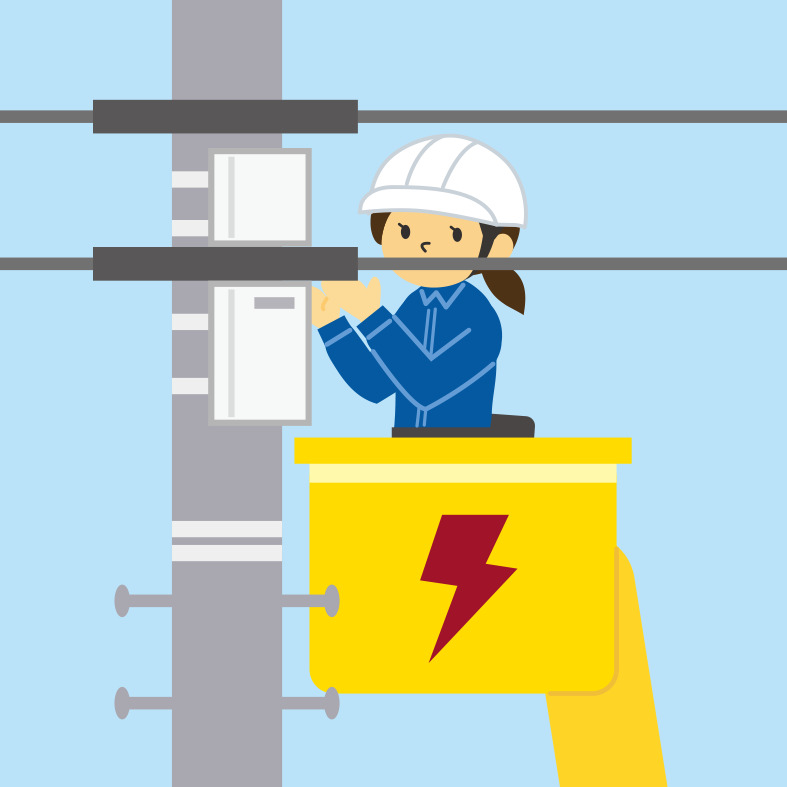
Building electricians design and install electrical equipment inside and outside of buildings. They climb utility poles to connect electric cables to buildings, and install switches, outlets, and other equipment by stretching electric cables around buildings undergoing construction or renovation. They also install and remove air conditioners, and install a variety of electrical equipment, such as automatic doors and elevators in buildings, and electric lights that illuminate parks and streets.
Railroad electrical work, on the other hand, involves the installation, maintenance, and inspection of electrical equipment for operating trains. This includes the construction of substation facilities that change the voltage of electricity sent from power plants, the re-casting of electric wires that send power to trains, and the installation of automatic ticket gates, broadcasting equipment, and other equipment at stations.
For those of us who live surrounded by products that run on electricity, inadequate electrical equipment not only causes serious problems in our daily lives, but also poses the danger of accidents such as fires and electric shocks. For this reason, it is a legal requirement that electrical work must be performed by a professional and qualified engineer. Electricians have an important job that is indispensable for the safe and secure use of electricity.
This is the point
Two types of electrician certifications
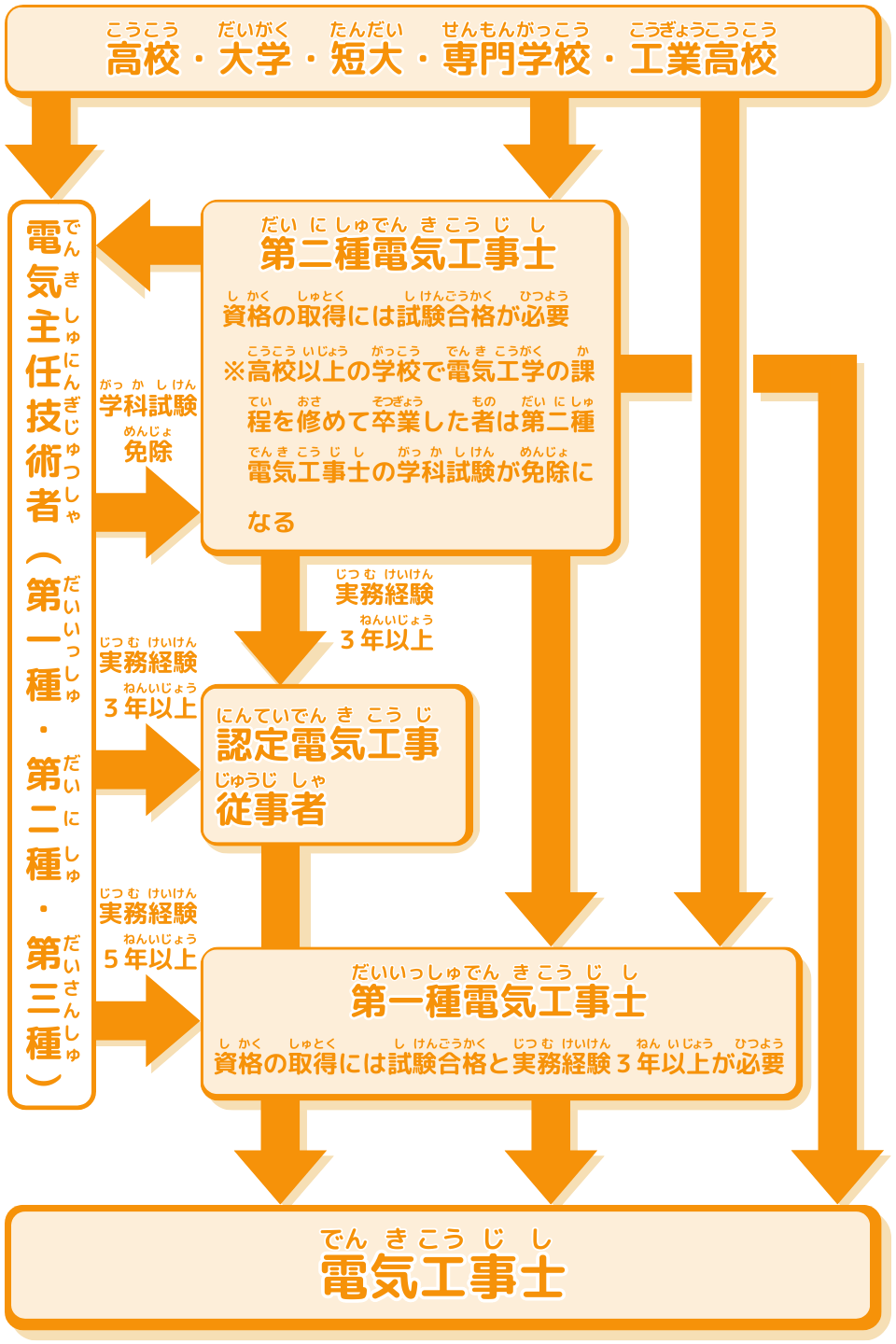
In order to perform electrical work, one must be qualified as an "electrician," which is one of the national qualifications. To qualify, one must pass the "Electrician Examination" administered by the Japan Electrical Engineer Examination Center (JECECEC). There are no restrictions on academic background or experience, and anyone can take the exam. The exam consists of a written test and a skills test, and those who pass the written test take the skills test. There are two types of electricians: Type II electricians and Type I electricians. In terms of exam difficulty, Type 2 is for beginners and Type 1 is for advanced trainees. In addition, the scale of construction work that can be handled and the period of validity of qualifications differ between Type II and Type I. Type II electricians can work on residential projects, while Type I electricians can work on commercial projects. Second-class electricians can only perform electrical work on residences and small buildings. On the other hand, a Type 1 electrician can perform electrical work on large buildings, such as buildings and factories, in addition to the work that can be performed by a Type 2 electrician. In addition, the Type II certification does not expire, but the Type I certification, which carries more responsibility, must be renewed every five years by taking a course. You may obtain a Type II certification first and then a Type I certification, or you may try for the Type I certification out of the blue. Of course, it is also a good idea to obtain only the Type II certification and specialize in electrical work, such as residential work. There is also a qualification called "certified electrician," which allows one to handle work that cannot be done with a Type 2 qualification. This certification can be obtained by a Type 2 electrician with at least three years of work experience by submitting a notification to the Electrician Examination Center.
How to become a first-class electrician outside of the electrician exam.
Chief Electrical Engineer" is a national certification that handles electricity, the same as electricians. The chief electrical engineer is in charge of supervising the safety of electrical facilities such as power plants, substations, factories, and buildings. There are different types of chief electrical engineers, from Type 3 to Type 1, depending on the voltage they are allowed to handle. This qualification can also be obtained by passing the Chief Electrical Engineer Examination administered by the Japan Electrical Engineers Examination Center (JETEC). In fact, with this qualification, one can also obtain the qualification of a First-Class Electrician. There is a "waiver system" for the Type 1 Electrician examination, which allows a person to obtain the qualification without taking the examination. Those who are qualified as chief electrical engineers and have at least five years of work experience can obtain the qualification as a first-class electrician by submitting a notification to the prefectural governor. Those who wish to become both a certified electrician and a chief electrical engineer may first qualify as a Type 2 electrician, then obtain a Type 3 chief electrical engineer license, accumulate five years of work experience, and then use the exemption system to obtain a Type 1 electrician license.
In the Future
Opportunities for electricians to work will increase.
Electricity, like water and gas, is one of the "social infrastructures" that are the foundation for supporting our daily lives. In the future, we expect to see an increase in the number of power generation facilities using solar and other natural energy sources, as well as charging stations for electric vehicles. There will also be an increase in renovation, repair, and rebuilding of old buildings. All of these require electrical work, and opportunities for electricians to work will increase. Conversely, the declining birthrate and aging population will reduce the number of workers, and electricians are expected to face a shortage of human resources. Those who qualify as electricians will have more opportunities to find work under favorable conditions.
Job Facts
Income.
The average annual income is 4.26-5.33 million yen.
Vacation?
Mostly two days off per week. Depending on the progress of the construction work, it is not always possible to take weekends off.
Where do you work?
New construction sites and remodeling construction sites.
Your Future Path
It's a chart that shows at a glance the main routes to getting a job as an electrician!