




funeral director

A specialist who organizes "funerals" and "rites" such as ancestral memorial services to send off the deceased. They support the bereaved family and their families, and are in charge of organizing and conducting the funeral ceremony.
Perfect For …
People who are mentally strong as the work involves human deaths. People who have the gentleness to support grieving bereaved families. Teamwork to cooperate with colleagues, flexible judgment, and physical strength are also necessary.
Job Details
Assist the mourners, make funeral arrangements, set up the venue, and conduct the ceremony
To place the body or remains of the dead in a grave is called "burial. The series of ceremonies performed for this purpose is called a "funeral. In a typical Buddhist funeral, "a wake (a farewell party on the eve of the funeral) is held on the first day, followed by a funeral service (a religious ceremony to send off the deceased), a farewell ceremony (a ceremony in which attendees send off the deceased), and cremation (in which the body is burned to make the remains) on the second day. These are important ceremonies to conclude the life of the deceased and for the bereaved family, friends, and acquaintances to sort out their feelings.
The funeral ceremony is organized by a representative of the bereaved family, called a "mourner," but it is assisted by a funeral service provider. The main tasks of the funeral service provider are to consult with the mourners, arrange the religious leaders, place, and things necessary for the funeral, set up the venue, and carry out the ceremony as scheduled. First, they transport the body of the deceased from the hospital or other institution to the home and lay the body to rest. Next, after listening to the wishes of the mourners and the bereaved family, the funeral's denomination, date, time, place, size, and budget are decided. Based on this, various arrangements are made. Specifically, arrangements are made for temple priests, church priests, a hearse to carry the coffin containing the body, a hired car for the bereaved family members, a crematorium, a portrait of the deceased to be placed at the venue, fresh flowers, thank-you cards, return of koten (money and goods offered to the deceased), and food for the wake and vegetarian meal (a dinner after the funeral service). On the day of the funeral or farewell ceremony, they guide the attendees and conduct the ceremony. The funeral director accompanies the mourners as they return to their homes after the ceremony and places the urn containing the remains on the altar.
Other services include arrangements for the 49-day memorial service (held on the 49th day after the anniversary of the death), consultation on the Buddhist altar (an altar for the repose of the souls of ancestors), the grave, and the placement of ashes, as well as insurance and inheritance consultation and procedures on behalf of the funeral director. The assistance of funeral service providers is reassuring to bereaved families who are grieving the loss of a loved one and are at a loss with unfamiliar rituals. They are thanked by the bereaved family for their sincere efforts. It must be a very rewarding job.
Key Points !
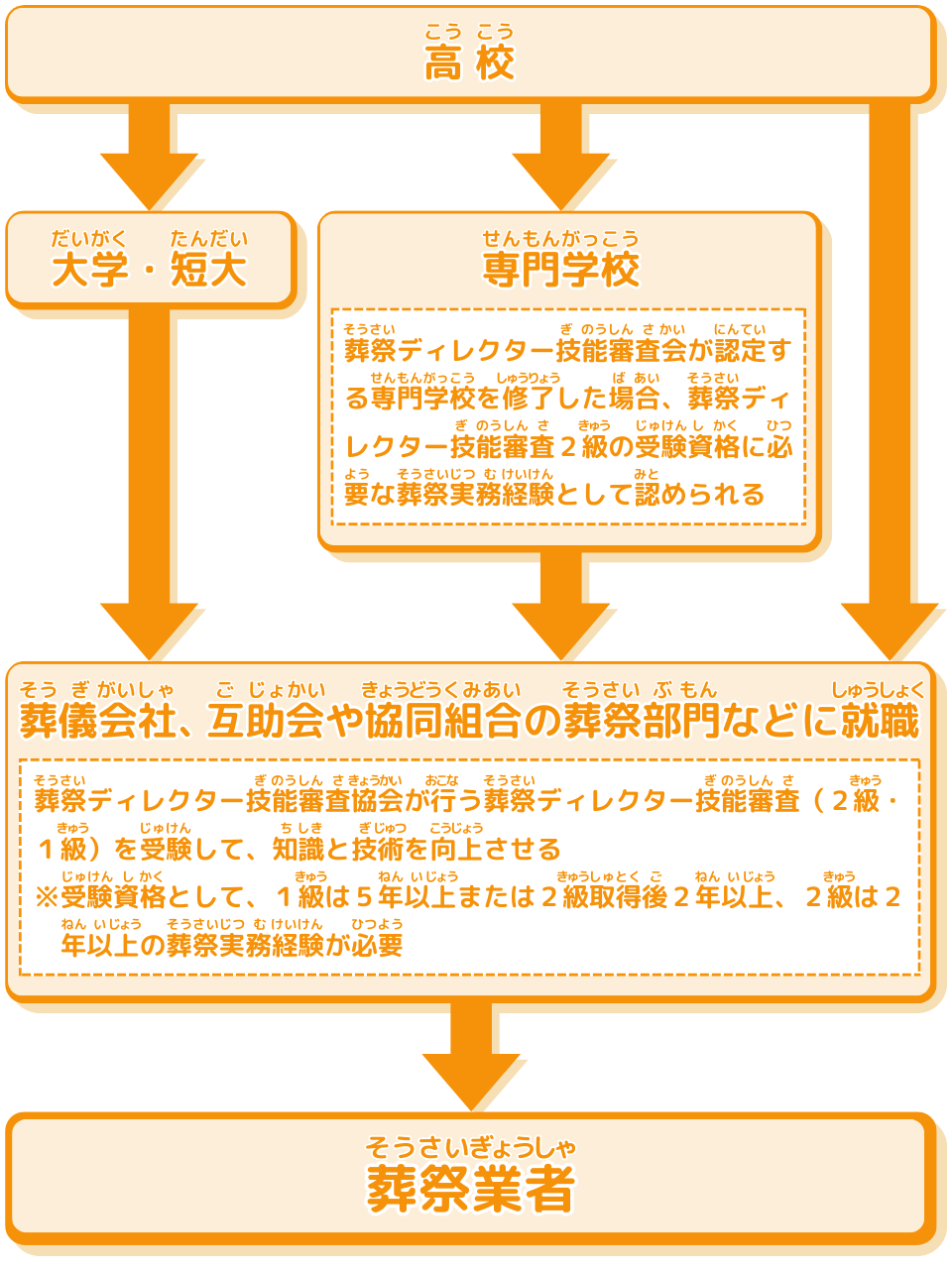
Find a job and gain work experience, or learn knowledge and skills at a vocational school.
No special qualifications are required to become a funeral director. No special qualifications are required to become a funeral director, and educational background is not particularly important. In most cases, the first step to becoming a funeral director is to work for a funeral service company (or the funeral service division of a mutual aid association or cooperative) and gain practical experience in the funeral service industry. Even within the same religion, funeral arrangements may differ depending on the denomination, so it is essential to make an effort to absorb as much knowledge as possible about funerals. By experiencing a variety of workplaces, they may become directors who can manage and conduct funerals on their own, or they may take on the role of instructing a large number of staff.
Another option is to attend a vocational school that offers courses and programs to acquire the knowledge and skills necessary to work as a funeral director, and then to find a job. Some schools offer courses that help students acquire funeral service-related qualifications and help them find employment with major funeral service companies.
On the other hand, since funeral service providers are involved in the death of a person, many companies actively accept people who have changed jobs, looking for people who have reached a certain age or have a wealth of life experience. It would be a good idea to work in a different profession and improve your communication skills before changing jobs.
The "Funeral Director Proficiency Examination" certifies the knowledge and skills as a funeral service provider.
There are no qualifications to become a funeral director, but the Ministry of Health, Labor and Welfare certifies the knowledge and skills of funeral directors through the "Funeral Director Skills Test". There are two levels, Level 1 and Level 2, each with different qualifications: Level 1 requires at least five years of work experience, or at least two years of work experience after passing Level 2; Level 1 cannot be taken without passing Level 2; Level 2 requires at least two years of work experience. The first level requires at least five years of work experience or at least two years after passing the second level. In addition, those who have completed a vocational school accredited by the Ministry of Health, Labor and Welfare can obtain the necessary work experience to qualify for Level 2. By improving their knowledge and skills, they will be better able to conduct funerals to the satisfaction of the bereaved family.
Incidentally, pets are also considered family members by many people these days, and the number of pet funerals is increasing. The Japan Animal Funeral Service and Cemetery Association offers a certification test called "Animal Funeral Director. There are two levels: Level 1 and Level 2; Level 2 requires no special qualifications, while Level 1 requires at least three years of work experience. Those who are interested in pet funeral services should aim for Level 1 in order to manage funeral services that are more in tune with the owners' hearts and minds.
In the Future
More work for funeral directors, but funerals are becoming simplified.
As Japan becomes an aging society, the number of deaths is expected to increase, and so is the workload of funeral service providers. Recently, however, more and more funerals are being simplified. One such example is the "family funeral," in which only family members and close friends attend the funeral. The basic flow of the ceremony, including the wake, funeral service, farewell ceremony, and cremation, is the same as in the past, but the scale of the funeral is smaller because the number of attendees is limited. On the other hand, there is also a "one-day funeral," which does not limit the number of attendees, but only the funeral service, farewell ceremony, and cremation are held, skipping the wake. There is also a growing number of "cremation/shiki funeral," in which the wake, funeral, and farewell ceremony are omitted and only the cremation takes place. The simplification of funerals is likely to continue for a variety of reasons, including the wishes of the deceased, economic issues, and changes in values and religious beliefs regarding funerals. However, even if the size and length of funerals are simplified, the role of funeral service providers remains the same: to support the bereaved family as they bid farewell to the deceased. In fact, they will need to work with even more sincerity.
Job Facts
Income.
Average annual income ranges from 3.43 to 3.9 million yen.
Vacation?
Since many funeral service companies are open 24/7, they often work "shifts" where the working hours and days of the week are not fixed. In addition, you cannot take a day off from the time you accept the job until the funeral is over. However, there is an old custom not to hold funerals on days that fall on the "tomohiki" day of the six days of the week, which is a divination day. Therefore, many companies, except for clerical staff, use Tomohiki, which has about four or five days in a month, as a holiday.
Where do you work?
On days when there are funerals, they operate ceremonies at funeral homes and funeral homes with cremation facilities. On days when there are no funerals, they conduct business at hospitals and police stations.
Your Future Path
It's a chart that shows at a glance the main routes to getting a job as a funeral director!