




gardener

A gardener is a craftsman who designs and creates Japanese gardens, mainly for private residences. After the garden is completed, they maintain the garden by tending to the trees and other aspects of the garden.
Perfect For …
Someone who is interested in nature. Someone who is constantly learning new information about construction techniques, tree characteristics, soil, water, etc. Someone who is physically strong enough to move plants, soil, etc.
Job Details
Maintain and manage Japanese gardens from design to construction and care.
A gardener is an expert in the design, construction, and subsequent maintenance of a Japanese garden. A Japanese garden is an attempt to reproduce the natural landscape of Japan in the form of a garden, consisting of elements such as ponds, embankments, garden stones, and garden trees that represent water, rivers, mountains, stones, and plants. The gardener listens to the client's wishes and designs the entire garden by combining these natural elements, taking into consideration such factors as sunlight and drainage conditions. After supervising the construction and completion of the garden, the gardener maintains and manages the garden, including the care of the plants, to preserve the charm of the garden, which is a traditional Japanese culture.
Key Points !
Difference between "gardener," "gardener," and "landscaper."
Similar occupational names to gardener include "gardener" and "landscaper. A gardener is a craftsman who specializes in pruning (trimming of garden plants). A landscaper undertakes large-scale landscaping and maintenance of parks and other facilities, whereas a gardener works on gardens for private residences. In a broad sense, both gardeners and arborists are included in the landscaping industry, but in general, large-scale work is considered to be landscaping.
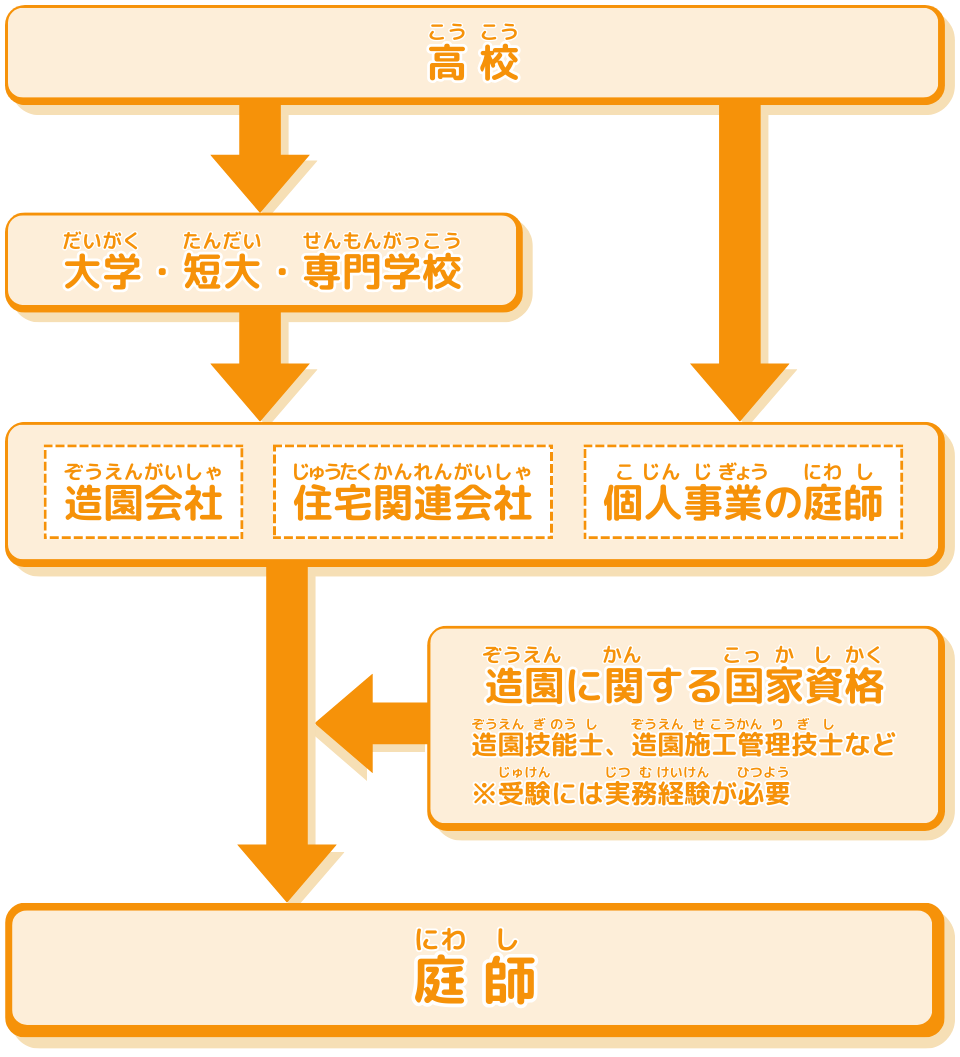
No qualifications or educational background required, but studying at a university or technical school will be advantageous for employment.
No qualifications or educational background is required to become a gardener. One can become a full-fledged gardener by working for a landscaping company or becoming an apprentice to a private gardener, learning techniques, and gaining experience. It is advantageous to learn about plants and landscaping in high school, college, or vocational school. In particular, if you want to be involved in large-scale landscaping, you should study in a university's "landscape architecture" or "civil engineering" department. These departments require knowledge in the sciences, so it is advisable to choose a science course from high school.
National certification in landscaping is obtained after employment.
There are several national certifications that certify competence in landscaping. For example, the "Landscaping Technician" tests knowledge and skills in a wide range of genres of landscaping and greening. The "Landscape Architecture Construction Management Engineer" certification is for large-scale landscaping projects such as parks, green spaces, amusement parks, etc. With this certification, one can prepare construction plans and become the person in charge of on-site management. Both of these certifications require work experience to take the exam, so you will need to prepare for the exam while working for a landscaping company or similar.
In the Future
Applying Japanese garden techniques to Western-style gardens
In recent years, the number of traditional Japanese-style private homes themselves has been decreasing, and Japanese gardens are also on the decline. In terms of future prospects, it must be said that the demand for gardeners who can make a living only from Japanese gardens is severe. As the number of gardeners who can work on traditional Japanese-style gardens decreases, the question will be how to carry on the unique Japanese gardening techniques. However, the skills of gardeners can also be applied to pruning trees in Western-style gardens and maintaining and managing the garden surroundings. An increasing number of gardeners are learning Western-style gardening and designing gardens, or undertaking "exterior" work, which includes the construction of gates, walls, hedges, and gardens. It is expected that gardeners will be required to expand the scope of their work to keep up with the changing times.
Job Facts
Income.
The average annual salary is 3.24-3.58 million yen. The landscaping industry as a whole is a world of competence, with salaries easily rising as one's skill improves.
Vacation?
Landscaping companies, for example, generally have a two-day workweek, but they are subject to the wishes of their clients, so they are not always off on weekends. In addition, work is often affected by weather conditions, and there are sometimes difficulties in scheduling work, such as days off when it rains or there are strong winds.
Where do you work?
They mainly work for or belong to landscaping companies, etc., and are dispatched to various job sites.
Your Future Path
It's a chart that shows at a glance the main routes to getting a job as a gardener!