





interpretation (i.e. oral translation)

Stand between people who speak different languages and translate them into their own languages.
Perfect For …
Someone who likes to talk and interact with people. People who are focused and responsible. People who want to learn about different things.
Job Details
Getting between people with different languages and helping them understand each other's thoughts and feelings
Interpretation is the act of interpreting words between people who speak different languages and translating them into a language that each understands. The job of an interpreter is to help people with different languages communicate with each other. Interpreters are needed for a wide range of jobs, including international conferences where people from many countries gather, business meetings with overseas clients at companies, guiding overseas tourists at hotels, broadcasting stations, police, and courts. The reason for this is that people travel around the world for work and tourism, and there are increasing opportunities to converse with foreigners even in Japan.
Interpreters are required to have not only the ability to speak a foreign language, but also the common knowledge of the country, expertise in the field they are interpreting, and the ability to convey this knowledge in an easy-to-understand manner. It is a difficult but rewarding job.
There are three types of interpreting jobs
There are three technical categories of interpreting work: Ad hoc (temporary) interpreting, which is the work of an interpreter to convey what is being said at the time, such as in a daily conversation. Ad hoc interpreting is the interpretation of what is being said by a person who speaks the language of the country, such as in a daily conversation, where the person is saying this or answering that. The second is consecutive interpretation. Consecutive interpretation is used in meetings, business negotiations, lectures, and so on. The second is "consecutive interpretation," which is used in meetings, business negotiations, lectures, etc. The speaker breaks up the conversation at a certain volume, and the minutes up to the break are interpreted. The third is simultaneous interpretation, which is used for large-scale international conferences and TV broadcasts. The third is "simultaneous interpretation," which is used at large international conferences and TV broadcasts. The interpreter must enter a room called a "booth," listen to the speaker's words through earphones, and interpret at the same time as understanding. Since this requires a high level of concentration, the interpreters form teams of several people and take turns after about 15 minutes.
Key Points !
Good at speaking a foreign language, but not an interpreter.
There are no special qualifications to work as an interpreter. What is required, of course, is "familiarity with a foreign language. Some people acquire language skills by going to universities or vocational schools to study languages, or by studying abroad. Tests that certify English proficiency acquired in this way include the TOEIC administered by the International Business Communication Association (IiBC) and the Practical English Proficiency Test (Eiken) authorized by the Ministry of Education, Culture, Sports, Science and Technology (MEXT). Since there are certification tests for many other languages in addition to English, it is a good idea to take a test to verify your language skills.
However, just because you are good at speaking a foreign language does not mean that you can interpret. Speaking one's own thoughts in a foreign language and translating the content of a meeting or business discussion into a different language in one's mind and conveying it to the other party in an easy-to-understand manner are two completely different skills that are required. In other words, interpreting is a profession that requires skill and training. For this reason, there are even "interpreting schools" for people who want to become interpreters.
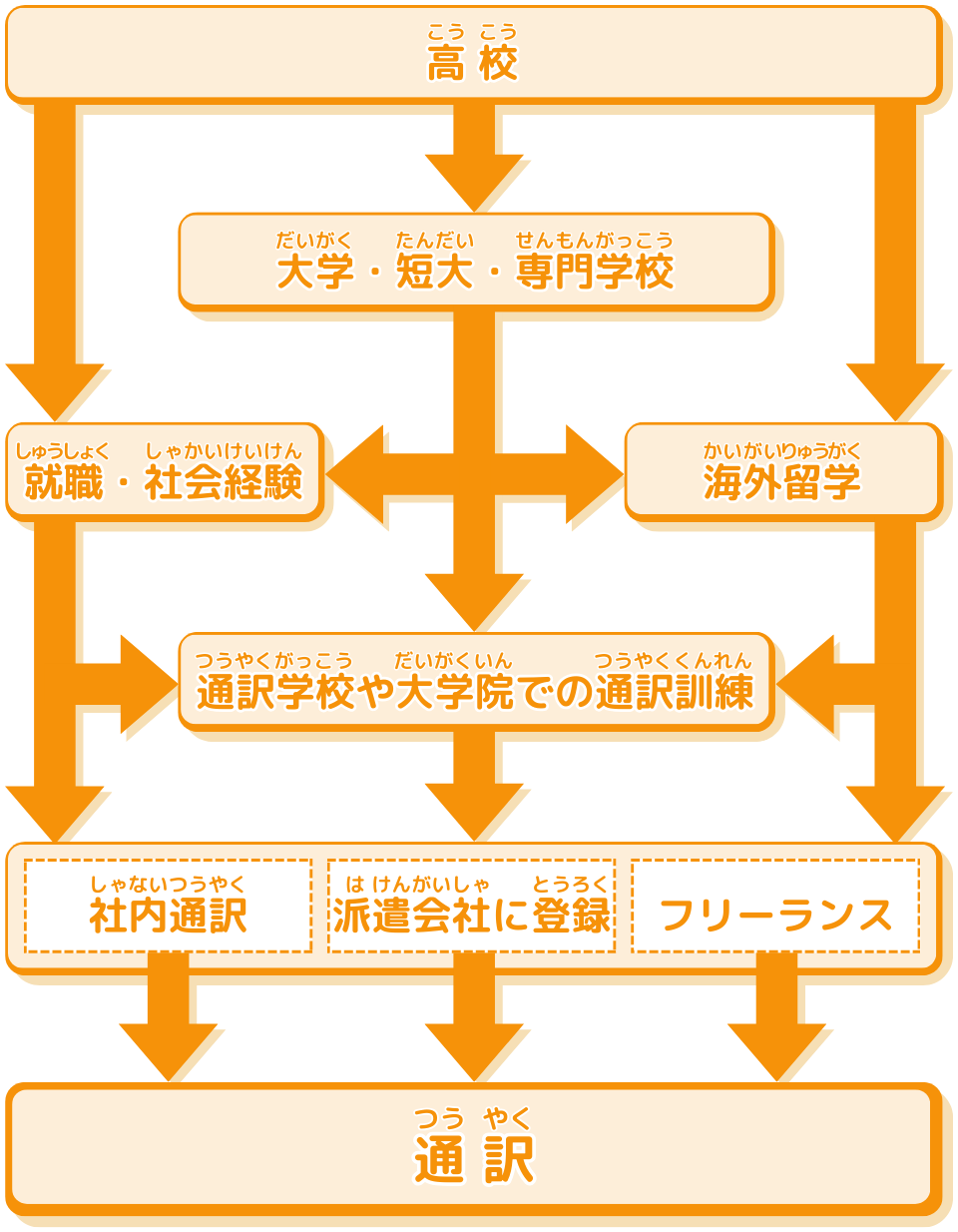
After graduating from an interpreting school, interpreters may work for a company as an "in-house interpreter," register with a temporary staffing agency to obtain work, or accept work as a freelance interpreter not affiliated with a company, among other options.
Certifications and qualifications related to interpreting work
The Test of Business Interpreting Skills (TOBIS) is conducted by the Center for the Advancement of Interpreting Skills (CAIS), a non-profit organization, to evaluate interpreting skills. Since interpreting skills are evaluated objectively, it is used by interpreters to find suitable jobs, and by companies and staffing agencies to determine which interpreters are best suited for the job.
On the other hand, one job where interpreting skills can be put to good use is as a "national tour guide" to assist overseas visitors to Japan on their journeys. To be eligible for this job, one must obtain a national certification from the Japan National Tourism Organization (JNTO). There are 10 target languages. The exam requires not only language skills but also extensive knowledge of Japan. Incidentally, it used to be impossible to guide visitors to Japan in a foreign language without this certification. However, with the revision of the Guide Interpreter Law in 2018, it is now possible to take money and guide interpreters without this certification.
In the Future
Differentiate from AI by interpreting the speaker's mind
Currently, advances in information technology have led to the development of machines and PC/smartphone applications with "automatic interpretation/translation" functions (i.e., translating text into other languages). The mechanism is that recorded speech is converted into text using speech recognition software, which is then translated by a machine, and the text information is then read aloud by the machine using speechreading software. However, Japanese conversations often do not include subject words, etc., and machine translation may not be able to interpret them correctly. In the future, as artificial intelligence AI advances further, the accuracy of automatic interpretation and translation should improve. In such a situation, it will be important for human interpreters to try to understand the flow of the conversation before and after, the speaker's facial expressions, tone of voice, gestures, etc., and to try to "interpret with the speaker's mind," which can be understood only by human interpreters.
Job Facts
Income.
The average annual salary is 4,660,000 to 6,480,000 yen. It varies depending on the company you belong to, freelance work, etc.
Vacation?
It depends on the company you belong to. In the case of freelance interpreters, they may be paid by the hour and work as interpreters for only a few hours a day. In addition, when working for a company that has overseas transactions, interpreting for meetings may be done on holidays or late at night due to the time difference.
Where do you work?
A place for international conferences, lectures, film festivals, sporting events, company reception rooms and meeting rooms, discussions and presentations. They may accompany the person conducting the business meeting on an overseas trip, or use a videoconferencing system.
Your Future Path
It's a chart that shows at a glance the main routes to a job as an interpreter!
Useful Qualifications
通訳の仕事につくために役立つ資格を紹介しているよ。