




investor

A person who earns income by "investing" to buy stocks, real estate, etc.
Perfect For …
People who are interested in how to increase their money. People who are quick to research what they are interested in. People who can think and make decisions by themselves. People who are not discouraged by failure.
Job Details
Buy "financial instruments" that are likely to increase in value and earn a profit.
Investment" means to invest (put money out) in assets with the expectation of a profit (moxie). By buying "financial instruments" such as stocks (securities issued by a stock company to raise funds) or real estate (land or condominiums), one earns profits such as dividends (money distributed through one's holdings) or rent. They also earn profits called "trading margins" if they sell them when their value has increased from the time they bought them. Another way to increase your money is to deposit or save it in a bank or other financial institution and earn interest (money earned based on the amount and duration of the loan). However, in the case of investment, if the value of a financial instrument increases, there is a high possibility of earning a higher profit than with a savings account. In other words, the job of an "investor" who earns income through investment is to predict and buy financial instruments that are likely to increase in value and thereby earn a profit.
Differences between individual investors, institutional investors, and speculators
There are two types of such investors: individual investors and institutional investors. Individual investors are individuals who invest with their own money. Among individual investors, those who make a living solely from their investment income are called "full-time investors," while those who invest while holding down other jobs, such as company employees, are called "dual-income investors. On the other hand, institutional investors are life insurance companies, non-life insurance companies, pension funds, trust banks, etc. that invest as part of their business. Since they invest with money entrusted by many customers, the amount of money they handle is much larger than that of individual investors.
Another type of work that is similar to that of an investor is that of a trader. Investors and speculators differ greatly in the time it takes to make a profit. An investor seeks to earn profits over the long term by anticipating the growth of the company in which he or she invests. Speculators, on the other hand, read the price movements of the stocks they invest in and repeatedly buy and sell stocks, taking advantage of opportunities. Some speculators are called "day traders" who complete their trades during the trading hours of the day.
Key Points !
Anyone can be an investor, but there is an age limit.
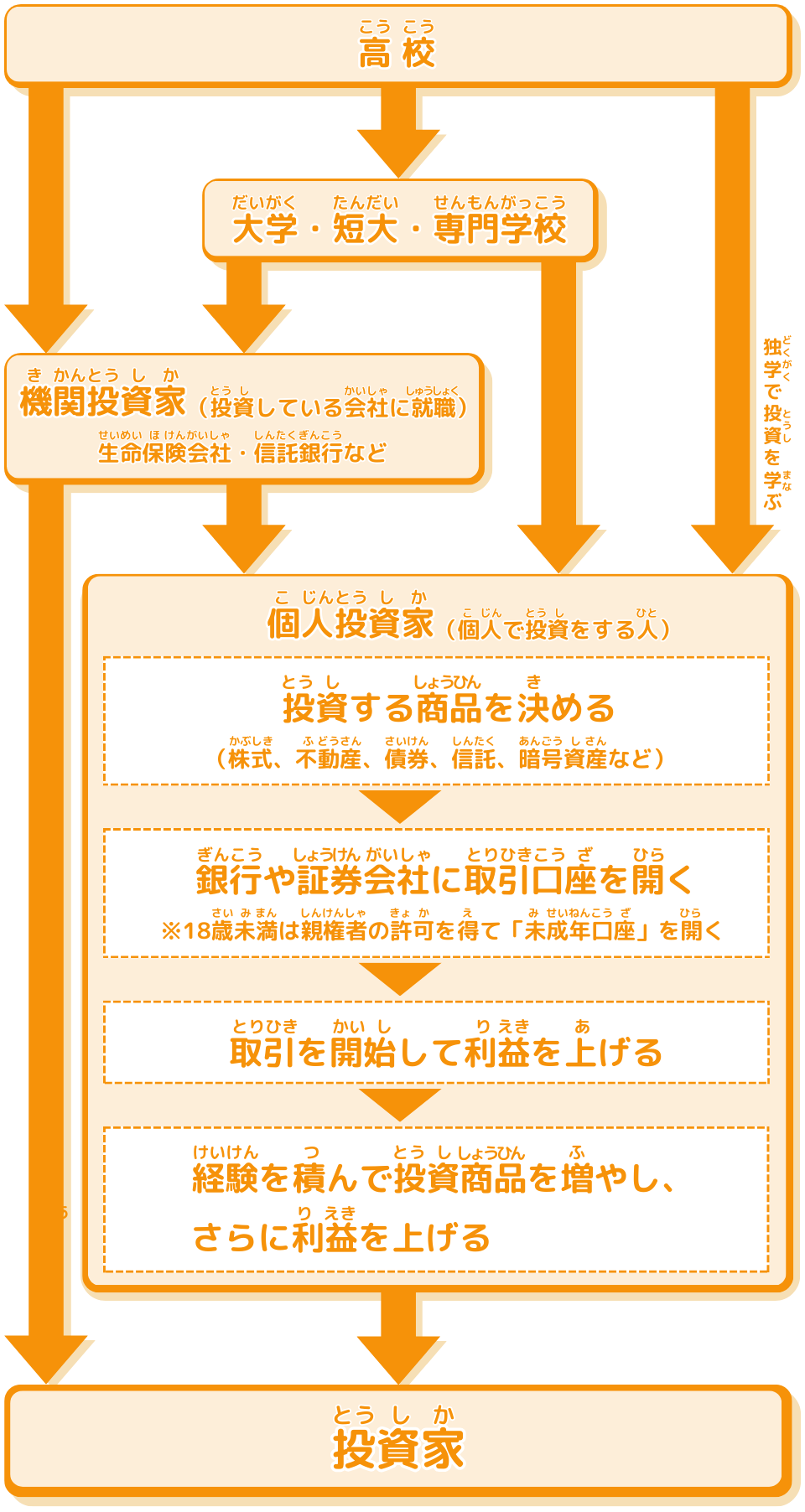
There are no special qualifications or licenses to become an investor. Anyone can invest as long as they have the money to start with, and there are even brokerage firms that allow investors to invest as little as 100 yen. However, there is an age limit. In order to invest, one must open an account at a bank or brokerage firm. However, to open an "underage account" for those under the age of 18, permission from a parent or guardian is required. Furthermore, minors are not allowed to engage in "margin trading," in which they borrow money from a brokerage firm to invest in stocks.
Education is also not required to become an investor. While it is possible to acquire the knowledge necessary for investment through self-study, it is also possible to use the various specialized knowledge one has acquired at university, junior college, or vocational school, such as management or economics, for investment.
Incidentally, although not a qualification to become an investor, there is a private qualification called "Investment Diagnostician" offered by the Investment Diagnostics Association of Japan. It was established to increase the number of people who can spread the correct way to invest. It may be a good idea to obtain this certification to deepen one's knowledge of investments.
Advantages and disadvantages of investors
One of the advantages (good aspects) of being an investor is that you can work (invest) wherever you have access to the Internet, such as a computer or smartphone. The freedom to work is an interesting aspect of being an investor. In terms of income, there is the possibility of making large profits as the value of the financial instruments invested increases.
On the other side, the biggest disadvantage (bad side) is the possibility of not only not gaining profit but also losing money. There is always the risk that the performance of the company in which you invest will deteriorate or that the market price (trading price/value of stocks, etc.) will plummet. If you have invested a large amount of money, you may lose a lot of money. Also, investors are not officially recognized as a "profession" and are treated as "unemployed. If you are unemployed, you may not be able to get a credit card, which can be inconvenient. For this reason, many people file a business registration with the tax office and operate as a sole proprietor (a person who runs some kind of business as an individual, not as a company).
In the Future
Individual investment may become indispensable.
In Japan, most people hold financial assets in the form of "cash" or "savings accounts" because of a high level of security and trust in savings accounts. However, in the 1990s, a one-year time savings account once offered an interest rate of about 6.0%, but the current (2023) low interest rate is 0.002%. 1 million yen deposited for one year earns only 20 yen in interest. This makes it difficult to increase assets with savings. The government has therefore launched a policy aimed at doubling "asset income" (new assets generated by assets) by using assets for investment rather than savings, and through stock dividends and other means. One such initiative is the NISA (National Institutional Small Investment Tax Exemption). Normally, profits from investments, such as dividends and trading gains, are subject to a tax of approximately 20%. However, if one opens a "NISA account (tax-exempt account)" at a bank or securities company, profits from financial instruments purchased through the account will not be subject to tax (there is a certain limit to the amount invested and the amount that is tax-exempt). This system is intended to increase the value of stocks through increased investment by individuals, and as the performance of joint-stock companies improves, the asset income of individuals will increase, and the overall Japanese economy will improve. From now on, investment may become indispensable for both individual asset building and for improving the country's economy.
Job Facts
Income.
According to a 2021 survey by the Japan Securities Dealers Association, 42.7% of individual investors have an annual income of less than 3 million yen, 69.3% have an annual income of less than 5 million yen, and 6.1% have an annual income of 10 million yen or more. The estimated average annual income is 4.35 million yen.
Vacation?
It would be adjusted to the holidays of the "stock market/exchange" where shares are traded. For the four exchanges in Japan, they are closed on Saturdays, Sundays, national holidays, and year-end and New Year holidays, as they do not trade. They are also closed on weekdays from 9:00 a.m. to 11:30 a.m. and from 12:30 p.m. to 3:00 p.m. or 3:30 p.m., as trading is limited to approximately five hours on these days. However, there is also a system (PTS trading) that allows trading outside of trading hours and at night.
Where do you work?
This can be done anywhere there is a computer or smartphone with Internet access.
Your Future Path
It's a chart that shows at a glance the main routes to an investment job!