




Japanese clothing manufacturer

While making Western-style clothing is called "Western-style dressmaking," making Japanese-style clothing is called "Japanese-style dressmaking. A "wajanshi" is a craftsman who tailors kimonos.
Perfect For …
People who have patience and like detailed work. People who are interested in Japanese traditions.
Job Details
Sewing a kimono from a single piece of cloth
The job of a kimono maker is to tailor kimono, a traditional Japanese costume. They cut one piece of fabric for one kimono and sew it together, mainly by hand. There are various types of kimonos, depending on where and how they are worn, and accordingly, obis, haori, hakama, and underwear, such as lintels, are required. The kimono maker tailors all of these items by hand. Kimonos can be re-tailored any number of times by unraveling the threads. This is called "mending," and it is one of the most important jobs of a kimono tailor.
This is the point
National qualification "Japanese dressmaking technician" that is advantageous for employment.
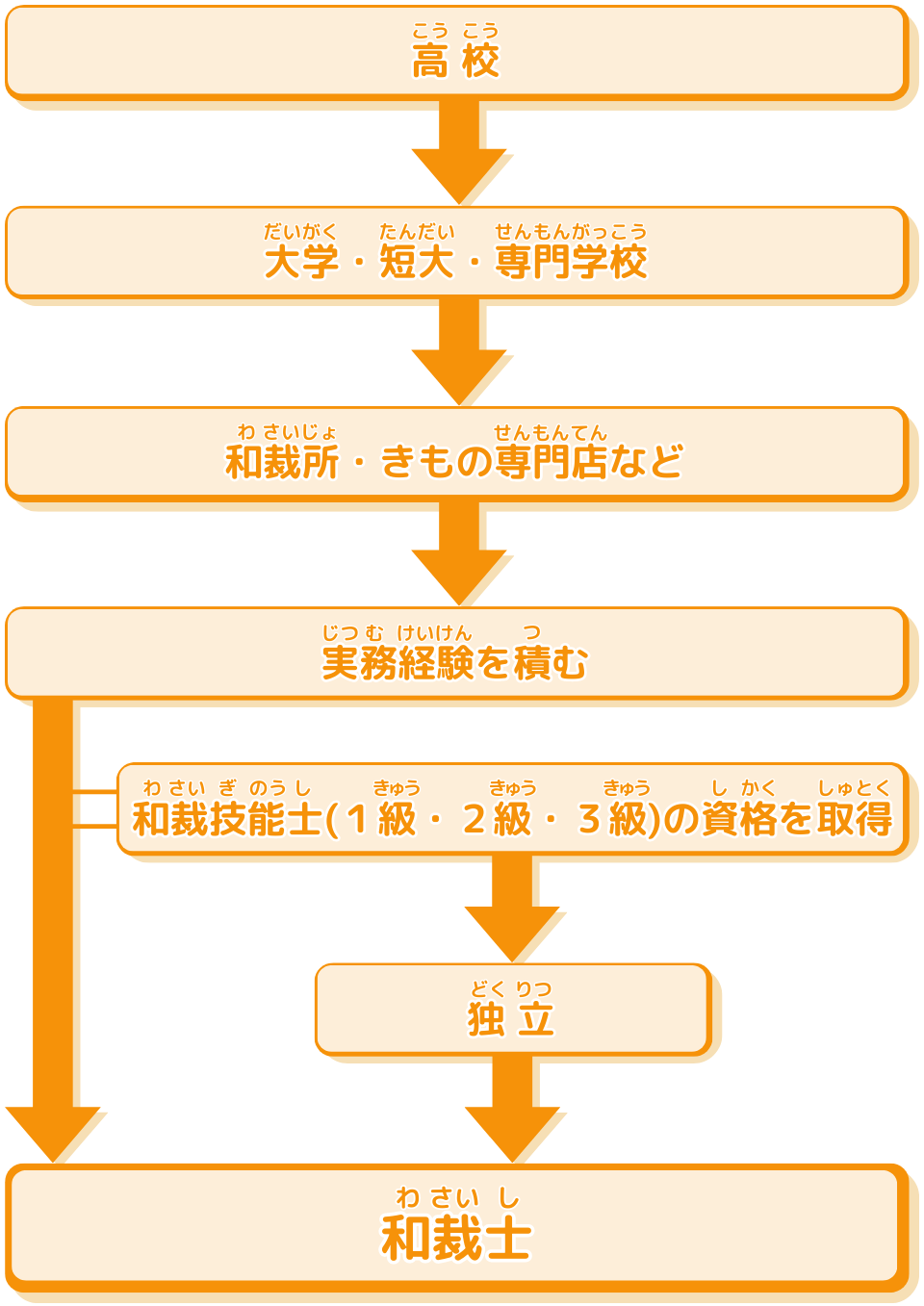
Japanese-style dressmaking involves unique techniques and tools that differ from Western-style dressmaking and are difficult to master on one's own. To become a kimono dressmaker, it is common to learn the basics of Japanese dressmaking at a university or vocational school, and then gain experience by working at a kimono-related business (e.g., a Japanese dressmaking shop, a kimono sewing shop, or a kimono specialty store). In addition, there is a qualification called "Japanese dressmaking technician" (1st, 2nd, or 3rd grade), which certifies knowledge and skills related to Japanese dressmaking in general, although it is not a mandatory qualification for working in the field of Japanese dressmaking. This is a national qualification authorized by the Ministry of Health, Labor and Welfare, so it is advantageous to obtain it when finding employment or setting up your own business.
What's the difference between a "Japanese Tailor" and a "Japanese Tailor Technician"?
The name "Wassamaishi" is widely used, but it is actually a registered trademark of the Japan Wassamaishi Association. Therefore, there is no problem in using the name to refer to a craftsman who tailors kimonos, but in order to call oneself a "kimono dressmaker" as a title, one must be registered with the Japan Wassamaishi Association. On the other hand, "Wasson Technician" is a title that can be given to those who have passed the Wasson Technical Skills Test. As the only national qualification for kimono, it is prestigious and a proof of skill for craftsmen who work in the field of Japanese dressmaking.
In the Future
For work that is respected as a valuable skill that supports traditional culture.
There are opportunities to wear kimonos in all seasons, such as yukata in summer, furisode (long-sleeved kimono for coming-of-age ceremonies), and ochromosa (a color change at weddings), but many people wear kimonos especially for "milestones in their lives. For tourists visiting from abroad, Japanese "kimono" is the national costume of their dreams. Kimono is a representative of Japanese culture, but unfortunately, there are not many Japanese who wear kimonos on a daily basis. The number of kimono makers, who tailor kimonos by hand, has been decreasing due in part to the emergence of inexpensive machine-made kimonos. This is why it can be seen as an opportunity. People who carry on traditional Japanese culture, such as flower arrangement, tea ceremony, and Japanese dance, need kimonos tailored by kimono makers. The work of a kimono dressmaker will be respected as a valuable skill that supports traditional culture.
Job Facts
Income.
When working at a Japanese tailor's office, the annual income is about 2.4 to 3.4 million yen. When taking on freelance work, the income is the tailoring fee for each piece of clothing.
Vacation?
If you work for a company, such as a Japanese sewing office, you basically have two days off a week. If you work as a freelancer at home, your days off will be irregular depending on the progress of your work.
Where do you work?
Japanese sewing shops, Japanese sewing factories, homes, etc.
Your Future Path
It's a chart that shows at a glance the main routes to getting a job as a kimono maker!