




judo therapist
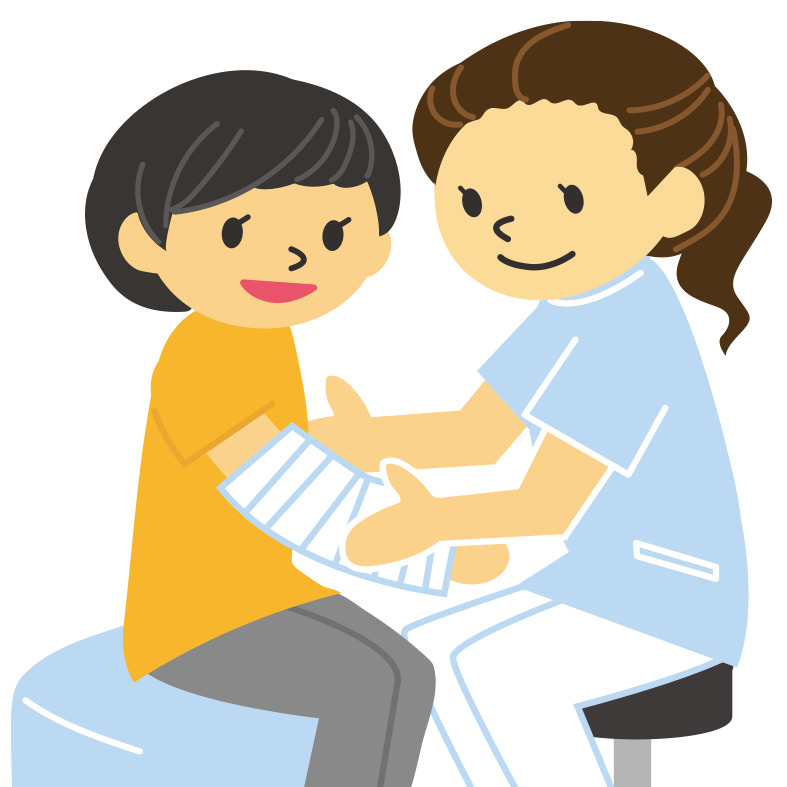
Specialists in healing injuries such as fractures, dislocations, and sprains, not with drugs or surgery, but with judo therapy, a technique derived from the ancient Japanese martial arts.
Perfect For …
People who want to work for the benefit of others. People who like to communicate with others. People who have the observational skills to sense the discomfort and pain of others.
Job Details
Provide treatment that harnesses the human body's "natural ability to heal wounds.
Judo therapy" recovers bones, joints, and muscles damaged by injuries (fractures, dislocations, strains, bruises, etc.) caused by falls or bumps in daily life or in sports. Judojeppojutsu is a technique that originated from "katsudo", a method of recovering injured people and healing wounds in jujutsu, an ancient Japanese martial art. Incidentally, judo is a fighting method of jujutsu, "killing technique," which developed into a competition.
There are three types of treatment performed by judo therapists who use such judo therapy: "restoration," "immobilization," and "post-treatment. Reconstruction" is the process of returning broken bones to their original shape and dislocated joints to their proper position. Fixation" refers to bandaging, casting, taping, or otherwise immobilizing the injured part of the body in order to heal the wound and relieve pain. Post-treatment" is a method of treating the injured area with various stimuli in order to speed up the recovery of the area that has been repaired or immobilized. There are "manual therapy," in which stimulation is given by rubbing, pressing, tapping, or squeezing with bare hands, "exercise therapy," in which the body is moved and muscle strength training is performed, and "physical therapy," in which heat, electricity, and other treatment devices are used. Judo therapists are experts in providing treatment that maximizes the human body's "natural ability to heal itself" without surgery or medication.
Key Points !
Learn Judo and obtain national certification as a judo therapist.
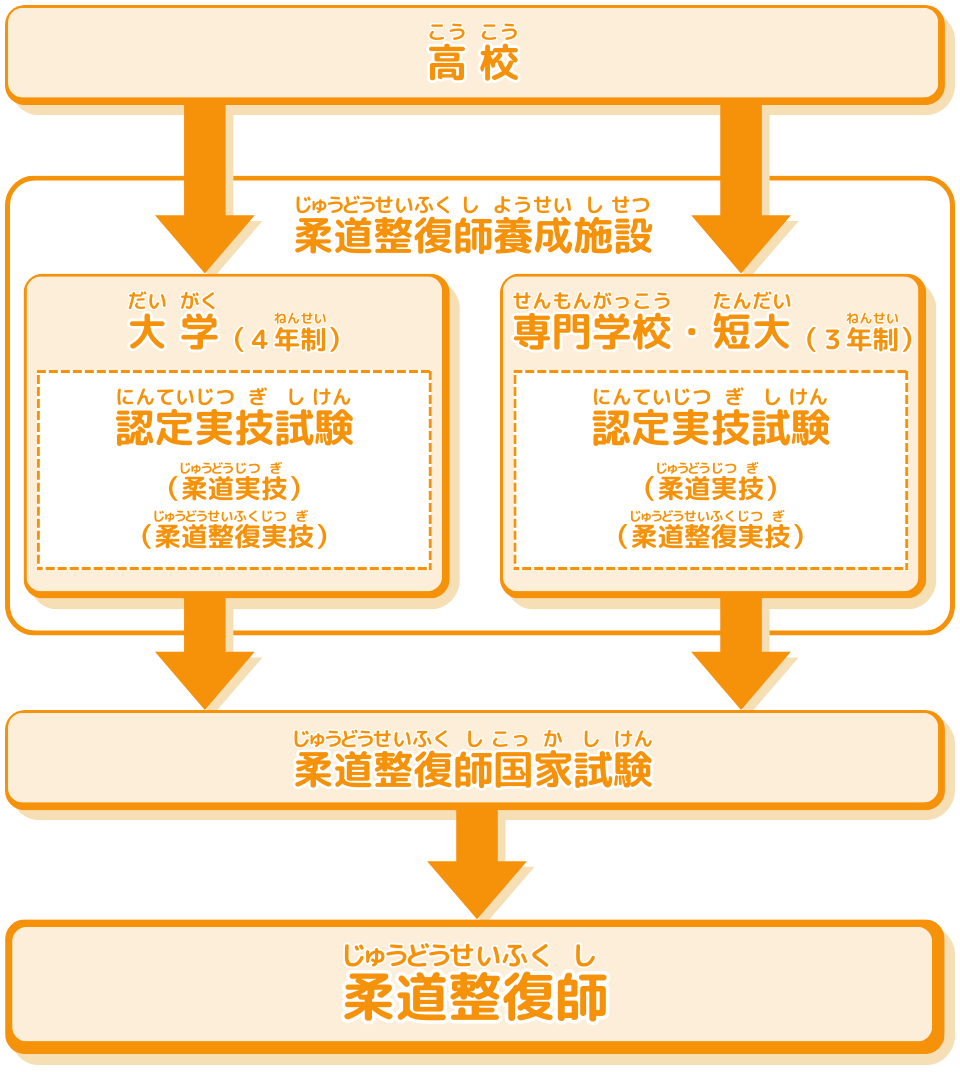
To become a judo therapist, one must first graduate from high school or obtain a qualification equivalent to graduation from high school, and then enter a judo therapist training facility (university, junior college, or vocational school). There, students spend at least three years acquiring knowledge of anatomy, physiology, and other aspects of the body, as well as judo and judo therapy skills. Since judo is a technique derived from judo, the key point is to actually study judo and learn basic knowledge and how to use the body. To graduate from a training facility, students must pass a "certification practical skills examination," in which "judo therapy practical skills" and "judo practical skills" are examined. Upon graduation, students are qualified to take the "Judo Therapist National Examination," which they must pass. Incidentally, the national examination consists only of a written test and does not include a practical skills test. In addition, since it is a legal requirement to attend a designated school, self-study is not possible to take the national examination.
What Judo Therapists Can and Cannot Do
Judo therapists are nationally licensed in the medical field, but the injuries they can treat are limited by law. Judo therapists can only treat traumatic injuries such as fractures, dislocations, sprains, bruises, and torn flesh. Among national medical qualifications, only judo therapists and physicians are permitted to perform this work. However, judo therapists can also provide first aid for "fractures and dislocations," but a physician's consent is required for continued treatment. Incidentally, "sprains, bruises, and flesh bruises" can be treated without a physician's consent. Judo therapists are covered by health insurance.
On the other hand, there are treatments that judo therapists are not allowed to perform, such as injections, medication, surgery, and x-rays. These cannot be performed by judo therapists even if ordered by a physician, and it is prohibited for judo therapists to direct them to do so.
Osteopathic physicians are also sometimes mistaken for osteopathic physicians, but osteopathic physicians are not nationally licensed and cannot perform medical treatment.
In the Future
More elderly people are prone to injury, and judo therapists are coming into play.
Judo therapists work in many places: in the medical field at osteopathic clinics, osteopathic hospitals, and hospitals; in the sports field as sports trainers; and in the nursing and welfare field as "functional training instructors" who help elderly people practice walking and strength training. Of course, they can also open their own osteopathic clinics and osteopathic hospitals. However, now that the emergency medical care system has been established, fractures and other injuries are often treated at hospitals. It is necessary to make an effort to provide more community-based medical services, such as more detailed treatment. In addition, as Japan's population ages, an increasing number of elderly people are expected to suffer unexpected injuries due to lack of exercise and weakened muscles. The need for functional training instructors at elderly care facilities and other facilities will continue to increase. Meanwhile, looking at the world, judo therapy, which treats patients with bare hands, is likely to be useful in many developing countries where doctors and medical facilities are in short supply. It would be a good idea to join an international exchange organization and make it your job to promote judo therapy overseas.
Job Facts
Income.
Average annual income is 3.59 to 4.7 million yen. For independent practitioners, it depends on the number of patients.
Vacation?
It depends on where you work. Even if they have a two day weekend, they may treat patients on weekends and holidays. They may also treat patients after hours, such as for emergencies.
Where do you work?
Osteopathic clinics, osteopathic hospitals, hospitals, rehabilitation centers, geriatric care facilities, sports gyms, etc.
Your Future Path
It's a chart that shows at a glance the main routes to a judo therapist job!