




Priest (Shinto priest)

Shinto priests work at shrines to transmit Shinto, one of Japan's ancient religions. They conduct ceremonies, attend to worshippers, and maintain the facilities. The term "kamishu" is a common term, and the official name is "kannushi" (priest).
Perfect For …
People with communication skills who can get along well with local people. People who respect Japanese history and traditions. People who can perform service activities naturally.
Job Details
Conveying the teachings of the ancient Japanese "Shinto" religion and connecting people with the gods.
There are many shrines throughout Japan that worship ancient Japanese deities, each of which serves as the "Ujigami" that protects the surrounding community and serves as a spiritual center for the local people. As administrators of such shrines, Shinto priests are responsible for passing on Shinto teachings and culture to future generations while engaging in activities rooted in the community. They conduct seasonal events, Shinto weddings, ceremonies to ward off bad luck, and other ceremonies at shrines, and visit shrines on request to conduct exorcisms and land-breaking ceremonies, serving as a link between the gods and people.
Key Points !
Most priesthoods are passed down from parent to child in a hereditary system.
In many cases, the priests who run shrines are hereditary (i.e., they are passed down from parent to child). Children born into a family of priests become priests to carry on the family shrine. In recent years, this system of hereditary succession has broken down, and some shrines no longer have a priest. Some shrines have begun to advertise on recruiting websites. As a result, the number of people from ordinary families who wish to become priests is gradually increasing. In any case, Shinto is a unique Japanese religion rooted in the history and traditions of Japan, and it is necessary to study it thoroughly at a university or Shinto training school where one can specialize.
To work as a priest, a "rank" is required.
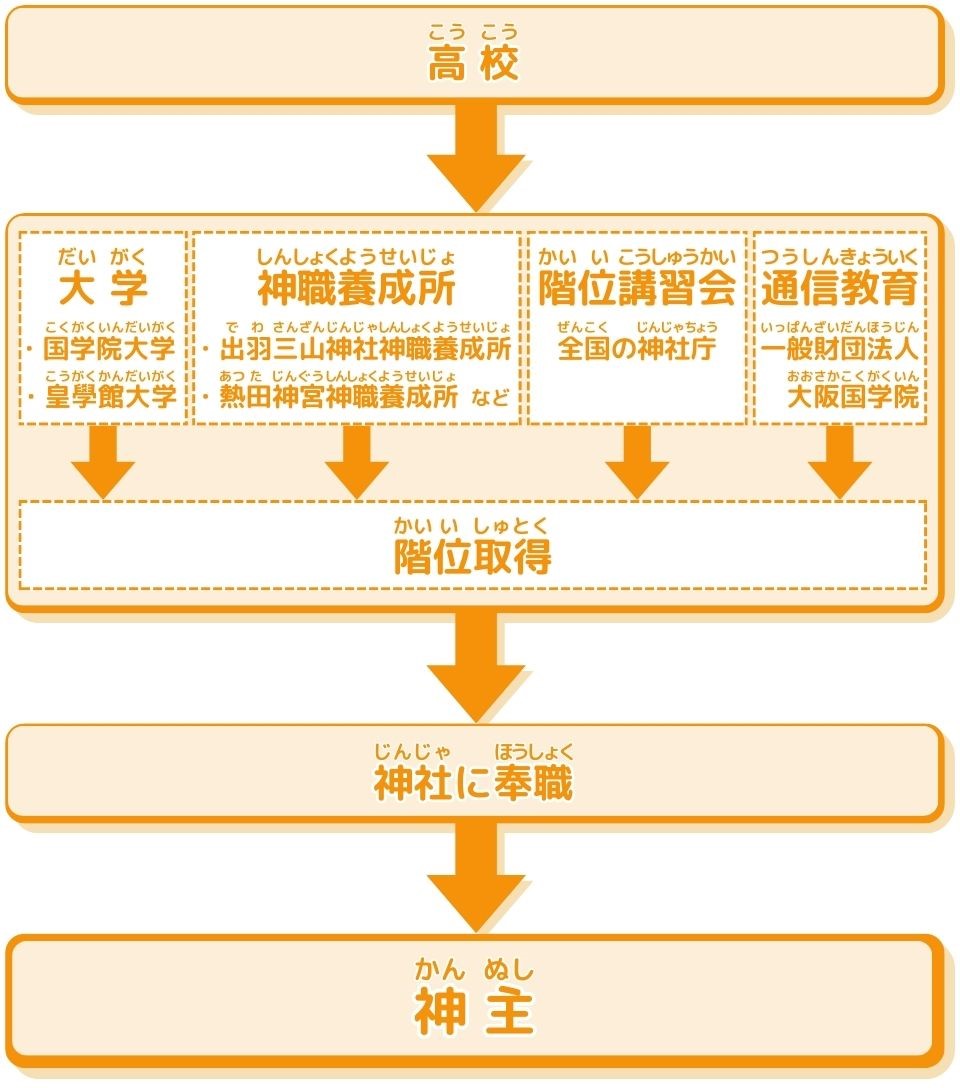
In order to work as a priest, a qualification called "rank" is required. Most of the shrines in Japan belong to an organization called "Jinja Honcho," which certifies priesthood ranks. Generally, priesthood is obtained by graduating from a university with a priesthood qualification course or by completing a priesthood training school. Currently, there are two universities that offer priesthood qualification courses: Kokugakuin University (Tokyo) and Kōgakukan University (Mie Prefecture). There are six priesthood training schools in Japan run by famous shrines, including Dewa Sanzan Shrine (Yamagata Prefecture), Shiobahiko Shrine and Shiogama Shrine (Miyagi Prefecture), and Atsuta Jingu Shrine (Aichi Prefecture). In addition, some universities and regional Shinto shrine offices hold annual training sessions and examinations on rank. There are several requirements, such as having a specific shrine in mind, but if you meet them, you can take the examinations. In addition, the Osaka Kokugakuin Foundation is the only organization in Japan that offers a correspondence course for obtaining priesthood qualifications.
Once you have been promoted to a higher rank, look for a place to "serve".
In the case of the priesthood, finding a job is called "ordination. If the priesthood is not hereditary, one must obtain ordination and then look for a place of employment. Until now, there have not been many job advertisements for priesthood positions, and only part-time positions such as miko (shrine maidens) and other miscellaneous work are advertised during busy seasons such as New Year's. If you want to become a priest in your own right, you will need to make connections with other people. When people wanted to pursue the priesthood as their main profession, they generally relied on their connections to find a place of dedication. Recently, however, "priesthood," "priesthood (apprenticeship acceptable)," and "priesthood (Shinto priest)" have begun to appear on SNS job sites. Some shrines are not affiliated with the main shrine agency, and opportunities are expanding, albeit gradually.
In the Future
Opportunities for people from ordinary families who want to enter the priesthood.
Many shrines are large enough to have a single Shinto priest, and once a priest is appointed, he is rarely replaced. New shrines are rarely built, and it is difficult to imagine a massive increase in the demand for priests in this world. However, many shrines are suffering from a lack of successors, so it may be worthwhile to try a new genre of employment, even if your family does not own a shrine.
Job Facts
Income.
The average annual income is 4.47-5.37 million yen. There is a disparity in income among shrines. The income of shrines is made up of fees for prayers and exorcisms, monetary offerings, sales of amulets and omikuji, etc. Shrines that are visited by many people, such as those in tourist areas, tend to earn more, while smaller shrines supported by local residents tend to earn less. The income of working priests also tends to be affected by such differences in workplaces.
Vacation?
Like most company employees, many shrines stipulate a two-day weekend. However, holidays are often returned for weddings, funerals, and ceremonial appointments. They are extremely busy during the year-end and New Year holidays, when they are open 24 hours a day. In the case of Shinto, morning and evening prayers are essential even on holidays, making it difficult to draw a line between work and private life.
Where do you work?
Shrines. Sites for ground-breaking ceremonies and festivals as requested.
Your Future Path
It's a chart that shows at a glance the main routes to getting a job as a priest!