





librarian
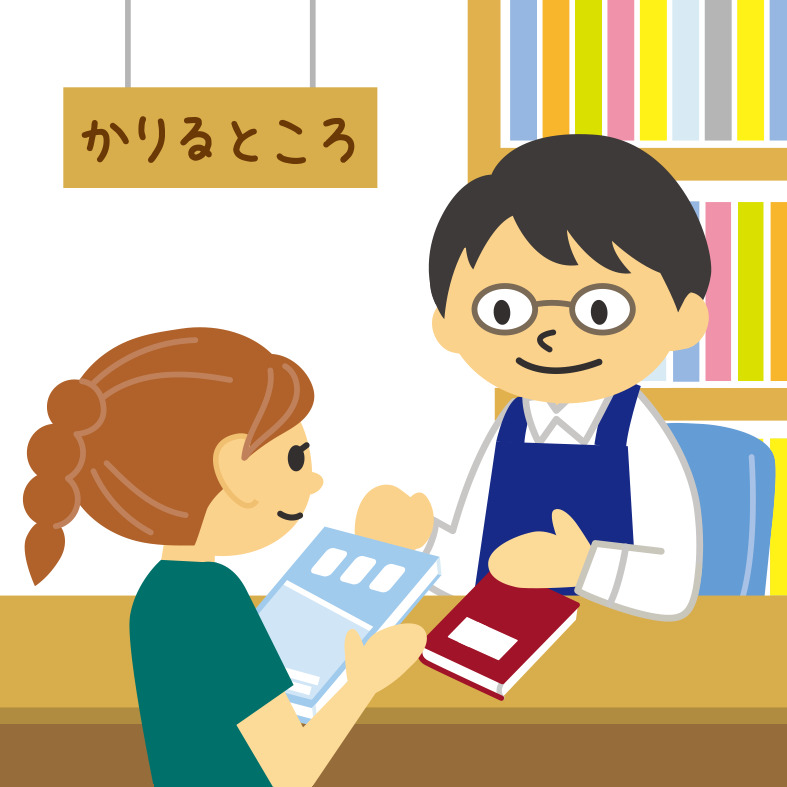
Employees work in libraries that collect, organize, and preserve books and materials. They use their expertise to provide a variety of services to users.
Perfect For …
People who like books. People who can communicate with others. Good at researching, sorting, and organizing. Physical strength to carry a large number of books is also required.
Job Details
Organize library books and materials to assist patrons with research and reading enjoyment
A "librarian" is a professional employee who works in a "library." Libraries are places where books and materials are collected, organized, and stored to help people conduct research and enjoy reading. The work of librarians often seen there includes "reception counter work" to check out, return, reserve, request, copy, and register users, and "reference work" to consult with users about their research and help them gather information. On the other hand, librarians perform "cataloging" tasks such as selecting books for the library, registering new books in the collection catalog, and attaching barcodes to books for management purposes. Among these tasks, classifying books by content according to set rules is an important part of the librarian's job. Labels are attached to the spines of the books to indicate the classification, and the books are placed on the shelves according to the classification. It is also important for the librarian to return books that have been returned to their original location and to organize disorganized shelves. They also check and inspect the collection, clean the bookshelves so that users can use them comfortably, apply cover film to the covers of books to protect them from scratches and stains, and perform simple repairs to books whose pages have come off or been torn. In addition, it is the librarian's job to devise and organize "reading events" such as "special corners" to introduce books by theme or book clubs.
Librarians find it rewarding to help preserve books and other materials, which are valuable cultural assets, for the future and to make library users happy. On the other hand, people's thinking can change depending on the books they read, so a librarian who selects books for the library can be said to have a heavy responsibility.
Librarians are teachers, so they also take classes.
Incidentally, libraries include "public libraries, private libraries, university libraries, school libraries, specialized libraries, and the Library of Congress. The basic job description of a librarian in any library is the same. However, the role of a "teacher librarian," a specialized employee of a "school library" in an elementary, junior high, or high school, is slightly different from that of a librarian in other libraries. As a teacher librarian is one of the teachers in charge of classes, he/she is responsible for planning classes using the school library and providing "instruction in learning, reading, and the development of information use skills. Other tasks include selecting books and materials to be purchased and planning the annual operation plan. If there is no "school librarian" who specializes in library work, a teacher librarian classifies, organizes, and checks out books and materials.
Key Points !
Three Ways to Obtain "Librarian Certification"
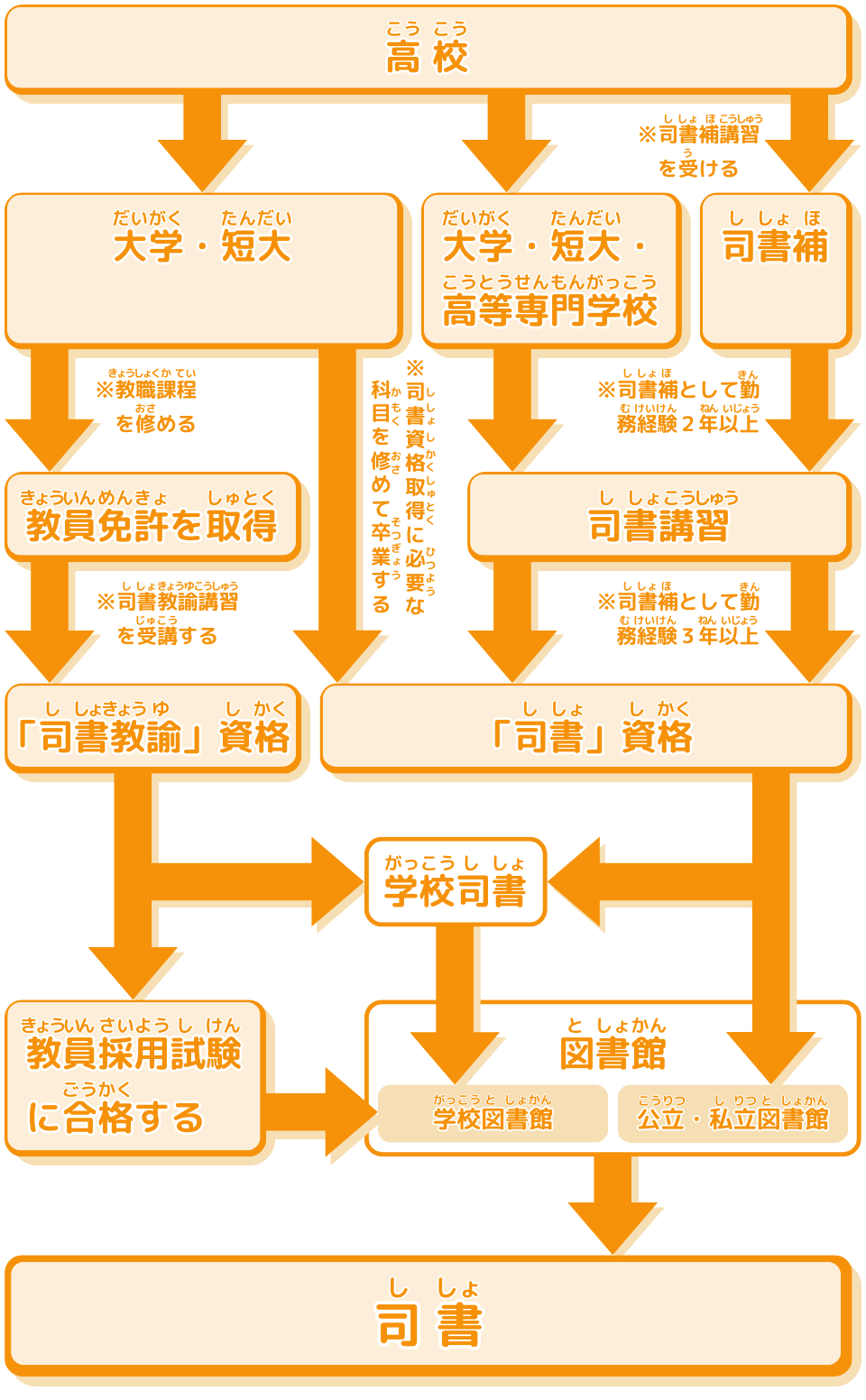
To become a librarian, one must have a national "librarian license. There are three ways to obtain this certification: first, by completing the required courses at a university or junior college; second, by completing a "librarian training course" for university, junior college, or technical college graduates; and third, by working as an assistant librarian (assistant to a librarian) for at least three years and completing a librarian training course.
After obtaining librarian certification through one of these methods, take the employment examination of the library of your choice. If you wish to work at a "public library" established by a local government, such as a prefectural or municipal government, you must pass an employment examination for a "general administrative position," which involves clerical work for the local government, since the employees working there are local public servants. Although some municipalities hire people as librarians (or assistant librarians) from the beginning, more often than not, people are assigned to libraries after being hired. In such cases, they may not be assigned to libraries even if they wish to be, or they may be transferred to a different department after a few years even if they are assigned to a library. There are also many employees who work in public libraries as "non-regular public servants" whose working periods and salaries differ from those of such regular public servants. On the other hand, those who wish to become librarians at private libraries, specialized libraries, or university libraries must pass the respective employment examinations. Incidentally, the "National Diet Library" also has an employment examination for staff, but you do not need to be a qualified librarian to take it.
Teacher Librarians" and "School Librarians" working in school libraries
Teachers who perform the professional duties of librarians in "school libraries" at elementary, junior high, and high schools are called "teacher librarians. To become a teacher librarian, one must obtain a teaching license to become a teacher, as well as a "teacher librarian license" to become a teacher. To become a teacher librarian, one must first obtain a teaching license by completing the necessary courses at a university or junior college, and then complete a teacher librarian training course. After obtaining both a teaching license and a teaching librarian license, the applicant must take a school employment examination. For public schools, it is necessary to pass the local government's educational employment examination, and for private schools, it is necessary to pass each school's employment examination.
Unlike teacher librarians, who are in charge of classes as well as school library duties, there are also employees called "school librarians" who specialize in school library duties. There are no special qualifications to become a school librarian, but qualifications such as a librarian, teacher's license, or teaching license, as well as work experience are often requirements for employment.
In the Future
Knowledge and skills in ICT, including a "digital library," will be required.
As long as there are libraries that collect, organize, and preserve books and materials, the jobs of librarians and assistant librarians, their professional employees, will not disappear. However, there are public libraries that have entrusted their operations to private companies for reasons such as the financial difficulties of local governments, and it cannot be said that the jobs of librarians who are public servants will always be stable. From a different perspective, it can be said that "there is a chance to work as a librarian at a public library if you belong to a private company that takes care of library operations without becoming a local public employee.
In addition, an increasing number of public libraries are offering "e-library" services, in which users can borrow e-books via Internet-connected computers, smartphones, tablets, and other communication devices. For users, this is convenient because they can use the service 24 hours a day, 365 days a year and do not have to go to the library to check out or return books. For libraries, there are many advantages as well, such as no place to store the actual books and no need to store them. Furthermore, it is expected that school libraries will also increasingly convert to electronic libraries in order to make use of the information devices that are being distributed to each child and student under the Ministry of Education, Culture, Sports, Science and Technology's "GIGA School Initiative. As ICT develops further, librarians will need to acquire knowledge and skills not only in paper books but also in ICT (information and communication technology), such as e-books and e-libraries, etc. If ICT develops further, librarians may be required to convert valuable books and other materials held in libraries into digital data within the library and transmit them to the world via the Internet. The librarian's job may be to digitize valuable books and other materials in the library and transmit them to the world via the Internet.
Job Facts
Income.
The average annual income ranges from 4.66 to 6.49 million yen.
Vacation?
Basically, two days off a week, although it varies from library to library. Public libraries are usually open on Saturdays, Sundays, and national holidays, so they take turns taking days off on their regular holidays and other weekdays. Teacher librarians are closed on Saturdays, Sundays, and holidays when schools are closed. During summer vacation when students are absent, they work the same as other teachers.
Where do you work?
Library. Reception counter, office, stacks, etc. Public libraries sometimes provide a "mobile library" service, using cars or boats loaded with books and other materials to visit areas where libraries are not readily accessible.
Your Future Path
It's a chart that shows at a glance the main routes to getting a job as a librarian!
必要な資格
司書の仕事につくために必要な資格を紹介しているよ。