
地方公務員になるには?仕事内容や必要な資格などを解説!
Work for the well-being of local residents by belonging to prefectural or municipal agencies.
地方公務員に向いている人は?こんな人にピッタリ!
People who want to work for the community and local residents. People who want to improve the community.
地方公務員の仕事内容を見ていこう!
Provide services that help people in the community lead safe and comfortable lives
Civil servants are employees who work in government offices and other public institutions. Employees working for national government agencies are "national public officers. Those who work for local governments (local communities), such as prefectures and municipalities, are called "local public officers. Prefectures are also called "regional local governments" and municipalities are called "basic local governments," and even within the same local government, each is responsible for different tasks.
Prefectures are mainly responsible for tasks related to each prefecture as a whole. Police work is one such task. Another important role is urban planning, road construction, river and coastal development, and the promotion of agriculture, forestry, fisheries, commerce, and other industries. In school-related matters, they determine the number of classes and teachers in public elementary and junior high schools, grant permission for the establishment of municipal elementary and junior high schools, and establish and manage prefectural high schools. On the other hand, municipalities are responsible for tasks related to people's daily lives. They are also in charge of family and resident registration, issuance of various certificates, garbage disposal, water supply and sewage system maintenance and management, public assistance, establishment and operation of nursing homes, and firefighting and emergency services. In school-related activities, they are responsible for the establishment and management of public elementary and junior high schools.
Despite these differences in work content, both prefectures and municipalities provide the same services to help people lead safe and comfortable lives. Those who want to help people with large-scale construction and projects should aim to become a "prefectural government official," while those who want to directly interact with and help local residents should aim to become a "municipal government official.
地方公務員になるには?必要な資格・役立つ知識もチェックしよう!
Become a local government official by passing an examination conducted independently by each municipality.
To become a local public officer, one must pass the "Local Public Officer Examination" conducted independently by each local government. Basically, any person can take the examination, regardless of academic background. However, there are age restrictions, and those who have been convicted of a criminal offense are not allowed to take the examination. In addition, some municipalities do not allow non-Japanese nationals to take the exam depending on the type of job. In addition, physical requirements such as height, eyesight, and physical strength are included in the qualifications for police officers and firefighters. The examinations are divided into primary and secondary examinations, with the primary examination consisting of a written test of general knowledge, etc., and the secondary examination consisting of an interview in most cases. The local civil service examinations are divided into three levels: entry-level (high school graduates), intermediate (junior college and vocational school graduates), and advanced (university graduates), which indicates the difficulty of the examinations. This does not mean that high school graduates can only take the beginner level (high school graduate level). Junior high school graduates can also take the exam if they meet the age requirements, and high school graduates can take the advanced level (university graduate level) exam.
Versatile Local Public Service Positions
The occupations of local public officers are varied and include "administrative staff" who do clerical work at prefectural, city, ward, and town/village offices; "technical staff" who do specialized work related to civil engineering, construction, electricity, machinery, etc.; "public safety staff" such as police officers and firemen; teachers and staff at public schools; teachers and nursery school teachers at public kindergartens and nursery schools; nursery school teachers The "public safety professions" include doctors, nurses, and pharmacists in public hospitals, veterinarians in public zoos and aquariums, and many others. Incidentally, teachers, kindergarten teachers, childcare workers, doctors, nurses, pharmacists, and veterinarians require national certification or licenses for their respective occupations. For this reason, these occupations are also called "qualification and license occupations. Other types of local public officers include employees of public water supply, sewerage, and transportation services (corporate employees), and janitors, school janitors, and school lunch workers (simple labor employees). In addition, local public officers are divided into "general positions" and "special positions. General positions here do not refer to clerical work, but rather to employees other than special positions to which the "Local Public Service Law" does not apply. Special positions include governors, lieutenant governors, mayors of cities, wards, towns, and villages, and members of local assemblies.
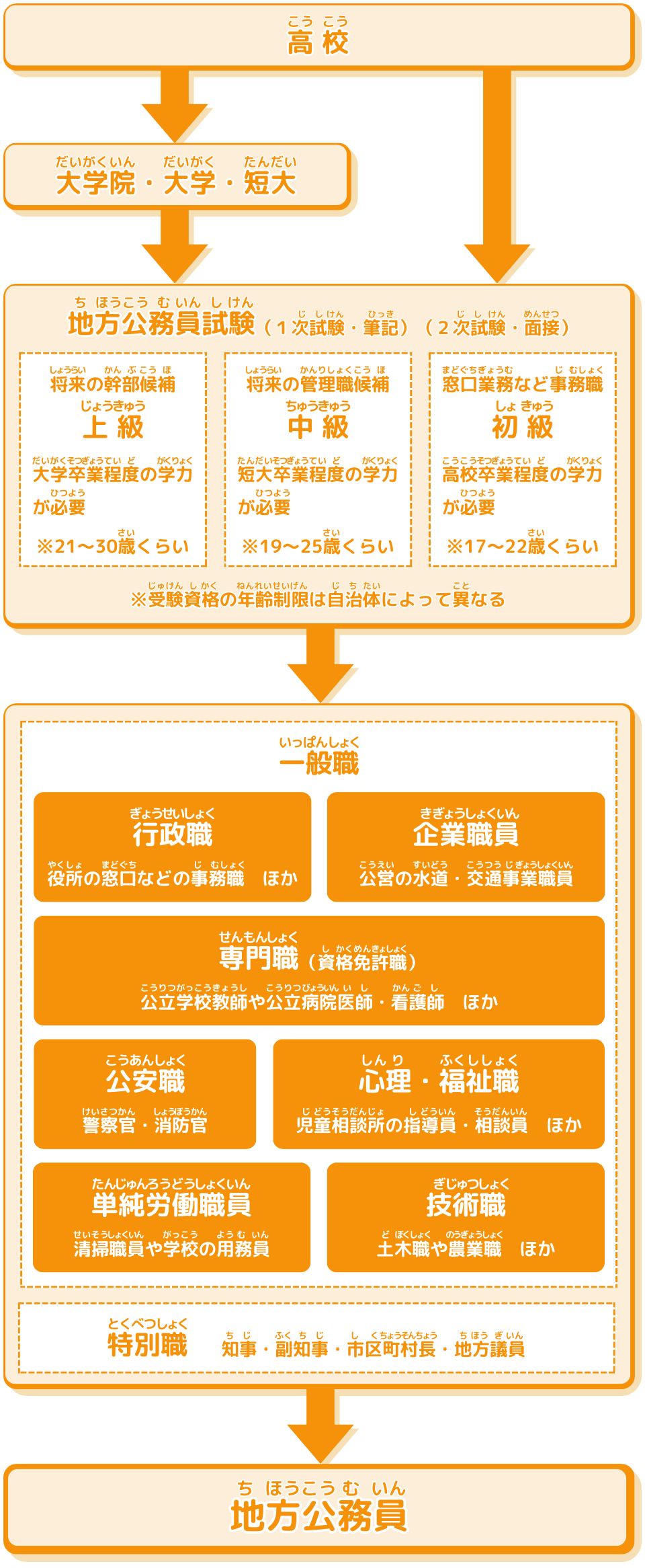
なるためチャート!地方公務員になるためのステップを図解するよ
キッズネットオリジナルの「なるためチャート」だよ!地方公務員の仕事につくための主な進路の例や必要な情報を図解しているよ。ぜひ参考にしてみてね!
地方公務員の将来性は?
Could there be an increase in the number of local officials with foreign citizenship?
As long as the system of local governments exists, the work of local public servants working for local residents will not disappear. However, as Japan's population continues to decline and the birthrate declines and the population ages, problems such as "deterioration of services to residents due to a shortage of local public servants" may become more serious in areas where there are few residents. Securing human resources for local public officials will be an important task for local governments. Currently, some local governments have eliminated the rule of "Japanese nationals" from the qualifications for civil service examinations and are hiring foreign nationals as local civil servants. In the future, all local governments may have multinational local government officials working for them. In order to work with such people, local public officials will need to have international communication skills.
【データ】地方公務員の年収・働き方・働く場所は?
Income.
It varies depending on the prefectural, city, ward, and town/village office and position in which the person is employed. The average monthly salary is approximately 410,000 yen.
Vacation?
Basically, two days off per week, although it varies by municipality. Saturdays, Sundays, national holidays, and year-end and New Year holidays are often holidays. Some municipalities open service counters for residents on holidays.
Where do you work?
Prefectural, city, ward, and town/village government offices, or their respective outposts. Administrative positions often involve internal transfers in order to experience a variety of duties.