




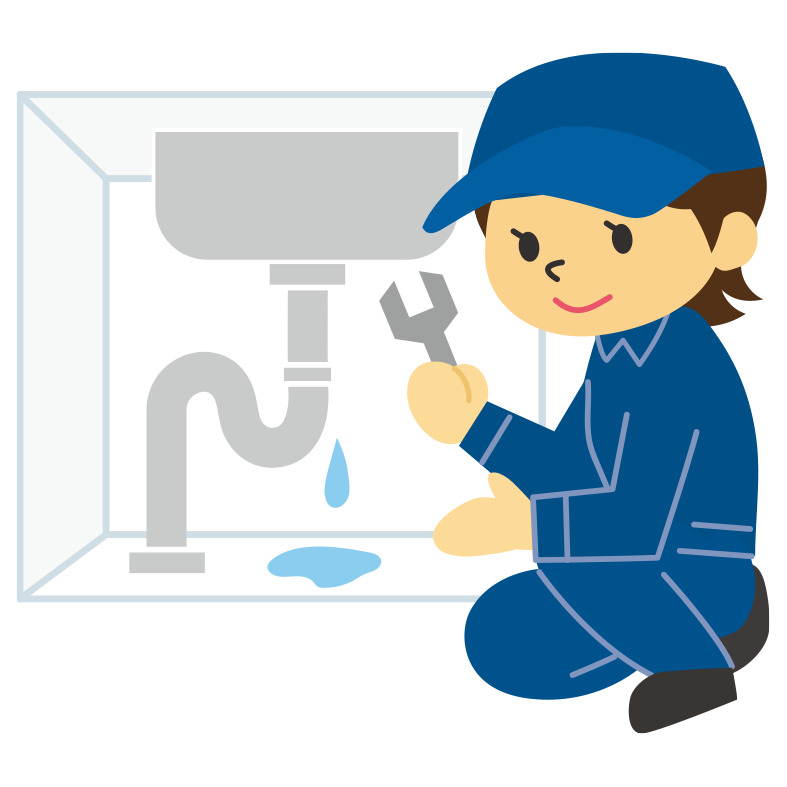
Specialized technicians who install pipes and hoses necessary for water, toilets, gas, air conditioners, etc., which are indispensable for daily life.
Perfect For …
People who like to assemble things by cutting and connecting. People who like to work steadily. Have perseverance and a sense of responsibility.
Job Details
Perform "plumbing" to install "pipes" for water and gas flow to buildings and equipment.
Plumbing" refers to the process of cutting, bending, and connecting pipes that carry water or gas to the required length and shape, and installing them in place. Plumbing" also refers to the process of checking to make sure that water and gas are not leaking from the connected pipes. Plumbers are professional engineers who install various types of piping in buildings according to blueprints in construction projects such as detached houses, condominiums, buildings, factories, and so on.
There are roughly five types of plumbing work, depending on the purpose of the piping. Sanitary piping" for running water and sewage, "gas piping" for supplying gas, "air conditioning piping" for air conditioning and boilers (equipment for producing hot water and steam), "fire prevention piping" for sprinklers (firefighting equipment that sprays water from the ceiling in case of fire), and "plant piping" for supplying special gas and chemicals used at factories. Piping for plants" to supply special gases and chemicals used in factories. There is also "medical gas piping" to supply oxygen and carbon dioxide used in hospitals.
Plumbers are also responsible for installing equipment connected to each type of piping, such as washbasins and toilets in sanitary piping, gas stoves and water heaters in gas piping, and air conditioners in air conditioning piping.
In addition to new plumbing, plumbers also maintain, inspect, repair, and replace installed plumbing.
Pipes installed indoors are often installed under the floor or ceiling in detached houses, or in a dedicated space called a pipe space (PS) in condominiums and other buildings. The work of plumbers, who have to twist their bodies into tight spaces, is very difficult. That is why they seem to feel a great sense of satisfaction when they successfully complete their work.
Key Points !
The fastest way to get a job is to get a job rather than to go on to higher education.
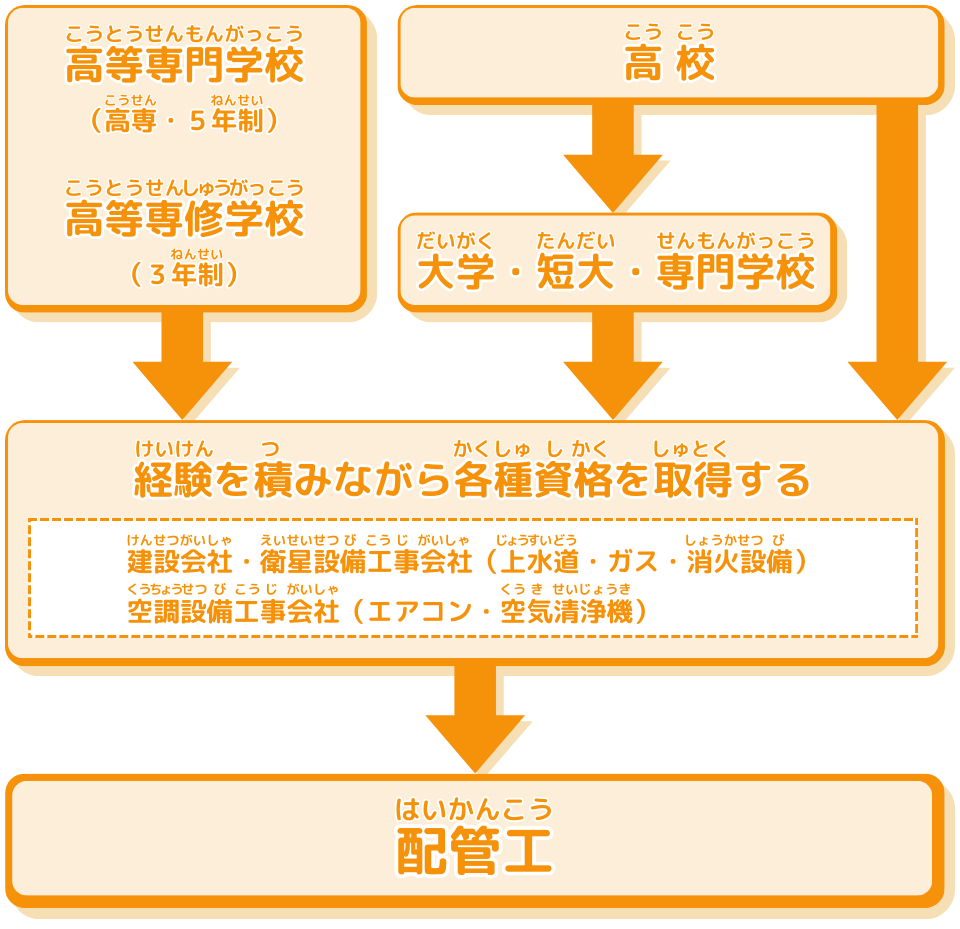
There are no special qualifications to work as a plumber, and no educational background is required. In most cases, plumbers are employed by "facility construction companies (sanitation and HVAC)" in the construction industry, and at first they acquire knowledge and skills by experiencing various job sites as apprentices. However, the timing and age of employment differs from person to person. Some people start working immediately after graduating from junior high school or high school, others start working after learning the skills at a higher vocational school or technical college, and still others start working after advancing to a university, junior college, or technical college to learn specialized architectural knowledge and skills. If you want to become a plumber as soon as possible, getting a job rather than going on to higher education is probably the best way to go.
3 Certifications for Plumbers to Advance in Their Careers
There are qualifications that can be obtained to prove that one has the expertise and skills as a plumber. The three most common qualifications are "certified plumbing technician," "certified plumbing construction management engineer," and "certified building equipment technician.
Plumbing technicians are nationally certified by the Ministry of Health, Labor and Welfare as technicians who perform plumbing work. There are two types of plumbing certifications: "architectural plumbing," which covers residential and building construction, and "plant plumbing," which covers construction of factories. There are three levels: Level 1, Level 2, and Level 3. Level 1 is for advanced tradespeople, Level 2 is for intermediate tradespeople, and Level 3 is for novice tradespeople.
Plumbing construction management engineers are nationally certified by the Ministry of Land, Infrastructure, Transport and Tourism as technicians who manage plumbing work. There are two levels of certification: Level 2 and Level 1, which require the preparation of construction plans and management of construction process, quality, and safety.
A certified building equipment engineer can provide advice on the design and construction supervision of building equipment when requested by an architect. It is a national certification approved by the Ministry of Land, Infrastructure, Transport and Tourism. However, the passing rate for the exam is low and the exam is quite difficult to pass.
By studying and honing their skills to obtain the respective qualifications, they can improve their professional knowledge and abilities. As you improve your career in this way, you can expect to increase your income.
In the Future
Plumbing work is always needed, and the number of female technicians is increasing.
Water, sewage, gas, and other facilities are known as "infrastructure. Plumbers who install the infrastructure that is indispensable for daily life and work will never disappear. Especially in Japan, the infrastructure that was built during the period of rapid economic growth (1950s-1970s) has become outdated and has reached the limit of what is called "50 years after construction. Plumbers will be called upon not only for new plumbing work, but also for repairing and replacing outdated pipes.
Meanwhile, the Ministry of Land, Infrastructure, Transport and Tourism is working on a plan to increase the number of women working in the construction industry. The number of women working in the construction industry was 700,000 (13.9%) in 2012, but this number will increase to 850,000 (17.7%) in 2022. One reason for the increase in the number of women is that there are more and more situations in construction work where physical and muscular strength are not required. In the past, heavy construction materials were carried by hand, but now cranes and other machines are used. Plumbing work also involves tightening metal fittings (bolts and nuts) to attach pipes, but nowadays, convenient tools are used that do not require strength. In addition, the work of plumbers is said to be "brain work that requires wisdom and ideas" because they work in a confined space. Since knowledge and skill are all that is needed to be successful, the number of female plumbers is expected to increase in the future.
Job Facts
Income.
The average annual salary ranges from 4.37 to 4.68 million yen. It varies depending on the facility maintenance company they belong to. Some experienced plumbers work independently as freelancers or run their own construction companies.
Vacation?
As of 2023, most companies have one Saturday off every two weeks and a fixed Sunday off. The Ministry of Land, Infrastructure, Transport and Tourism aims to have a two-day workweek in the construction industry from April 2024.
Where do you work?
The equipment maintenance company to which the worker belongs arranges and processes piping, which is then transported to the job site for installation. Some workers do not stop by the company they belong to, but go directly to the job site or go home.
Your Future Path
It's a chart that shows at a glance the main routes to getting a job as a plumber!