





Mari (Space researcher)

Space development work involves going beyond the Earth and playing an active role in outer space. One example is the creation of satellites that are used for a variety of purposes, from weather information to planetary exploration. Mari-san, who is involved in the development of satellites, tells us about the work of space researchers.
What kind of work does a space researcher do?
What to carry in a rocket
If you want to go to space or take a satellite into space, you will use a vehicle called a "rocket" to go to space. In Japan, the development of such rockets has been continued for a long time. The job of the space development team is to determine how to use the rocket to transport the object to be flown into space and what kind of object it will carry. One of the most common rocket launches from Japan is a satellite. Satellites have interesting features such as solar panels on both sides to charge the sun's energy, or they are covered with gold leaf. In fact, there are so many artificial satellites flying around the earth today.
Conduct research, disseminate results
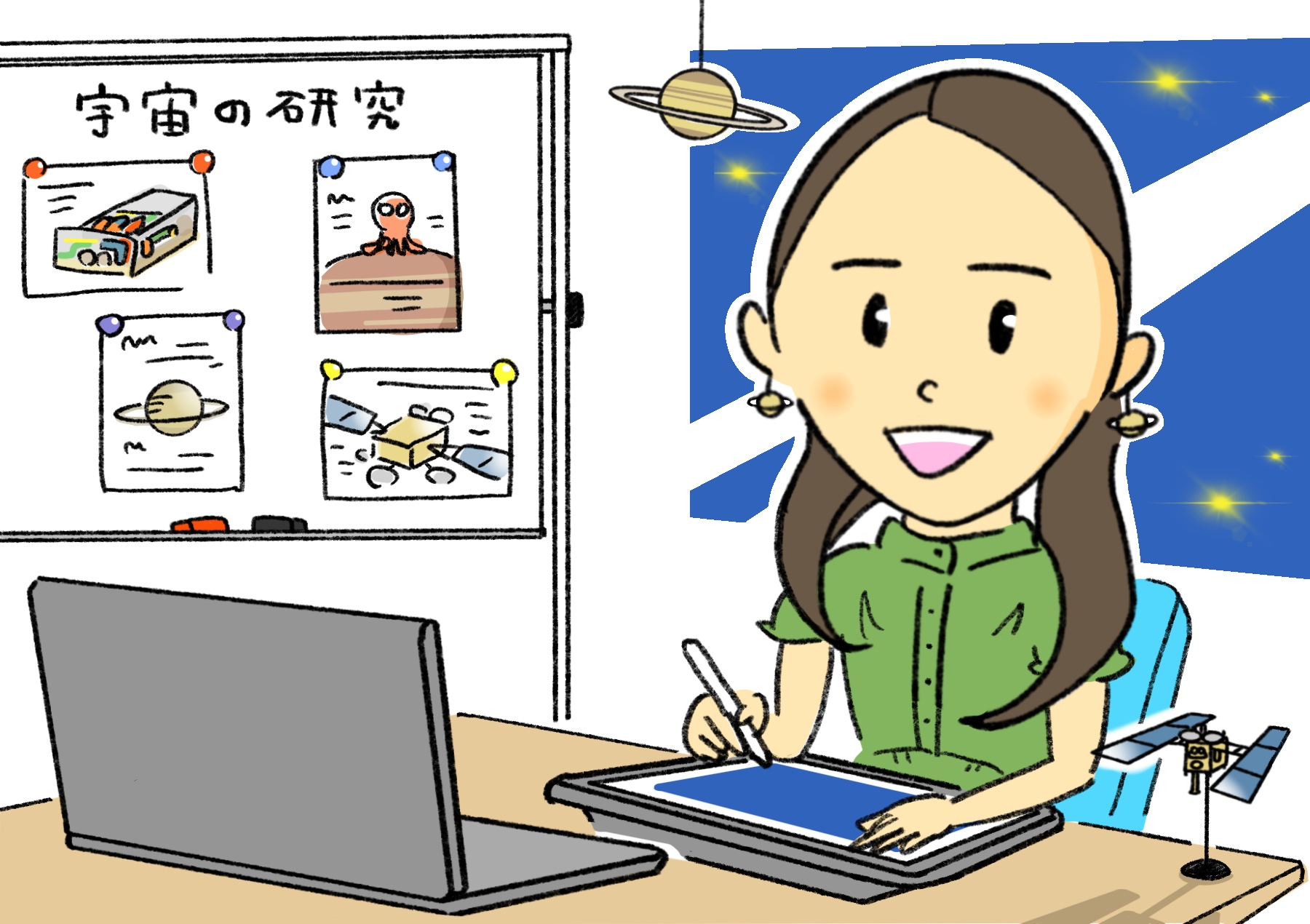
I am working on engines to be loaded onto small satellites. Satellites come in a variety of sizes; in fact, there are satellites as small as a plastic bottle or as small as the size of the palm of your hand. The reason why engines are loaded on those small satellites is that they are needed to go farther than the orbit around the earth. If you have a rocket take it from Earth to orbit and leave it there, the satellite can actually go around the Earth on its own without an engine. We are researching engines that can be used to go further away from the Earth to explore asteroids and Mars.
The word "research" may give the image of being in a laboratory doing experiments all the time, but in reality, I write papers on how my research was done and present the results of my research in front of many people. First of all, I clarify what I don't know, and what I don't know, I try to understand. I am doing two things: first, to clarify what I don't know, and second, to make what I don't know understand understandable.
What is the role of satellites?
The first is to protect people's lives by watching the Earth from space. For example, when a disaster occurs, satellites can observe the situation from space and inform people on the ground.
They also play a role in making sure that the Internet, which you normally use, is not interrupted in the event of a disaster.
How did you become a space researcher?
When I was in junior high school, the first satellite "Hayabusa" returned with soil from an asteroid. At that time, various events were held to commemorate it. While I was there, I did a lot of research and listened to lectures, and I felt that it sounded interesting and I wanted to be involved in it. So I entered the Department of Aerospace Engineering, where I could make satellites, and here I am today.
What are the challenges of space exploration?
Recently, the environmental problems of space and the increase in waste have become a problem. Satellites that are being launched in large numbers today will surely reach the point where they will no longer be useful. Satellites that have reached the end of their useful life may burn up if they fall into the Earth's atmosphere, but some satellites are left orbiting in circles. They become garbage that goes around in circles, broken or having reached the end of their life span. Now there is research being done on how to get rid of it. It's not good for the environment in terms of pollution, and there is the possibility of colliding with another satellite that has newly entered orbit because it's going around in circles. So one of the issues is how to get rid of this.
This article is based on the content of the "Language Park Special Lecture: Ask the Pros! (Sponsored by Gakken Educational, Inc. in cooperation with Blueberry, Inc.
What is Kotoba Park?
It is an online Japanese language study course for elementary school students that develops listening, speaking, and reading skills for 25 minutes per session.