




speech therapist

The program provides functional recovery training, examination, guidance, and other assistance to people who have difficulty with normal "verbal communication" such as speaking and listening, as well as problems with "eating.
Perfect For …
People who have a strong sense of care for others. People who like to communicate with others. People who have perseverance.
Job Details
Help people who have problems with verbal communication and eating.
There are various types of communication in which people convey their feelings and thoughts to each other. One of them, verbal communication, involves bodily functions such as hearing (the ability to listen), speech, pronunciation, and cognition. When these functions are impaired by illness, accident, or congenital disorders, problems with verbal communication can occur. Speech-language pathologists are professionals who help people with such problems by examining them to determine the cause of their problems, providing training and guidance to restore their functions, and so on.
For example, if a person has a hearing impairment, he or she may not be able to hear the other person's speech or his or her own voice, resulting in unnatural pronunciation or loudness of voice, making it difficult for the person to communicate. In such cases, a speech-language pathologist will examine how well the patient can hear, and provide guidance and advice on how to communicate by wearing hearing aids. In addition, if the brain is damaged by a disease in which blood vessels in the brain become clogged or ruptured, the problem of not being able to speak properly may remain even after the disease is cured. In addition, diseases of the vocal cords and tongue can cause hoarse voices and tongue tangles. In such cases, we instruct the patient on the appropriate vocalization method and exercises to restore the tongue function.
On the other hand, for those who suffer from problems in chewing and swallowing food, speech-language pathologists also provide training and guidance on how to eat and swallow. Speech-language pathologists work with a wide range of patients, from children to the elderly. They help people with problems and their families not only in hospitals but also in schools and nursing homes.
This is the point
Three paths to becoming a speech-language pathologist
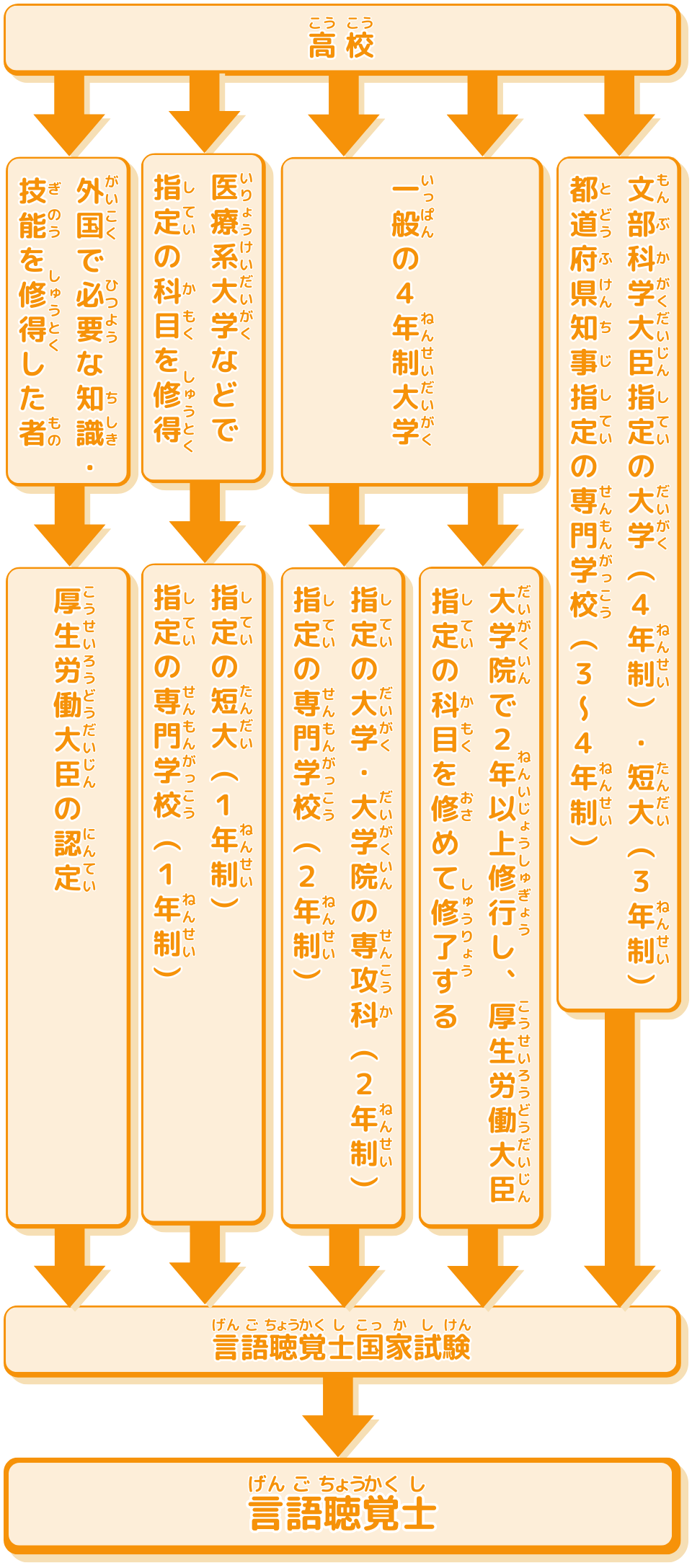
To become a speech-language pathologist, one must pass the National Examination for Speech-Language Pathologists administered by the Ministry of Health, Labor and Welfare. However, not everyone can take this examination. In order to take the exam, one must attend a school designated by law and study a set of subjects to acquire the knowledge and skills necessary to become a speech-language pathologist.
There are three main paths to fulfill the qualifications to take the exam. The first is to "study for three to four years at a designated university or vocational school after graduating from high school. The second is to "graduate from a general university and study for two years at a designated university, graduate school, vocational school, or graduate school. Or, "acquire the necessary subjects for speech-language pathologists at a medical university, etc., and study for one year at a designated school. In addition, those who have completed the necessary studies at a university or other institution outside of Japan are eligible to take the examination if they are certified by the Minister of Health, Labor and Welfare. Since the applicant must attend a designated school, self-study or correspondence courses are not acceptable.
Many women in the national rehabilitation specialty.
Rehabilitation" or "rehabilitation" for short refers to functional recovery training to help physically disabled people return to society. There are three national qualifications that specialize in rehabilitation, and speech-language pathologist is one of them. The other two are physical therapists and occupational therapists. Physical therapists use heat, electricity, and other physical means to restore the motor functions of people with physical disabilities. Occupational therapists, on the other hand, provide rehabilitation for eating, bathing, and other activities of daily living, as well as mental rehabilitation, in order to restore the mental and physical functions of people with physical and mental disabilities. Speech-language pathologists, who specialize in the same rehabilitation work but focus on restoring the ability to speak and hear, are four times more likely to be female than male, perhaps because they do less physical work than the other two. In many cases, there are systems in place that allow women to work after marriage or childbirth, and the work environment seems to be conducive to women.
In the Future
Speech-language pathologists come into their own in an aging society.
Japan is projected to have an elderly population of 39.21 million by 2040. This means that one in three of the nation's population will be 65 years of age or older. As the population ages, more and more people will have difficulty in hearing, speaking due to cognitive decline, and swallowing food. The need for speech-language pathologists to assist them will increase. Incidentally, speech-language pathologists cannot provide the three types of rehabilitation services that speech-language pathologists provide: hearing tests, training to wear hearing aids, and training to swallow food, without the direction of a physician or dentist. However, "language training," which enables the patient to understand and express words, and "articulation training," which enables the patient to pronounce words correctly, can be provided without a doctor's order. There may be a way to become an independent or start a business as a specialist in providing these two services.
Job Facts
Income.
The average annual income is between 401 and 4.43 million yen.
Vacation?
It depends on where you work. Even if you have a two day weekend, it does not necessarily mean that you will have weekends off.
Where do you work?
Hospitals, clinics, rehabilitation centers, home nursing offices, nursing homes, elementary and junior high schools, special needs schools, etc.
Your Future Path
It's a chart that shows at a glance the main routes to getting a job as a speech-language pathologist!