




registered surveyor

A specialist who measures the "location, shape, area, and height" of land.
Perfect For …
Serious and patient, as the same work will be done over and over again. People who like to use computers and other technologies that are becoming more and more advanced every day.
Job Details
Measure land and create "survey maps" that will be used as the basis for construction and mapping.
Prior to construction or civil engineering work, the main task is to measure the location, shape, area, height, etc. of the land on which the work is to be done and create a document called a "survey map. Based on those survey drawings, blueprints for buildings and land development are created, and construction work and development planning begin. In other words, the surveyor's job is an important one, as it is the basis for all construction work. Depending on the results of the survey, construction plans may change. Therefore, accuracy and high precision are required for this job.
There are two main types of surveyor jobs. The "outside work" is done outdoors, and the "inside work" is done indoors. Outside work involves actually going to planned construction sites and surveying with a team of several people using a variety of equipment. Internal work is clerical work. The "inside" work involves making survey plans and compiling the survey results obtained in the "outside" work into a survey map.
The surveying necessary to construct buildings, roads and bridges is called "civil engineering surveying," but surveyors also perform other types of surveying. There are two other types of surveying that surveyors perform: cartographic surveying, which is used to create maps, and cadastral surveying, which measures the area of land owned by individuals, companies, and other entities. The process of measuring land is the same for both types of surveying, and the work may seem a bit simple. However, it is a very rewarding job that is highly public in that it is recorded on maps and gives one a sense of being of use to society.
Key Points !
3 Ways to Become a Surveyor
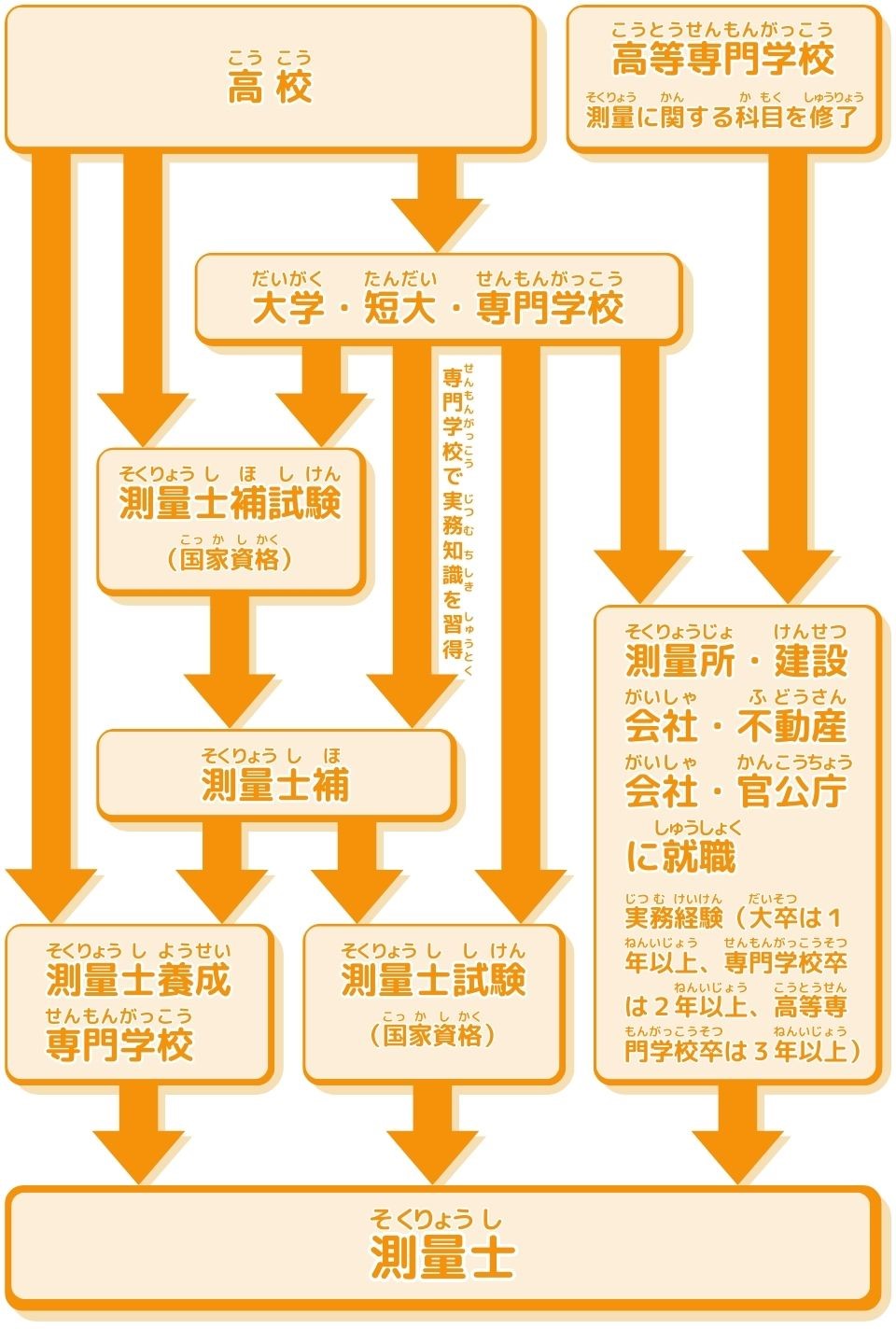
To work in surveying as an engineer, you need to be nationally certified as a "certified surveyor" or "assistant certified surveyor. There are three major ways to become a licensed surveyor. The first is to pass the national examination for professional surveyors, which is difficult, but there are no specific qualifications, and anyone can take the exam. The second is to study surveying at a university, junior college, technical college, or vocational school, graduate from such school, and then gain work experience for a set number of years (at least one year at a university, two years at a vocational school, or three years at a junior college or technical college) at an employer. Finally, there is also the method of first becoming an "assistant surveyor" and then becoming a licensed surveyor through further study. Incidentally, there are two ways to become an assistant certified surveyor: (1) graduate from a university, junior college, technical college, or vocational school after studying surveying, or (2) pass the national exam to become an assistant certified surveyor. In addition, to be recognized as a professional surveyor or assistant professional surveyor, one must not only be qualified but also registered with the Geospatial Information Authority of Japan (GSI).
Surveyors and assistant surveyors have different jobs they can do.
The difference between the two is the nature of the work that can be performed. The difference between the two is the work they can perform. Assistant surveyors, on the other hand, cannot create a survey plan, but rather survey according to the instructions of the survey plan prepared by the surveyor. As such, the surveyor is considered to have a higher level of qualification than the assistant surveyor. However, there is no distinction between the two in terms of actual work, and there is not much difference in the content of their work.
In the Future
Requires the ability to use new technology and equipment.
Surveyors are needed for the future. Civil surveying" is the basis for all construction work, so it comes into play not only in the construction of new buildings, but also in the redevelopment of water and sewage systems. Mapping and surveying is also indispensable in the creation of maps used on the Internet. Furthermore, "cadastral surveying" is also important to clarify land boundaries to prevent problems surrounding land transactions.
Surveying techniques are expected to change in the future. While two-dimensional (planar) surveying using light reflection used to be the mainstream, it is now shifting to three-dimensional (three-dimensional space) surveying using laser scanners. Drones carrying laser scanners are sometimes flown to survey from the sky. The technology is expected to advance further in the future. Some say that if such technology becomes easily available to everyone, surveyors will no longer be needed. What surveyors will need in the future will be the ability to use new technologies and equipment in addition to specialized surveying skills and knowledge.
Job Facts
Income.
The average annual salary ranges from 4.37 to 4.85 million yen. It varies depending on the company you belong to and if you are an independent practitioner.
Vacation?
Even if the company to which they belong has a two-day workweek, working hours and days off tend to be irregular because surveying work is performed during lunch breaks and on holidays when other work is being performed on site. Surveying work can last dozens of days to several months, during which time they may not get much time off and may take turns taking vacations.
Where do you work?
Surveying offices, construction companies, real estate companies, government agencies. Sites to be surveyed.
Your Future Path
It's a chart that shows at a glance the main routes to getting a job as a surveyor!