




clinical technologist

A laboratory professional who examines the blood and cells of patients. An indispensable behind-the-scenes force in modern medicine.
Perfect For …
It is a series of detailed tasks that involve looking at test tubes and microscopes and staring at inspection data every day, so it requires patience and perseverance to continue working diligently. This is a job that involves a great deal of responsibility, and mistakes are not tolerated.
Job Details
Prepare the data necessary for accurate diagnosis and treatment by doctors through a variety of tests.
Its job is to produce test data on a patient at the request of a physician. The tests are divided into two categories: specimen tests, which examine a portion of a patient's body tissue, blood, urine, stool, etc., and biometric tests (physiological function tests), which obtain medical information by taking electrocardiograms and electroencephalograms on the patient himself/herself. Technological advances in this field are remarkable, and tests must be performed quickly and accurately, and accurate results must be obtained.
Key Points !
From universities to vocational schools, you can aim for national certification from the school that suits you best.
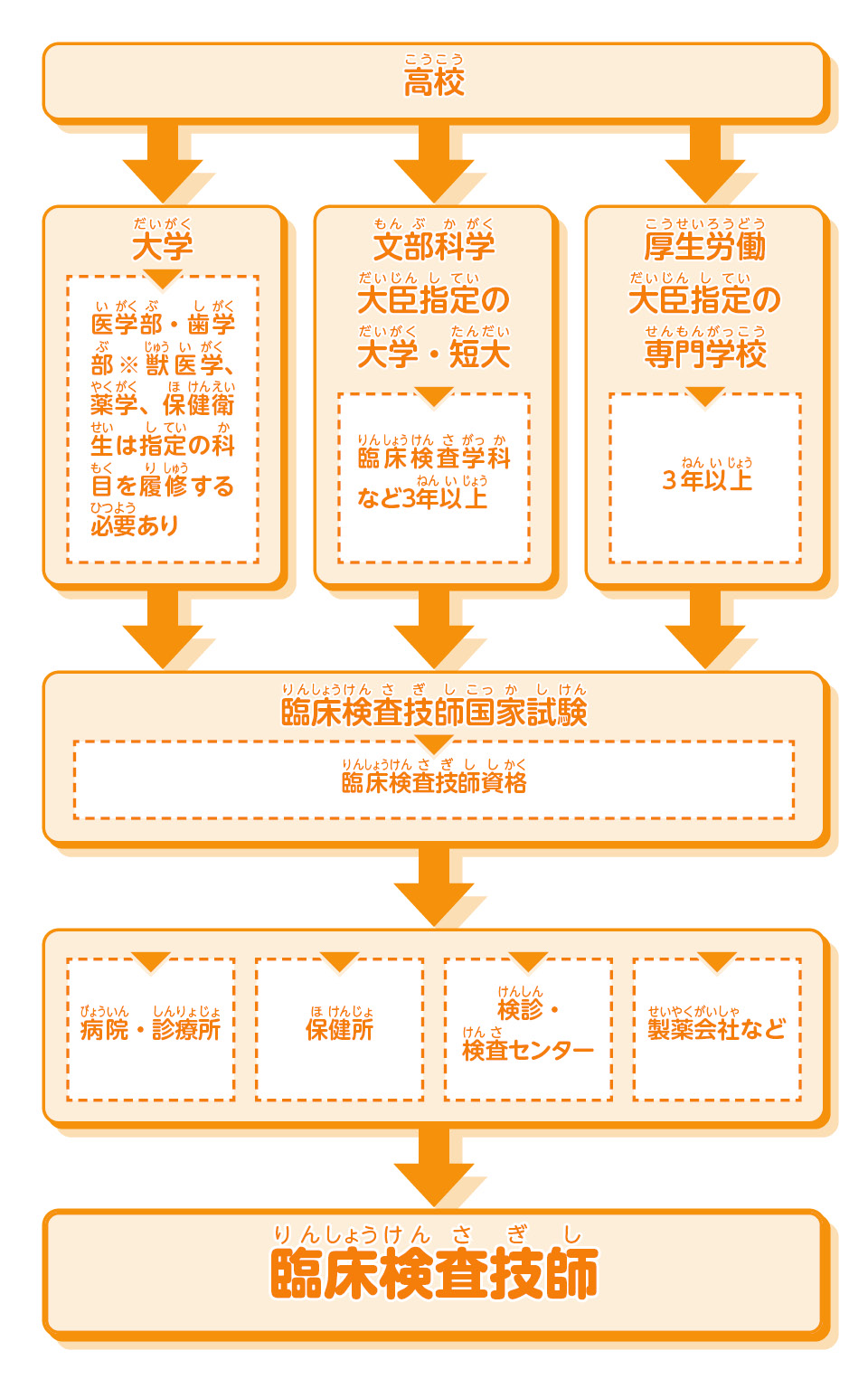
Clinical technologists are nationally certified. Graduates of medical or dental schools of universities, medical departments of three-year junior colleges, or training courses of vocational schools are eligible to take the national examination. Graduates of veterinary medicine and pharmacy schools are also eligible to take the exam. In this case, however, it is necessary to take the required courses, so be careful to earn credits. Incidentally, the pass rate for the national certification varies from year to year: 71.5% in 2020, 80.2% in 2021, and 75.4% in 2022, but it does not seem to fall below 70%.
In the Future
Responding to fragmented needs while mastering the use of advanced, state-of-the-art inspection systems.
As for the inspections themselves, the physical workload seems to be decreasing as various analyzers are being developed and complex inspection tasks are being automated. However, it is necessary to constantly collect information in order to master inspection systems that make full use of the latest technology. In addition, the need for testing is increasing due to the spread of screening for cancer and lifestyle-related diseases. In areas such as physiological and pathological testing, which cannot be automated, there will continue to be a need for such testing in the future.
Job Facts
Income.
The national average annual salary is 4,927,000 yen, although it varies depending on where you work, such as hospitals, health check centers, and private laboratories.
Vacation?
Although it varies from workplace to workplace, the workday is usually an eight-hour day shift. However, as medical institutions have begun to take on standby systems on holidays and at night, laboratory technicians tend to work on holidays and on night duty more and more.
Where do you work?
National and private hospitals, clinics, testing centers, pharmaceutical companies, etc.
Your Future Path
It's a chart that shows at a glance the main routes to getting a job as a clinical laboratory technician!